Image by:
Who Wishes to Fight Must First Count the Cost
By Martin Foskett, Reporter
PUBLISHED:
UPDATED:
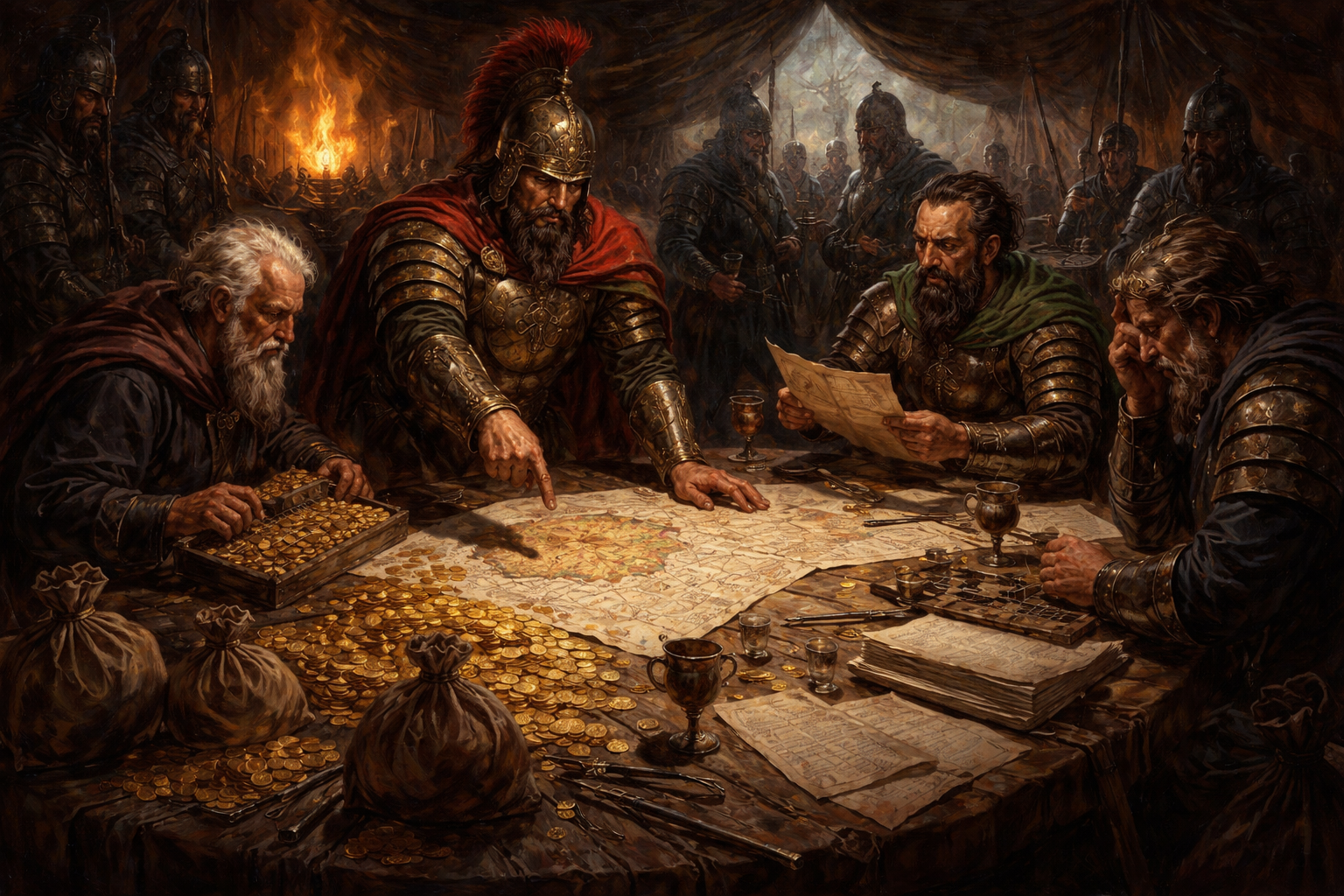
The line has been wheeled out for centuries like a battered abacus: count the cost. It appears whenever tempers run hot, sabres rattle, and a decision is about to be made by people who do not personally pay for it. The ancient warning, attributed to Sun Tzu, remains stubbornly relevant because nothing about human impulsiveness has improved. Technology has advanced, budgets have ballooned, rhetoric has softened, but the old habit of charging headlong into conflict without a ledger has endured like a hereditary condition.
Impulsive conflict, whether martial, political, corporate, or domestic, has a habit of announcing itself as courage. It dresses as decisiveness. It claims urgency. It promises glory. Then it empties the vaults, drains the workforce, fractures morale, and leaves behind a landscape of unpaid invoices and baffled survivors wondering why nobody ran the numbers before lighting the fuse.
Sun Tzu’s admonition was never just about armies clashing on muddy fields. It was about arithmetic. About inventory. About food stores, labour, stamina, legitimacy, and time. War, in his formulation, was not a test of bravery but a test of bookkeeping. Anyone could fight. Only a fool fought without first calculating what the fight would consume.
History is littered with leaders who skipped this step. They mistook noise for strength and movement for progress. They confused emotional satisfaction with strategic advantage. The first flush of conflict felt invigorating, flags unfurled, speeches delivered, uniforms pressed, but the hangover arrived swiftly. The bill always did.
Counting the cost begins with the physical. Bodies break. Machines wear out. Infrastructure buckles. Roads turn into targets. Power stations acquire strategic importance precisely because nobody planned to lose them. Conflict converts useful things into fragile things. Trucks become coffins. Factories become rubble. Hospitals become overflow units. The physical toll is measurable, photographable, and eventually unavoidable.
Yet the physical cost is the easiest part to grasp. Accountants can count equipment. Engineers can estimate repairs. Casualties can be tallied with grim precision. Governments excel at this sort of arithmetic because it fits neatly into columns. It can be briefed. It can be buried in appendices. It can be postponed until after the vote.
The economic toll is less obedient. War does not merely spend money; it rearranges it. Capital flees uncertainty. Insurance premiums swell like infected wounds. Supply chains kink and snap. Labour disappears into uniforms or graves. Inflation slinks in through the back door, posing as a patriotic necessity while quietly eroding savings and wages. Entire generations find themselves paying interest on decisions made by people long retired from responsibility.
Sun Tzu understood this. He wrote of prolonged campaigns that drained treasuries and exhausted populations. He warned that a nation bled white by extended conflict would invite disaster even if no enemy remained. Victory, in such cases, arrived hollowed out, a shell of triumph rattling in an empty hand.
Modern conflict has refined this art of self-impoverishment. The numbers are larger, the spreadsheets more colourful, the euphemisms more elaborate. “Investment” replaces “loss.” “Stability operations” mask long-term commitments. Emergency budgets become permanent fixtures. The war ends, allegedly, but the economic hangover lingers like damp in a poorly built extension.
Then there is the emotional toll, the cost least discussed, most underestimated, and hardest to reverse. Conflict corrodes trust. It normalises suspicion. It trains populations to see enemies everywhere and solutions nowhere. Families fracture under strain. Communities polarise. Language coarsens. The collective nervous system remains permanently clenched, waiting for the next crisis because crisis has become familiar.
Leaders rarely account for this because it does not fit into briefing notes. Emotional exhaustion cannot be amortised. Cynicism does not show up on balance sheets. A population taught to accept perpetual emergency becomes brittle, reactive, and difficult to govern without coercion. Sun Tzu warned against this too, albeit in the language of morale and spirit. An army, he noted, is not merely fed with grain but sustained by belief. Once belief erodes, no quantity of supply can compensate.
Impulsive conflict accelerates this decay. It thrives on immediacy. Decisions are framed as binary: act now or suffer later. The space for calculation is dismissed as weakness. Doubt becomes treachery. Counting the cost is recast as cowardice. The ledger is kicked under the table.
The irony is that true strength lies in restraint. Sun Tzu’s philosophy prized victory without battle precisely because it preserved resources. The ideal campaign concluded before it began. The enemy capitulated, alliances shifted, pressure applied elsewhere. The cost remained theoretical rather than terminal.
Modern leaders struggle with this concept. Non-action lacks theatre. It produces no footage, no stirring speeches, no medals. It requires patience, competence, and an acceptance that success may look boring. In an age addicted to spectacle, boredom is the ultimate political sin.
Impulsive conflict also thrives because its costs are unevenly distributed. The decision-makers rarely bear the consequences directly. They speak of sacrifice in abstract terms, gesturing toward other people’s sons, savings, and sanity. The emotional insulation of power allows rashness to masquerade as resolve.
Sun Tzu, writing in a less forgiving era, understood that rulers who bankrupted their states or shattered their armies did not enjoy lengthy retirements. Accountability was brutal and immediate. Modern systems have inserted layers of insulation: committees, advisors, post-conflict memoirs. Failure is rebranded as complexity. The ledger is never balanced.
Counting the cost is not an argument for passivity. Sun Tzu was no pacifist. Conflict, he acknowledged, is sometimes unavoidable. But unavoidable does not mean unexamined. The warning is not “never fight” but “know precisely what fighting will consume.” The distinction is everything.
This principle applies beyond warfare. Corporate boardrooms launch hostile takeovers without calculating reputational damage. Political movements declare total opposition without considering voter fatigue. Governments pick regulatory fights without understanding the compliance burden imposed on businesses already gasping for air. The pattern repeats: impulse first, arithmetic later.
In each case, the rhetoric is the same. The cause is just. The enemy is intolerable. Delay is dangerous. The cost is dismissed as manageable. Then the invoices arrive. Talent leaves. Markets wobble. Trust evaporates. The organisation survives, perhaps, but diminished, poorer, angrier, less capable than before.
Sun Tzu’s genius lay in his refusal to romanticise conflict. He stripped it of honour and framed it as a logistical problem. How much grain? How many carts? How long can morale be sustained? What happens if the enemy does not collapse on schedule? These were not philosophical musings but survival questions.
Modern discourse prefers slogans. It prefers moral absolutes to messy calculations. Counting the cost requires admitting uncertainty. It demands the courage to say that some victories are not worth their price. This is deeply unfashionable.
The tragedy is that the warning remains available, translated, quoted, and routinely ignored. The line about counting the cost is trotted out after disasters, engraved on plaques, cited in think pieces. It is rarely applied beforehand, when it might actually matter.
Perhaps this is because counting the cost forces a confrontation with limits. It acknowledges scarcity, of money, of goodwill, of human endurance. Impulsive conflict thrives on the illusion of infinite reserves. There is always another budget, another generation, another excuse until there is not.
Sun Tzu offered no comfort here. He was blunt. Prolonged conflict impoverishes states. Rash action invites defeat. Leaders who mistake emotion for strategy doom those they command. These were not poetic flourishes but cold assessments from someone who had watched the sums go wrong.
The lesson endures because the arithmetic has not changed. Resources remain finite. People remain fragile. Confidence remains perishable. Conflict, once unleashed, consumes far more than planned and returns far less than promised.
To count the cost is not to flinch. It is to govern. It is to recognise that strength lies not in the speed of reaction but in the depth of preparation. Victory, if it comes, must arrive solvent, economically, physically, emotionally intact enough to matter.
Anything else is theatre, loud, expensive theatre with a very long interval and no refunds.
Closing Reflection
Sun Tzu’s warning endures because it offends modern instincts. It demands patience in a world addicted to speed and arithmetic in an age intoxicated by emotion. Those who wish to fight will always find reasons. Only those willing to count the cost discover whether the fight is worth surviving.