Image by: Knelstrom Media
Scratch the cynic, and out limps a broken optimist.
By Martin Foskett, Reporter
PUBLISHED:
UPDATED:
Cynicism does not arrive fully formed in a leather jacket with a permanent smirk. It is manufactured. It is fired in the kiln of disappointed hope, glazed in betrayal, and left out in the drizzle of modern life until it hardens into something socially fashionable. Beneath every eye-roll about politics, every muttered “figures,” every withering snort at another government announcement, there lingers the fossil of a person who once believed things might actually improve.
“Scratch any cynic, and you will find a disappointed idealist,” observed George Carlin, that grim American ringmaster of televised disillusionment. The line lands because it is true in a deeply unfashionable way. Cynics are not born sneering at council meetings or scoffing at Treasury forecasts. They start out caring.
They care too much.
The child believes in fairness. The teenager believes in justice. The twenty-something believes in reform. Somewhere along the road between manifesto and mortgage, between protest placard and pension contribution, something cracks. The world reveals its paperwork.
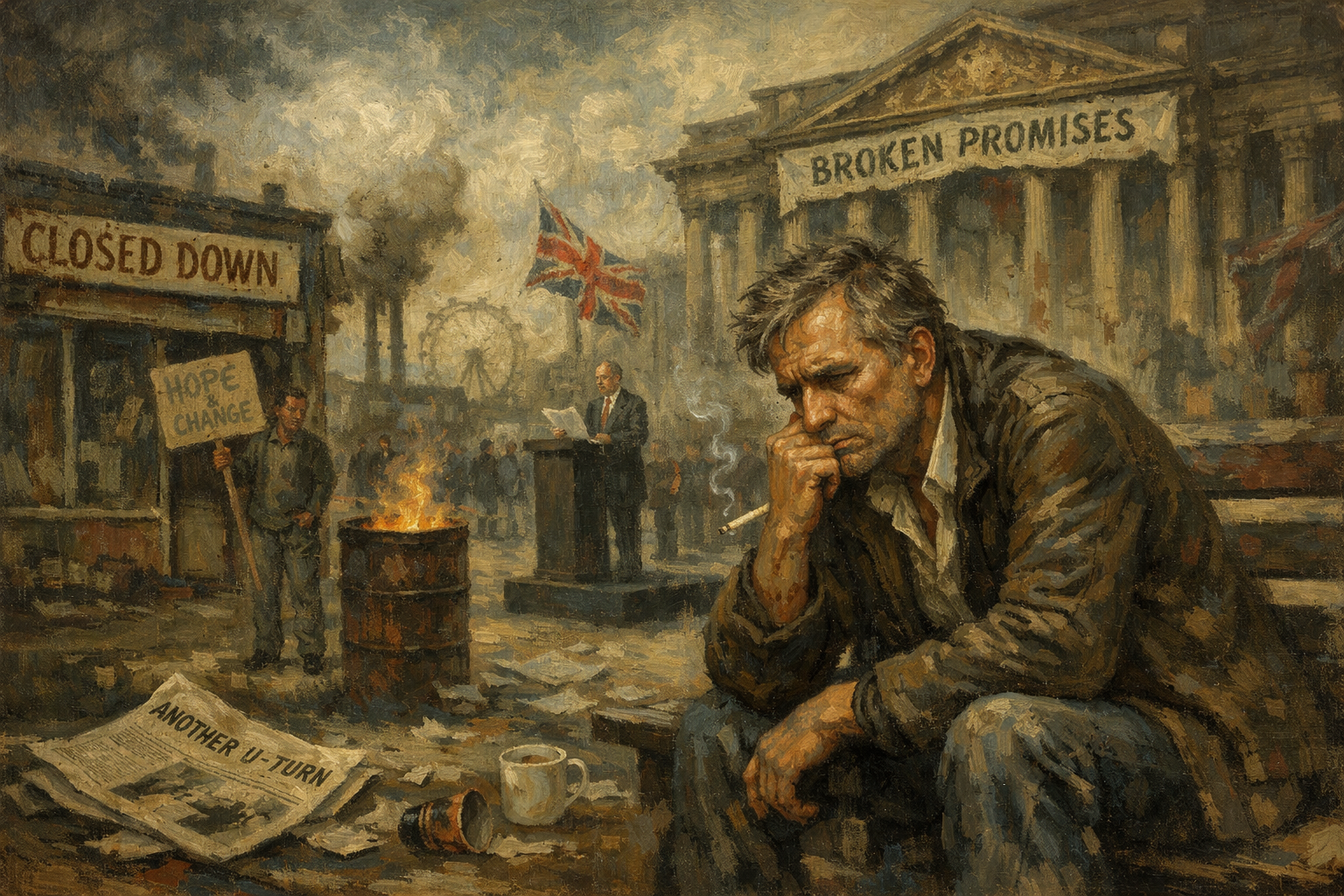
Across Britain’s high streets, that crack is visible in the shuttered shops and the laminated “To Let” signs flapping like exhausted flags. Once upon a time, the shopkeeper believed in graft: open early, close late, treat customers well, build something solid. Then came business rates that climb like ivy, regulations written in language only a compliance department could love, and energy bills that resemble ransom notes. The idealist who believed in enterprise now mutters darkly about “the system.” A cynic is born, not from apathy, but from effort.
The same alchemy plays out in politics. Voters who once dutifully queued at polling stations are beginning to treat elections as theatre. Manifestos promise transformation; budgets deliver rearrangement. Grand pledges shrink into footnotes. Official forecasts trumpet growth “next year.” Next year becomes a horizon that moves as reliably as a mirage. It is not that people cease to believe in a better country. It is that they notice the machinery prefers inertia.
Cynicism, then, is not laziness. It is armour.
The armour is necessary because hope is expensive. Hope requires emotional investment. It demands trust in institutions, leaders, markets, and neighbours. It demands the belief that effort correlates with outcome. When that equation fails repeatedly, the rational mind conducts a cost-benefit analysis and concludes: better to scoff than to suffer.
There is a particular British flavour to this evolution. The nation that mastered understatement has refined scepticism into an art form. The raised eyebrow. The dry “interesting.” The slow clap at a ministerial announcement promising “bold new frameworks.” It is not nihilism. It is pattern recognition.
Yet beneath the patter lies bruised optimism.
Consider the graduate who once championed public service. The speeches were earnest, the ideals lofty: transparency, fairness, social mobility. Years later, the same individual navigates layers of bureaucracy so dense they could be declared a protected habitat. Proposals vanish into consultation. Reform is “under review.” The civil servant who once believed in transformation now perfects the art of survival. Cynicism creeps in quietly, disguised as professionalism.
Or the homeowner who believed property ownership represented stability. The brochure glowed with images of tidy lawns and rising equity. Then, interest rates adjusted. Inflation chewed through savings. Official reassurances insisted the fundamentals were strong. The cynicism that follows is not anti-market. It is anti-pretence. It resents being told that strain is strength.
The private-sector idealist experiences similar whiplash. The entrepreneur launches with faith in innovation, competition, and risk and reward. Then comes the regulatory avalanche: forms in triplicate, inspections, levies, compliance seminars delivered by people who have never sold anything beyond a slide deck. When policymakers speak of “supporting business,” the entrepreneur hears the distant rumble of another initiative requiring paperwork. Cynicism here is not hostility to capitalism. It is fury at bureaucracy masquerading as assistance.
George Carlin understood this psychological pivot. His comedy carried the rhythm of someone who once believed in civic virtue. The punchlines were not casual contempt; they were disappointed sermons. He mocked institutions because he expected better of them. The laughter he provoked stung because audiences recognised their own dashed expectations in it.
Scratch the cynic, and one finds not indifference, but injury.
The injury is cumulative. Each broken promise deposits a layer of sediment. The referendum failed to fix anything. The policy was rebranded instead of reformed. The corporate scandal followed by the ritual apology tour. Official statements assure lessons have been learned. Cynics keep a ledger.
Yet cynicism performs a paradoxical service. It filters nonsense. It resists utopian overreach. It questions grandiosity. In an age addicted to “transformational” schemes and “once-in-a-generation” opportunities that recur annually, a certain dryness is protective. The sceptic asks: who benefits? Who pays? What is the catch?
The trouble begins when cynicism ossifies into total disengagement. When every initiative is presumed corrupt, every reform futile, every ambition naïve, that stage is not strength; it is surrender dressed as sophistication.
The disappointed idealist still cares. The pure cynic claims not to.
Britain’s current mood oscillates between the two. Surveys suggest trust in political institutions remains brittle. Turnout fluctuates. Online discourse crackles with sarcasm. Yet when local causes arise—threatened libraries, community hospitals, planning disputes—residents mobilise. Petitions circulate. Meetings fill. The caring instinct reawakens. Cynicism peels away just enough to reveal the original impulse: things could be better.
The free-market argument, stripped of slogans, rests on a similar belief. It assumes individuals, when allowed to act, can improve their circumstances. It assumes voluntary exchange outperforms a central decree. It assumes effort has dignity. Those assumptions are not cynical. They are optimistic about human agency. When layers of control smother that agency, cynicism flourishes not because markets failed, but because meddling did.
There is a lesson in that.
Every new policy announced with orchestral self-importance risks manufacturing another cynic if delivery falters. Every corporate rebrand that substitutes typography for accountability erodes public patience. Every official forecast revised downward after confident assurances fertilises the soil of sarcasm.
And sarcasm, once seeded, grows aggressively.
Still, cynicism indicates that expectations once existed. A society entirely devoid of disappointment would be one that never aspired. The sneer is the aftershock of belief.
In quieter moments—away from televised panels and online trench warfare—the disappointed idealist surfaces. It appears that parents volunteer at schools despite grumbling about council budgets. In business owners sponsoring local sports teams while lamenting taxes. In neighbours organising street parties even after years of complaining about planning departments. Cynicism provides commentary; idealism does the work.
That may be Carlin’s enduring point. The shell hardens, but it does not replace the core. The bruised heart continues to beat beneath the armour, albeit with caution.
The question, then, is not how to eliminate cynicism. That would require erasing memory. The question is whether institutions—political, corporate, civic—can reduce the rate at which they mint it. Reliability would help. Modesty in promises would help more. Delivering incremental improvements without fanfare might do wonders for the national mood.
There is something profoundly conservative in that approach. Fewer grand crusades. More competence. Less theatre. More results. Cynicism thrives on spectacle without substance. It withers in the presence of steady performance.
The British public, for all its dryness, has shown tolerance for imperfection when honesty accompanies it. What exhausts patience is the cycle of overstatement followed by retreat. Cynics are not demanding utopia. They are demanding proportion.
Scratch the cynic, and the disappointed idealist stares back, arms folded, waiting. Not for miracles. Not for revolutions. Simply for grown-up governance and grown-up markets. For promises that fit within the realm of physics. For effort that produces visible fruit.
The armour may remain. It has earned its place. But beneath it, the original belief persists like a stubborn ember: that institutions can function, that enterprise can thrive, that fairness can exist beyond brochures.
Cynicism is the scar tissue of hope.
And scars, while permanent, testify to healing as much as harm.