Image by: Knelstrom Media.
Britain sends four officers down a political rabbit hole
By Martin Foskett, Reporter
PUBLISHED:
UPDATED:
A fifteen-year-old schoolboy, a Conservative councillor, a photograph featuring rabbit ears and four police officers. Somewhere in the West Midlands, British law enforcement has become entangled in an incident that reads like a rejected comedy script. A teenager mocked a politician on Facebook. The politician complained. Police arrested the teenager, seized electronic devices and collected his DNA. What began as crude political satire became a serious argument about free speech, police powers, and the increasingly delicate state of public life.
The teenager, identified publicly only as Fraser, is a Reform UK activist from Walsall. Unlike most boys his age, whose interests might revolve around football, computer games or finding something edible in the fridge, Fraser has developed an enthusiasm for local government. Council meetings. Political campaigning. Committee proceedings. The full municipal experience, complete with fluorescent lighting and discussions capable of sending a healthy adult into a medically significant sleep.
His interest in Wolverhampton politics led to a disagreement with Conservative councillor Simon Bennett, leader of the city’s Tory group.
Initially, the dispute concerned clothing.
Fraser questioned why a councillor had attended a committee meeting wearing shorts, a T-shirt and trainers. Hardly the opening salvo of a revolutionary uprising. More the sort of observation an elderly bloke in a working men’s club would make, still believing a collar should accompany any serious discussion about public expenditure.
Then came the rabbit.
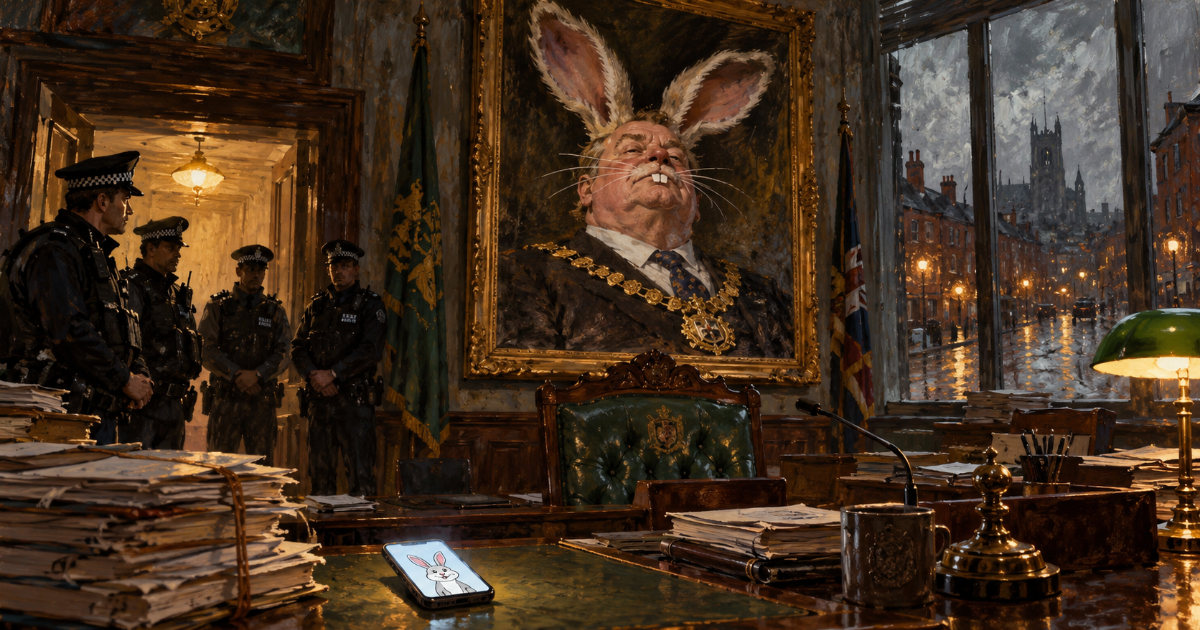
An edited photograph appeared on Facebook showing Bennett with artificial rabbit ears, whiskers and prominent teeth. The accompanying joke suggested that the animal was consuming what remained of Wolverhampton Conservatives’ credibility.
Not exactly the finest hour of British political cartooning. Nor was it particularly sophisticated. But satire has never required a certificate in advanced comedy from the Department for Culture.
The situation became considerably less amusing when another post made a derogatory comparison involving a male sex worker. Bennett considered the remarks personally offensive and described the language as homophobic.
That detail matters.
The arrest did not stem from a rabbit photograph alone. It followed several posts, including an insult the councillor considered more serious. Bennett said he had been subjected to repeated personal targeting and sought advice before contacting police. He also expressed concern about the teenager’s involvement with Reform UK figures.
Such concerns deserve proper consideration. Elected representatives should not be expected to tolerate genuine threats or sustained harassment simply because they hold public office.
But ordinary political mockery should not automatically become a police matter because someone with a council title finds it unpleasant.
On the morning of 3 August, four West Midlands Police officers arrived at Fraser’s family home. According to the teenager’s account, he was woken, arrested and searched outside in view of neighbours before being taken to a police station.
Fingerprints were taken. A DNA sample was collected. A custody photograph followed. His electronic devices were seized.
For a youngster whose alleged misconduct involved social media comments, the response possessed all the administrative enthusiasm of a major criminal investigation.
Somewhere between the rabbit ears and the fingerprinting equipment, proportion had apparently wandered off for a cup of tea.
Fraser was later released on bail, with a reported condition that prevented him from attending Wolverhampton council meetings. His phone and computer were retained for approximately a month.
For a teenager interested in politics, that meant losing access to both his usual online activities and the council proceedings he had been attending.
The Free Speech Union has taken up his case, arguing that the arrest disproportionately interfered with political expression. His lawyers have raised the possibility of legal action against West Midlands Police.
Police correspondence has referred to allegations potentially involving a hate crime offence, although the precise legal grounds for the arrest have not been publicly established. West Midlands Police has said that crime reports are investigated in accordance with policing guidance.
As of the latest available reports, no criminal charge has been confirmed.
That uncertainty is important. An allegation is not a conviction, and an arrest does not prove an offence occurred.
A rather splendid political contradiction sits at the centre of this affair.
The councillor belongs to the Conservative Party, traditionally associated with individual liberty, restraint in government and scepticism towards excessive state intervention.
The schoolboy supports Reform UK, a party competing for much the same politically dissatisfied electorate.
Yet the resulting spectacle involves a Conservative politician complaining about the behaviour of a teenage political opponent and the state responding with a police operation.
British politics has developed a peculiar talent for making its own principles look like optional extras.
Meanwhile, the public pays for policing through taxes collected from workers, shopkeepers, tradespeople and businesses already facing enough demands on their earnings.
Police resources are finite. Officers spending time investigating disputed Facebook remarks are officers unavailable for other duties during those hours.
That does not mean online harassment should be ignored. It means investigations, arrests and restrictions on liberty require sound legal justification and a sensible assessment of necessity.
A functioning democracy depends upon the public being able to criticise those who exercise authority. Sometimes that criticism will be clever. Sometimes it will be foolish, childish, unfair or spectacularly unfunny.
Freedom of expression would be a rather meaningless principle if it protected only polite compliments delivered by people wearing suitable footwear.
A distinction remains between genuine harassment and political ridicule. Determining where that boundary lies requires evidence, judgement, and respect for the law, not the assumption that every offensive remark deserves a custody sergeant’s attention.
The enduring absurdity is that a crude image of a councillor with rabbit ears has now acquired an audience far beyond Wolverhampton. A minor political insult has become a national argument about the state’s powers.
The rabbit was supposed to eat away at the Conservatives’ credibility. Instead, the affair has left British policing facing uncomfortable questions about its own.
And somewhere beneath the paperwork, the interviews and the legal correspondence sits a fairly simple proposition.
A country confident in its democracy should possess a thicker skin than a cartoon rabbit.
[adinserter name=”Block 1″]