
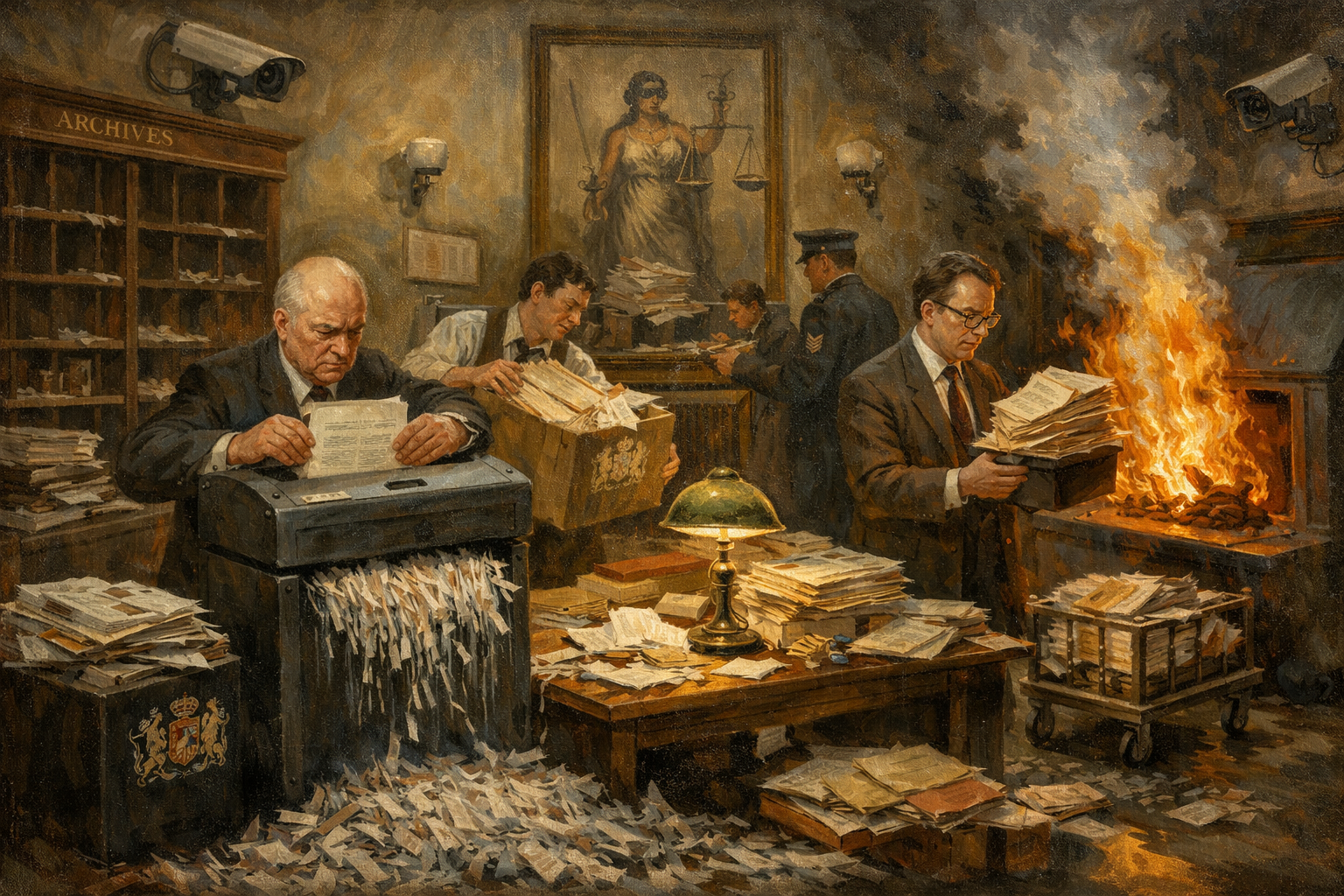
Image by: Knelstrom Media
When Nothing to Hide Suddenly Needs Shredding at Speed
By Martin Foskett, Reporter
PUBLISHED:
UPDATED:
The slogan arrives every time a new database is wheeled out of Whitehall on a sack barrow: if there is nothing to hide, there is nothing to fear. It is delivered with the cheery confidence of a man selling extended warranties. And yet, somewhere between the scanner and the shredder, court records and archives are now being quietly ordered into deletion. A nation urged to accept total recall is simultaneously being asked to forget.
The contradiction sits there like a leaking filing cabinet in a locked corridor. Surveillance Britain, all cameras and compliance, has been marketed as a benign civic upgrade: safer streets, smoother justice, smarter government. The citizenry is told to relax into it, because transparency is apparently a one-way mirror. The state sees everything. The public is expected to see less and less.
What has emerged instead is a bureaucratic nervous breakdown. Court documents, historic records, case files and administrative archives, once the dull ballast of institutional memory, are being assessed not for historical value, but for inconvenience. Some are slated for deletion. Others are being quietly “managed”. The language is always hygienic. No one says erased. No one says destroyed. The files are being relieved of their future.
This is presented as modernisation. Digital efficiency. Data protection. Storage constraints. All the familiar excuses line up in a neat parade. Yet the timing is uncanny. Surveillance powers have multiplied, retention periods have expanded, facial recognition has wandered off the leash, and oversight has become a part-time hobby. At precisely this moment, the paper trail begins to evaporate.
The official line remains serenely intact. Law-abiding citizens have nothing to worry about. Records are removed only to protect privacy, reduce duplication, or comply with regulatory obligations. This would be reassuring, were it not for the small problem that courts and archives exist precisely to preserve uncomfortable facts. They are not lifestyle blogs. They are not mood boards. They are where the state’s decisions are recorded for posterity.
The courts are supposed to be the place where power leaves fingerprints. Judgments, filings, transcripts, procedural records, all the tedious scaffolding that allows later scrutiny. Without it, accountability becomes an oral tradition, passed down by people who no longer work there. The archive is not nostalgia. It is evidence.
And evidence, it seems, has become an administrative hazard.
There is an odd inversion at work. Ordinary people are encouraged, even compelled, to leave ever-thicker data trails. Cameras log journeys. Databases catalogue associations. Algorithms infer motives. The citizen’s past is treated as a permanent exhibit. Meanwhile, the state’s own paperwork is being evaluated for how much trouble it might cause if it remains accessible.
The phrase “nothing to hide” was always a rhetorical cudgel, designed to shame dissent into silence. It implied that only the guilty could object to observation. But observation is not the same as remembrance. Surveillance is about capture. Archives are about consequence. One gathers information. The other allows reckoning.
The deletion of court records carries a particular chill. Courts are not think tanks. They are not policy units. They are meant to be dull, procedural, stubbornly factual. Their records outlast governments, ministers, and fashionable doctrines. They exist so that decisions made under pressure can later be examined without the benefit of spin.
To order their deletion is not an act of tidying. It is an act of narrative control.
The justifications, when examined, are as consistent as fog. Data protection is invoked, but selectively. The same system that insists on indefinite retention of personal data for security purposes suddenly becomes squeamish about keeping its own institutional memory. Privacy is cited, but only when it applies to the state’s paperwork, not to the citizen’s movements, purchases, or communications.
Storage costs are mentioned, even though budgets often expand when new surveillance platforms are proposed. Billions can be found for databases, contractors, consultants, and software licences. Pennies become scarce only when it comes to preserving records that might one day be awkward.
There is also the creeping use of automation, deletion by algorithm. Retention schedules applied at scale. Decisions once made by archivists, people trained to understand historical value, are increasingly delegated to systems designed to minimise liability. The algorithm does not care about precedent. It cares about risk exposure.
This is how memory dies in a modern state, not with bonfires, but with compliance checklists.
The irony is thick enough to slice. A government that insists on omniscience suddenly develops amnesia when its own past is involved. Transparency is demanded of the governed, but treated as optional for the governors. The public is told to trust systems it is no longer allowed to inspect.
This has consequences beyond the academic. Court records are used by journalists, researchers, campaigners, and ordinary citizens trying to understand how justice is applied, patterns of behaviour, systemic errors, procedural shortcuts, and institutional bias; only become visible over time. Remove the records, and each case becomes an isolated anecdote, conveniently forgettable.
History, stripped of documentation, becomes folklore. And folklore is easy to manage.
The defenders of this approach insist there is no conspiracy, merely housekeeping. That no one is trying to rewrite history, to keep the cupboards organised; this would be more persuasive if the same zeal were applied to limiting surveillance itself. Instead, the cupboards containing public memory are emptied, while the ones holding personal data are reinforced and expanded.
The result is an asymmetry of power. The state remembers everything about the individual. The individual is allowed to remember less and less about the state.
It is worth noting that this is not an accidental drift. It is a policy choice. Retention and deletion are two sides of the same coin. Choosing to forget is as deliberate as choosing to remember. And when forgetting consistently favours those in authority, the motive deserves examination.
The phrase “nothing to fear” rings hollow in this context. Fear is not only about being watched. It is about being unable to prove what happened. It is about standing before authority with nothing but a memory, while the files that once corroborated it have been quietly pulped.
Surveillance without archives is not safety. It is power without receipts.
A state confident in its actions preserves its records. It allows future scrutiny. It accepts that mistakes will be catalogued alongside successes. A state that deletes its past while expanding its gaze is not protecting privacy. It is protecting itself.
And so the slogan collapses under its own weight. If there is truly nothing to hide, then there is no need to erase. The shredder only becomes necessary when memory itself is inconvenient.