Image by: Knelstrom Media.
When markets had lungs: the death of the trading pit
By Martin Foskett, Reporter
PUBLISHED:
UPDATED:
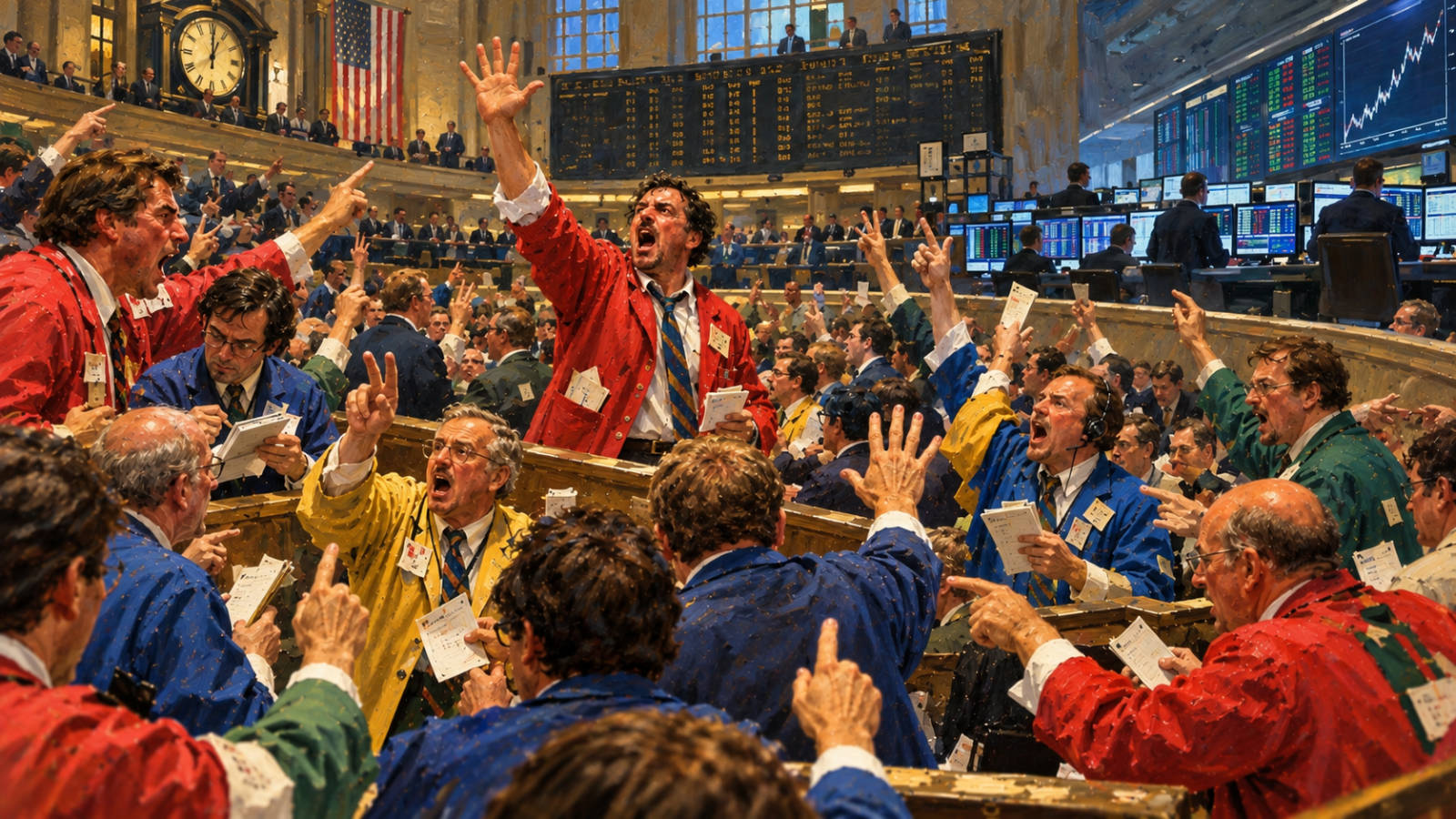
There was a time when global capitalism conducted its business by packing several hundred men into a stepped wooden pit and encouraging them to scream numbers at one another. Fortunes travelled through raised fingers. Wheat changed hands with a flick of the wrist. Men in jackets apparently designed by rival branches of the emergency services traded interest rates. Somehow, amid the shouting, sweat, paper tickets and elbows, prices emerged. Then the computers arrived. They did not shout. They did not require coloured jackets. Most inconveniently, they were faster.
Open outcry grew from an extremely simple requirement. Markets needed buyers and sellers in the same place.
The great commodity exchanges of the nineteenth century formalised something merchants had been doing in coffee houses, warehouses and street markets for generations. Chicago became particularly important. The Chicago Board of Trade, founded in 1848, developed alongside the grain trade of the American Midwest, creating organised markets where farmers, merchants and processors could manage the unpleasant business of not knowing what wheat or corn might be worth several months later.
The pit was ingenious.
Traders stood on tiers so faces and hands remained visible. Bids and offers were shouted publicly. Hand signals carried information through noise that would have defeated ordinary conversation. A palm toward the face generally meant buying. Palm away meant selling. Fingers communicated quantities and prices.
To outsiders it resembled an argument in a municipal swimming pool without the water. To participants it was an information network.
By the late twentieth century the system had become one of capitalism’s great theatres. Chicago traded agricultural contracts, currencies, Treasury instruments and stock indices. New York’s commodity floors handled oil and metals. London had LIFFE, where traders in bright jackets filled the floor at Cannon Street Bridge before its move to Spitalfields. Tokyo, Paris, Singapore and other financial centres had their own versions.
A good floor trader possessed qualities difficult to reproduce on a curriculum vitae. Mental arithmetic mattered. So did memory, nerve, stamina and the ability to recognise a hand signal through a forest of shoulders while somebody nearby was attempting to shift several thousand contracts before lunch.
Information had physical geography.
Standing in the right place mattered. Knowing who was buying mattered. A sudden change in a large broker’s behaviour mattered. Experienced locals could read a pit almost as a farmer reads weather.
There was also an obvious problem.
Access was restricted. Memberships could be expensive. Geography mattered enormously. Markets operated according to local hours. Orders travelled through layers of telephone clerks, brokers, runners and trading desks. Human beings misheard numbers. Tickets disappeared. Arguments erupted over trades.
The floor was remarkably effective technology for the nineteenth century. Unfortunately for the floor, the twentieth century eventually invented better technology.
Electronic trading began nibbling at its edges during the 1980s. Then the nibbling became eating.
CME’s Globex helped demonstrate that futures contracts could trade electronically beyond the traditional session. European exchanges pushed harder. Germany’s electronic derivatives market became a formidable competitor. LIFFE discovered the danger with particular brutality when electronic rivals showed that liquidity, supposedly loyal to a famous trading floor, could move remarkably quickly when offered cheaper, easier execution.
London’s LIFFE floor closed in 2000.
Across the industry, screens offered advantages that were increasingly impossible to dismiss. Electronic markets could operate for longer hours. Participants could connect from different countries. Orders could be matched in milliseconds. Audit trails improved. The expensive physical infrastructure surrounding thousands of floor personnel became harder to justify.
More importantly, liquidity began migrating to the screen.
That was the fatal mechanism. Markets live where other market participants live. Once sufficient volume moved electronically, traders followed because refusing to follow liquidity is an expensive form of nostalgia.
Chicago held out longer.
Even there the arithmetic became merciless. By 2015, open outcry represented only about one per cent of CME Group’s futures volume. That year, most of its futures pits in Chicago and New York closed. Options survived longer because complicated multi-leg transactions could still benefit from human negotiation.
Then came 2020.
Covid emptied trading floors with an efficiency that decades of corporate strategy had failed to achieve. Pits closed as an emergency measure. Markets continued functioning. That was awkward.
A trading floor could defend itself while claiming to be necessary. It became considerably harder after the financial system experimented with sending everybody home.
In 2021, CME announced that most of the pits closed during the pandemic would not reopen. A tradition stretching back generations ended not with a market crash, a fist fight or somebody hurling a trading card into the ceiling, but with a corporate announcement and functioning broadband.
Yet open outcry did not become completely extinct.
The London Metal Exchange still operates its Ring, one of the strangest surviving pieces of financial machinery in Britain. Category One members sit around the famous red circle while metals are traded in tightly scheduled sessions. Copper, aluminium, zinc and other industrial metals still acquire important reference prices through human voices in a room.
The Ring survives partly because the LME market itself is unusual. Its complex structure of prompt dates means participants may need to trade numerous dates and combinations. Human negotiation retains practical value there rather than merely providing attractive footage for television.
Chicago also retains genuine open outcry.
Cboe operates a major options trading floor in the historic Chicago Board of Trade building. Options can involve complicated packages of strikes, expiries and quantities where negotiation between human market makers can still compete with pure electronic execution. The modern floor is not a rebellion against technology. It is a hybrid environment surrounded by screens, data and electronic systems.
CME has likewise retained limited open outcry activity in options, although nothing resembling the sprawling ecosystem that once occupied its floors.
Then there is the New York Stock Exchange.
The NYSE floor survives magnificently as a physical institution, complete with traders, designated market makers, opening bells, television cameras and the architecture of American financial mythology. But it should not be confused with the old open outcry world in its pure form. The NYSE became a hybrid electronic market and eliminated its traditional open outcry system during the transformation of the 2000s. Humans remain important around openings, closings, auctions and unusual market conditions, but the overwhelming machinery of modern equity trading is electronic.
That distinction matters.
A building full of traders is not necessarily an open outcry market.
The old pits died because capitalism did what capitalism is supposed to do. It found a cheaper, faster and more scalable method and ruthlessly adopted it. No ministry had to abolish the coloured jacket. No committee needed a ten-year transition programme. Technology attacked the economics and the economics surrendered.
Something was lost.
The pits created characters because they demanded character. A young clerk could arrive with little more than nerve and numeracy and, occasionally, fight a way into serious money. Traders developed languages, hierarchies, rivalries and instincts peculiar to physical markets. They were rough meritocracies, though hardly perfect, where hesitation could become financially educational within seconds.
Modern electronic markets are quieter, broader and vastly more accessible. A trader in Essex can observe markets once available principally to exchange members standing in Chicago, London or New York. Competition has moved from lungs and elbows to fibre connections, algorithms and computing power.
The barriers changed rather than vanished.
The final irony is that open outcry was killed by the very force its inhabitants spent their careers worshipping. Competition arrived.
It wore no coloured jacket, occupied no seat in the pit and bought no exchange membership. It appeared as software, offered lower costs and greater reach, then waited for customers to decide.
They did.
Today the surviving Ring in London and options floors in Chicago resemble living fragments of an industrial age rather than museum pieces. They survive because, in particular corners of complicated markets, human negotiation can still earn its keep.
That is the only protection markets have ever respected.
When the human voice produces value, somebody will pay for it. When it does not, the screen lights up, the pit falls silent, and several acres of expensive financial real estate suddenly discover an exciting future in corporate hospitality.
[adinserter name=”Block 1″]