Image by: Knelstrom Media
When Luther Nailed a Thesis to Western Stability
By Martin Foskett, Reporter
PUBLISHED:
UPDATED:
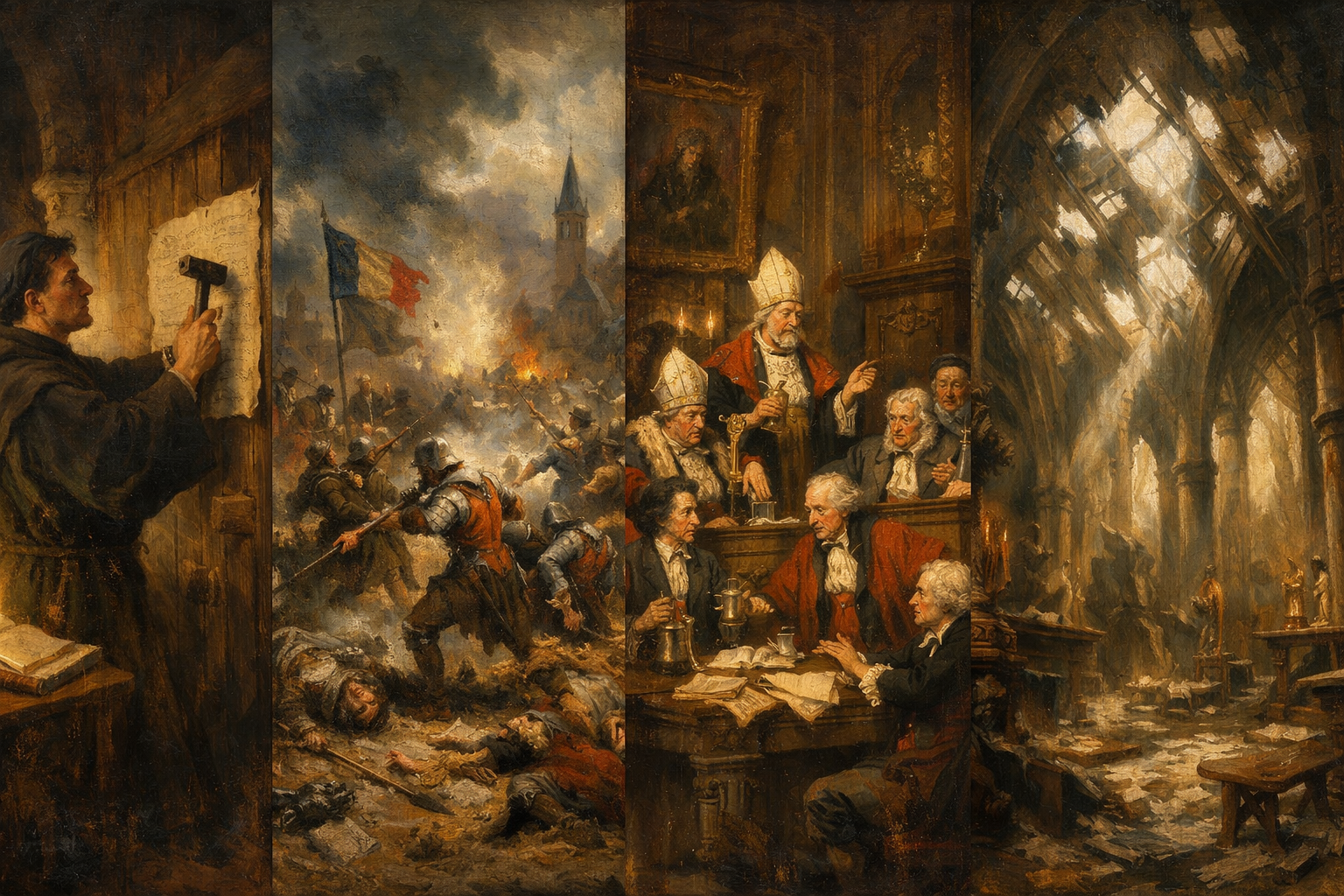
The West did not collapse in a weekend. It did not wake up confused about gender, debt, borders and meaning because of a poorly moderated comments section. The long unravelling began, as most respectable catastrophes do, with a monk, a hammer, and a document pinned to a church door in 1517. The moment Martin Luther decided Rome required a theological performance review, Europe’s spiritual plumbing was knocked loose. Five centuries later, the pipes are still rattling.
The Reformation is usually presented as a brave stand for conscience against corruption. A heroic tale of scripture wrested from clerical monopoly. Which it was, in part. The medieval Church had grown corpulent, indulgence-hawking and drunk on temporal power. Reform was overdue. But history rarely offers tidy moral victories. It offers trade-offs. And the trade-off for breaking a single spiritual authority was the birth of permanent fragmentation, theological, political, psychological.
Christendom, before it splintered, operated like a vast if creaking cathedral roof. Authority descended from God to Church to Crown to common field. It was not egalitarian. It was not always just. But it was coherent. The average peasant in Kent or Cologne understood his place in the cosmic filing system. There were saints, there were sins, there was a hierarchy, and there was an eternal scoreboard.
Then came the printing press, vernacular Bibles, and the intoxicating suggestion that ultimate truth might be individually interpreted. The doctrine of sola scriptura, scripture alone, did not merely challenge Rome. It democratised authority. It handed theological sovereignty to the literate conscience. Europe had discovered spiritual self-service.
Soon enough, unity fractured. Lutheran princes. Calvinist republics. Anglican monarchs. The Thirty Years’ War turned central Europe into a graveyard with weather. England lurched from papal obedience to royal supremacy under Henry VIII, then from Protestant austerity to Marian Catholic revival, then back again. The Reformation did not simply reform religion; it nationalised it. Faith became a function of statecraft.
Out of this turmoil emerged something modern observers mistake for progress: the secular state. After enough blood had been spilt over transubstantiation and predestination, European elites quietly concluded that perhaps God should be moved to a less flammable administrative department. Religion was domesticated. Politics filled the vacuum.
The great irony is that the Reformation’s insistence on individual conscience planted the seed of liberalism while simultaneously weakening the shared metaphysical canopy that restrained it. Once the idea took hold that each believer could personally interrogate doctrine, the principle did not stop at theology. It expanded. Why obey a king by divine right? Why accept inherited hierarchies? Why submit to custom at all?
The Enlightenment, often treated as an entirely separate chapter, grew directly from this soil. Figures such as John Locke and Voltaire did not emerge from medieval monasteries. They emerged from a continent already accustomed to questioning sacred authority. Reason replaced revelation. The state replaced the Church. The individual replaced the community as the primary unit of moral concern.
Markets thrived in this environment. That much is undeniable. The Protestant work ethic, thrift, discipline, literacy, fed directly into the commercial dynamism of northern Europe. Capitalism found fertile ground in a culture that valued diligence and personal responsibility. The West’s extraordinary economic ascent owes no small debt to the virtues of the Reformation.
But virtues unmoored from metaphysical guardrails have a habit of mutating.
Individual responsibility, without a shared moral architecture, drifts into individual sovereignty. Sovereignty drifts into entitlement. Entitlement drifts into grievance. The modern Western citizen, armed with rights but suspicious of duties, is a distant theological cousin of the 16th-century reformer insisting on private interpretation.
The slow erosion of common belief created a vacuum. Nature abhors one. The state, ever-opportunistic, stepped in with forms, frameworks, regulators, and helplines. What medieval bishops once adjudicated, bureaucrats now administer. The customer service portal has replaced the confessional. Salvation is pursued through policy.
In Britain, the path from Canterbury to Whitehall was gradual but decisive. The Church of England became an instrument of the Crown; later, the Crown became a constitutional symbol; eventually Parliament became sovereign in all but liturgical costume. Transcendent authority flattened into parliamentary arithmetic.
Across the Atlantic, the Protestant inheritance shaped the civic creed of the United States, but there too fragmentation accelerated. Thousands of denominations. Revivalism. Personal revelation elevated above institution. A spiritual free market. It was dynamic. It was entrepreneurial. It was also inherently unstable.
When faith ceases to provide an agreed narrative of meaning, societies look elsewhere. Nationhood attempted to fill the void in the 19th century. Industrial might did the same in the 20th. Today, identity politics, consumer branding and bureaucratic expansion compete for the throne. The West did not lose belief; it outsourced it.
The social struggles currently animating Western capitals demographic anxiety, cultural fragmentation, distrust in institutions, spiralling public debt are not random eruptions. They are late-stage symptoms of a civilisation that privatised truth and then discovered that shared norms cannot survive indefinite privatisation.
Marriage, once sacramental and socially enforced, becomes contractual and provisional. Community, once parish-based and intergenerational, becomes digital and transactional. Citizenship, once tied to land and loyalty, becomes an administrative status negotiable by paperwork.
The Reformation did not intend this. It sought purification, not perpetual relativism. Yet once authority was decentralised, there was no logical endpoint. Every subsequent revolution political, sexual, technological followed the same blueprint: challenge hierarchy, assert autonomy, fragment consensus.
Conservatives often romanticise a pre-modern unity without acknowledging its corruption. Progressives celebrate liberation without counting its cost. The more uncomfortable truth is that Western success and Western instability share the same root system.
A culture trained to question dogma will eventually question itself.
This is not an argument for returning to indulgence sellers or papal infallibility. It is an observation that metaphysical cohesion matters. Markets require trust. Democracies require restraint. Freedom requires boundaries. Remove the shared story that legitimises those boundaries and freedom slowly consumes its own scaffolding.
The welfare state, for instance, rests on moral assumptions about solidarity and obligation that it cannot itself manufacture. When communal bonds weaken, redistribution becomes mechanical rather than relational. Taxation grows heavier; gratitude grows thinner. Citizens relate to one another as fiscal abstractions.
Even debates about speech and identity echo 16th-century disputes. Whose interpretation is authoritative? Who defines orthodoxy? Who is a heretic? The vocabulary has changed. The instincts remain.
In a peculiarly British twist, the national Church still sits in the House of Lords while attendance declines and moral consensus evaporates. Bishops debate climate policy as parish halls convert to yoga studios. The architecture remains. The belief drains quietly through the floorboards.
Western societies now oscillate between radical autonomy and frantic regulation. One decade celebrates self-definition; the next demands speech codes. The pendulum swings because the centre does not hold. It was loosened, however nobly, in the 16th century.
None of this suggests inevitability. Civilisations are not domino trails pre-set by monks with stationery. But long arcs matter. The Reformation shattered a single sacred canopy and replaced it with competitive narratives. Out of that competition came liberty, industry and constitutional government. Out of that same competition came fragmentation, hyper-individualism and a state perpetually attempting to glue together what shared belief once bound.
Western societies are not failing because they embraced freedom. They are struggling because freedom, unaccompanied by durable moral consensus, becomes weightless.
Five centuries after that hammer strike in Wittenberg, the echo still ricochets through parliaments, courtrooms and culture wars. The West lives in the house the Reformation remodelled, spacious, profitable, argumentative, drafty.
And every winter, someone asks why the heating will not stay on.