Image by: Knelstrom Media.
Ryanair, reputation and the almighty Dublin arrival
By Martin Foskett, Reporter
PUBLISHED:
UPDATED:
I should preface this by admitting that my negativity towards Ryanair had been quietly fermenting for years. Headlines, anecdotes, airport folklore and those inevitable stories involving somebody’s cousin being financially mugged by a suitcase had all done their work, until I had somehow developed a fairly substantial aversion to an airline I had never actually flown with. Oddly, that suspicion never quite extended to Michael O’Leary himself. There is something cheek-by-jowl about the man that I rather admire. He has spent decades bucking the system, irritating the establishment and demonstrating the deeply unfashionable economic principle that people quite like cheap things.
So when Haurchide and I decided it was time to give our kids their first experience of flying, we chose Dublin and, somewhat inevitably, Ryanair. I was apprehensive, but there comes a point when borrowed opinions need to be dragged into daylight and tested against reality. I wanted to discover whether Ryanair’s infamous reputation was deserved, exaggerated, or simply the cultural baggage accumulated by a company that has never pretended a low-cost airline ticket comes with a footman and a silver breakfast trolley.
The alarm went off at 3 am, an hour which I maintain is less a legitimate time of day than an administrative error. Nothing respectable happens at three in the morning. Foxes are fighting over discarded kebabs, nightclub survivors are reconsidering several major life choices, and sensible families are unconscious beneath duvets. Yet there we were, Haurchide, the kids and me, surrounded by bags, coats and passports in a house so quiet that every zip sounded like industrial machinery.
I checked the passports with the intensity of a man carrying nuclear launch codes, then checked them again before performing the traditional British airport ritual of repeatedly touching every pocket despite knowing perfectly well where everything was. Eventually we bundled ourselves and our luggage into the taxi and disappeared into the black Essex morning.
The roads were largely empty, street lamps flickering rhythmically across the windows. At the same time, the children carried that peculiar mixture of exhaustion and excitement that comes from being removed from bed in darkness. They informed us that something marvellous was about to happen. Haurchide and I sat among the luggage as civilisation slept, and somewhere along the road towards Stansted the taxi driver decided to ask the question.
“Who are you flying with?”
“Ryanair.”
The scoff from the front was magnificent.
This was not some delicate little expression of uncertainty. It was a substantial, fully developed scoff, the sort of noise a man might make after being told you had invested the children’s inheritance in a timeshare on an active volcano.
He told us that he had driven Michael O’Leary when Ryanair was first starting and, according to his recollection, the encounter had left quite an impression.
“The most arrogant man I have ever met,” he said, before adding that he had vowed there and then that he would never fly with Ryanair.
I looked across at Haurchide.
Marvellous. We had not even reached Stansted.
I had spent years absorbing negative Ryanair folklore, and finally decided to test the airline for myself. Before we had even reached the airport, our taxi driver had opened his own personal archive and produced a decades-old Michael O’Leary story. Even the taxi driver had an opinion on Ryanair. The company’s reputation had apparently followed us out of the house, climbed into the taxi and was now sitting in the front seat.
Obviously, I had no way to verify an encounter from years ago, nor was I going to treat one man’s recollection as a definitive character assessment of O’Leary. It was his memory and his opinion, nothing more. But the timing was exquisite, particularly because his verdict did very little to alter my own peculiar admiration for the man.
O’Leary has always struck me as possessing something increasingly endangered in corporate life. Edges.
Modern executives increasingly seem to emerge from the same laboratory, wearing identical suits and speaking a language composed almost entirely of stakeholder engagement, exciting journeys, and carefully rehearsed concern. You could replace half of them with a beige curtain and a LinkedIn account without anybody noticing until Christmas.
O’Leary has never seemed afflicted by this condition.
His public persona has long been provocative, abrasive and deliberately disruptive. Whether one likes the style or not, he understands attention and appears entirely comfortable irritating people while getting on with the business of selling them airline tickets. Behind all the theatre sits an almost brutally simple commercial proposition. People want to travel, they particularly want to travel cheaply, so give them a basic fare, charge separately for the things they choose to add, keep the aircraft moving and resist pretending that everybody boarding a flight to Dublin is Aristotle Onassis.
It is uncomplicated capitalism, and the inconvenient truth for Ryanair’s legion of critics is that an enormous number of passengers continue voting for it with their wallets.
Still, admiring the business model from the safety of the ground was one thing. Actually entrusting my wife, children and luggage to it before breakfast was another matter entirely.
I had checked us in online a few days earlier without any problems. We had our 10 kg cabin bags and one 20 kg hold bag, and I had approached Ryanair’s luggage rules with the caution normally associated with transporting enriched uranium through customs. Bags had been weighed, dimensions checked, and allowances scrutinised until I possessed an unhealthy familiarity with the approximate mass of our underwear.
At Stansted we approached the self-service bag drop expecting, or perhaps subconsciously hoping for, the first confrontation with the legendary Ryanair machine. Instead, the bag went onto the scales, the label went on, the system accepted it and our suitcase disappeared into the mysterious subterranean kingdom beneath the airport.
That was it.
No confrontation, no hidden tribunal and nobody appearing from behind a partition carrying a tape measure and an invoice large enough to destabilise the mortgage.
Haurchide and I looked at each other. Everything was working, which was becoming mildly irritating because I had brought years of prejudice with me and Ryanair seemed determined not to validate any of it.
Security came next, another part of the journey that recent headlines had conditioned me to approach as though we were about to participate in an endurance event. The doom and gloom surrounding post-Brexit British travellers has occasionally made crossing a border sound less like international travel and more like an expedition requiring Sherpas.
Our experience was considerably less dramatic. Even including a trip through secondary screening, we were through in around thirty minutes.
I have spent longer trying to leave IKEA.
We emerged into Stansted’s vast commercial ecosystem, where apparently nobody can be allowed near an aircraft without first negotiating several acres of perfume, whisky, sunglasses, sandwiches and emergency Toblerone. The children were becoming increasingly excited while I was becoming increasingly dependent on caffeine. At that hour coffee is no longer refreshment. It is essentially life support served in cardboard.
Eventually we made our way to the gate and waited for about an hour, which provided ample opportunity to observe one of the stranger rituals of modern aviation. Every passenger has an allocated seat aboard the same aircraft travelling to precisely the same destination. Yet, the moment somebody wanders vaguely towards the boarding area, an entire population begins to rise.
One person stands. Another notices. Somebody picks up a bag. Within minutes, a queue exists despite absolutely nothing happening.
Nobody knows why, but being British we instinctively understand that an unexplained queue must contain some form of opportunity, so the atmosphere rapidly becomes one of orderly suspicion.
Eventually, boarding began and the moment arrived—my first Ryanair aircraft.
After years of accumulated negativity, I was half expecting something between a municipal bus and a livestock trailer with wings. Instead, I stepped aboard and found a cabin that was very clean, tidy and perfectly pleasant.
This was becoming ridiculous.
Haurchide and I stowed the bags, got the children settled and watched them absorb everything around them. The windows, the seats, the overhead lockers, the sounds and the curious spectacle of grown adults attempting to persuade luggage into spaces clearly smaller than the objects they were holding.
For the kids, none of the mythology mattered. They did not care about Ryanair’s reputation, Michael O’Leary, baggage fees or furious internet discussions about cabin dimensions. They were sitting inside an aeroplane for the first time in their lives and were about to fly.
That rather punctured the mythology for me.
Children possess the useful ability to experience what is actually happening rather than what everybody else has instructed them to expect. Haurchide and I had wanted to give them their first flight, and suddenly there we were, strapped into the seats with the doors closed and Stansted sitting outside the window.
The aircraft pushed away from the gate and began making its way along the taxiway with what seemed to me like considerable enthusiasm. I watched the terminal slide past as our pace increased and, unable to resist, turned to the family.
“Who’s driving, Lewis Hamilton?”
Haurchide has been married to me long enough to know that journeys generally come with an unsolicited commentary service.
Something strangely appropriate about the purposeful way we moved towards the runway. No ceremony, no theatrical pause to contemplate the majesty of human flight, just the practical business of getting an aircraft out, getting it airborne and getting it to Dublin.
I rather liked that.
Aircraft make money in the sky, not sitting beside terminals admiring themselves, and Ryanair’s entire philosophy seems built around that wonderfully unsentimental fact.
We lined up, the engines rose, and suddenly the runway was rushing beneath us. A few moments later Britain dropped away, and the children were flying.
That was the moment Haurchide and I had wanted to give them.
They stared through the windows as roads became lines, houses became tiny models, and the landscape unfolded beneath us. For them something extraordinary was happening. For me something considerably less romantic, but almost equally surprising, was becoming apparent.
Nothing had gone wrong.
No baggage catastrophe, boarding confrontation, or administrative ambush. Nobody had demanded the deeds to my house because a zip protruded three millimetres beyond an approved luggage frame. We had bought tickets, followed the rules and boarded an aeroplane.
The flight itself was gloriously uneventful, which is exactly how I prefer aviation. At 35,000 feet, excitement is generally undesirable.
Looking around the cabin, I saw families, couples, children peering through windows, passengers staring at phones, people buying things and others sleeping. It did not resemble the aviation punishment chamber years of folklore had somehow constructed in my imagination.
It looked like public transport with clouds.
Somewhere over the Irish Sea I began wondering whether this was the central misunderstanding surrounding Ryanair. It does not really sell romance. It sells movement.
There was a time when commercial aviation came wrapped in theatre. Smart clothes, elaborate meals, generous baggage allowances and the suggestion that boarding an aircraft temporarily elevated you into some minor branch of the aristocracy.
Ryanair appears to have taken that entire concept into a shed and beaten it with a calculator.
Do you want to go to Dublin? Fine. Here is a seat. Do you want additional things? Fine. Pay for them.
Something almost aggressively free-market about the proposition, and I find the lack of pretence refreshing. The modern consumer has developed a curious expectation that everything should simultaneously become cheaper and more luxurious, which works beautifully until economics walks into the room and asks who is paying.
Ryanair largely avoids the argument. The basic product is transport and the extras have prices. Nobody needs to pretend that a cheap ticket across the Irish Sea should include a butler called Sebastian and a lightly poached salmon.
Eventually Ireland appeared beneath us, green emerging through the window as we began our descent towards Dublin. The atmosphere changed almost imperceptibly as tables disappeared, belongings were gathered, and seat backs returned upright. Haurchide and I made sure the children were settled while they stared outside at the ground creeping steadily closer.
Everything was calm. Everything was ordinary.
Everything was going suspiciously well.
Then came the landing.
I have experienced a few landings in my time, but this one introduced itself properly.
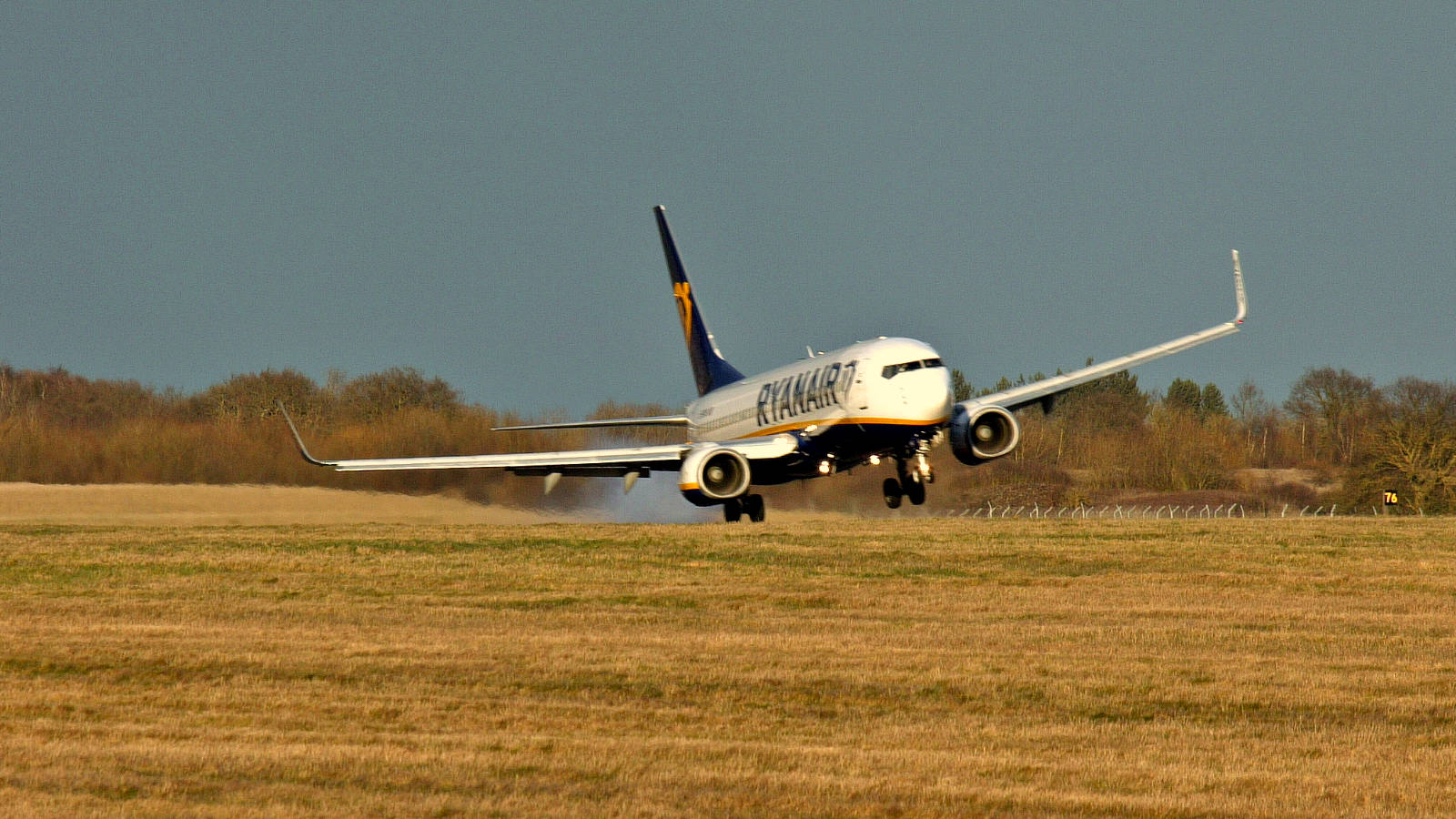
We crossed the threshold with what felt like considerable purpose, continued down towards the runway and then met Ireland with an almighty bang.
The wheels hit hard, followed by a couple of enthusiastic bounces as we travelled up the runway, and for one glorious moment I wondered whether we had landed at Dublin Airport or challenged it to a fist fight.
Then the aircraft settled.
I looked across at Haurchide. The kids were still smiling, everybody remained where they were supposed to be, and the Emerald Isle had officially received the Foskett family.
Forcefully, admittedly, but successfully.
There was no ambiguity about whether we had landed. Ireland had physically confirmed our arrival.
And after years of apprehension, folklore and second-hand negativity, I found myself confronted by a deeply inconvenient conclusion.
I liked Ryanair.
There. I’ve said it.
Not to the extent that I intend erecting a statue of Michael O’Leary in the garden or commissioning a blue and yellow shrine in the spare room, but our experience had been genuinely pleasant. Check-in had worked, the bag drop had worked, security had been manageable, boarding had worked, the aircraft was clean, the flight had been uneventful, and we had arrived in Dublin with our luggage and children present and correct.
That final point sounds almost embarrassingly obvious, but it is the product.
Transport.
Haurchide and I wanted to give the kids their first airline experience, and Ryanair delivered precisely that without drama.
Would my opinion be different if the flight had been cancelled? Possibly. Would I feel differently if our suitcase had disappeared into another dimension? Certainly. Would this Dispatch sound different if we had spent hours stranded somewhere attempting to resolve a problem? Almost definitely.
Nothing went wrong, so I cannot tell you what Ryanair is like when things do go wrong, and that distinction matters. Companies often reveal their real character when the machinery stops behaving, and somebody needs help.
But I cannot review a disaster that did not happen.
I can only judge the journey Haurchide, the children and I actually experienced, rather than somebody else’s story, an angry social media post or the legendary misfortune of somebody’s neighbour’s cousin and a cabin bag in Málaga.
Our experience was good.
That was the revelation.
The taxi driver had started the morning by supplying his own decades-old verdict on Michael O’Leary before we had even reached Stansted. I had arrived with years of accumulated prejudice of my own. Then Haurchide, the children and I did something rather dangerous to a firmly established opinion.
We tested it.
On this occasion, Ryanair won.
Reputations are peculiar things because they accumulate far more efficiently than ordinary experiences. One complaint attaches itself to another, stories travel, headlines survive, and the mythology expands. Nobody writes furious online posts announcing that their aircraft departed roughly when expected, the cabin was clean, and they arrived safely at their destination.
Normality has terrible public relations.
Yet normality was precisely what Ryanair delivered. A straightforward, no-frills means of getting a family from Stansted to Dublin at a price that made the journey accessible, followed by a landing robust enough to rearrange several internal organs and one long-held opinion.
I had set out wanting Haurchide and the kids to have a good trip, particularly because this was the children’s first experience of leaving the ground. Somewhere between our 3 am escape through sleeping Essex and that almighty Dublin thump, I got an experience of my own. Ryanair stopped being the airline I had heard about and became the airline we had actually flown. We stepped into Ireland together, the children buzzing, Haurchide beside me, the luggage present and my old prejudice looking increasingly ridiculous somewhere back across the Irish Sea. Michael O’Leary had not converted me, the advertising had not converted me and years of Ryanair folklore certainly had not. A perfectly ordinary flight achieved something far more persuasive. It proved me wrong.
[adinserter name=”Block 1″]