
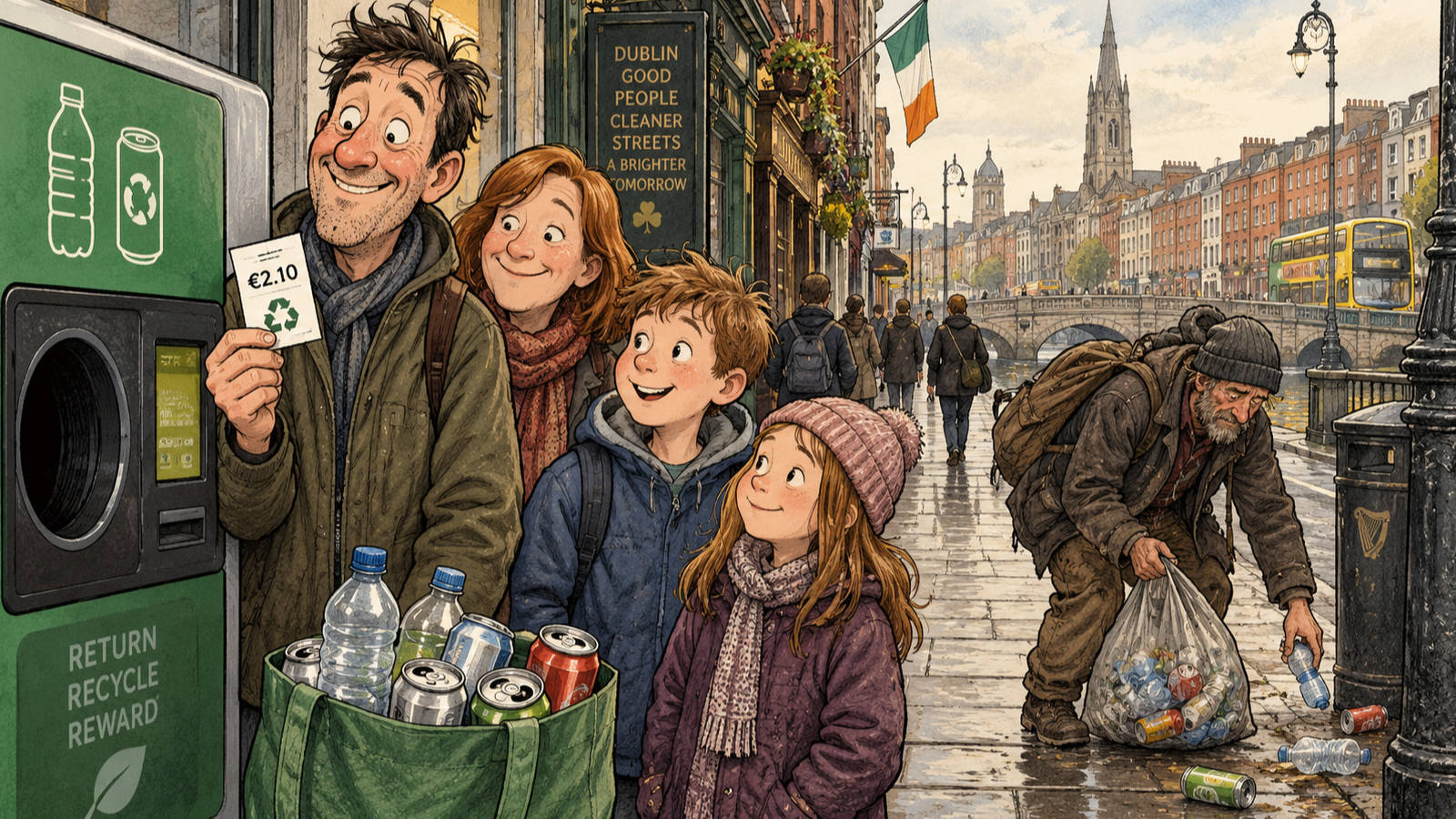
Image by: Knelstrom Media.
Ireland’s Bottle Deposit Scheme: When Rubbish Becomes Worth Money
By Martin Foskett, Reporter
PUBLISHED:
UPDATED:
Sometimes the cleverest public policy doesn’t require a minister behind a lectern, a glossy leaflet featuring suspiciously cheerful families, or a taxpayer-funded campaign explaining why we should all become better people by Tuesday. Sometimes it merely puts a price on something we used to regard as rubbish and allows ordinary human self-interest to lumber into action. During a family visit to Dublin, I discovered that Ireland has done precisely this with plastic drinks bottles and cans. We saved ours, fed them back into the system and walked away with €2.10. Later, elsewhere in the city, I watched a homeless man collecting the bottles other people had discarded. Between my €2.10 and his bag of other people’s empties sat a remarkably elegant lesson in economics, recycling and the stubborn reliability of people responding to incentives.
I had not travelled to Dublin intending to conduct an economic experiment involving fizzy drink containers.
Family visits rarely begin that way.
There are bags, coats, conversations, cups of tea, the inevitable logistical mystery involving where somebody has put something important, and the general domestic choreography of several people temporarily occupying the same patch of civilisation.
But bottles began accumulating.
A plastic one here. A can there. Another bottle after that.
Normally, on a trip away, I would have regarded the empty container as having completed its brief earthly purpose—drink consumed. Bottle finished. Find bin. End of relationship.
Ireland had other ideas.
Its national Deposit Return Scheme has been operating since 1 February 2024. Eligible PET plastic drinks bottles and metal cans from 150ml up to three litres carry a deposit. The smaller containers cost you an extra 15 cents. Larger ones, above 500ml and up to three litres, carry a 25-cent deposit.
You pay it when you buy the drink.
You get it back when you return the container.
The government can make many things incomprehensible before breakfast. Ireland, to its considerable credit, has managed not to do that here.
Buy bottle.
Pay deposit.
Return bottle.
Get money.
Even I could follow it.
So we began keeping the empties.
This produced a subtle change in household behaviour that no environmental poster, council leaflet or earnest television advertisement has ever quite managed to achieve in me.
The bottles stopped looking like rubbish.
They became inventory.
Not valuable inventory, admittedly. Nobody was going to ring a commodities broker in Frankfurt and announce that the Foskett family had cornered the Dublin mineral water futures market.
But they were worth something.
Eventually we took them back and received €2.10.
Two euros and ten cents.
Hardly the sort of windfall that causes private bankers to materialise from behind curtains. I was not pricing yachts. Nobody from Monaco telephoned.
But that is exactly why the experience stuck with me.
The amount was trivial enough to reveal the mechanism.
Those containers had acquired value.
Before the scheme, an empty drinks bottle was something to get rid of. Under the scheme, chucking an eligible bottle into an ordinary bin began to feel faintly ridiculous.
It was no longer merely disposing of plastic.
It was throwing away money.
Humans are peculiar creatures about this.
Tell us something is recyclable and many of us will dutifully recycle it, provided the correct bin is nearby, the lid is the approved shade of municipal mauve, and nobody has redesigned the collection calendar overnight.
Tell us the same object is worth 25 cents, and suddenly we become junior accountants.
That bottle over there?
Money.
That can on the table?
Money.
Who put 15 cents in the rubbish?
Retrieve it immediately.
This is the bit of environmental policy I find rather refreshing. It does not depend entirely upon virtue.
Governments are terribly fond of designing policies for imaginary citizens. These fictional people rise every morning eager to optimise society, study official guidance over their cornflakes and reorganise their behaviour according to whichever strategy document has just emerged from a department.
Real people are different.
Real people are busy.
Real people forget things.
Real people cannot always be bothered.
And real people, quite reliably, dislike throwing away money.
Ireland’s scheme takes that unromantic fact about human nature and puts it to work.
Then I saw the other side.
We were walking through another part of Dublin when I noticed a homeless man collecting discarded bottles.
I watched him picking up containers that other people had apparently decided were not worth the inconvenience of returning.
To them, rubbish.
To him, value.
There is an important line here which ought not to be blurred for the sake of a neat argument. A bottle deposit scheme is not a solution to homelessness. It is not a poverty programme. Nobody sensible should pretend that collecting discarded cans represents some glorious new branch of social policy.
But what I saw was still economically interesting.
Somebody had thrown away an asset.
Somebody else had picked it up.
Twenty eligible 15-cent containers represent €3. Twenty of the 25-cent containers represent €5.
Again, nobody is retiring to Marbella.
But the fascinating part is what happens to the incentives.
The original purchaser has a reason to return the container.
If the purchaser cannot be bothered, another person has a reason to collect it.
That person gets the deposit.
The container comes off the street.
The material goes back into the recycling stream.
Nobody needs to dispatch a clipboard battalion to stand beside the litter bin delivering a seminar on civic responsibility.
The bottle does the persuading.
It has a price attached.
I rather like systems that acknowledge people as they actually are, rather than as government departments would like them to be.
And the Irish numbers suggest this is doing considerably more than providing me with €2.10 worth of holiday entertainment.
By March 2026, more than 2.5 billion bottles and cans had been returned through the Irish scheme. More than 1.4 billion were returned in 2025 alone, after 874 million came back between the February 2024 launch and the end of that year.
More striking is what appears to have happened to recycling rates.
The organisation administering the scheme estimates that the overall recycling rate for the containers it covers has climbed from roughly 49 per cent before introduction to more than 90 per cent. Around 76 per cent are now captured directly through the deposit system, with the remainder recovered through mixed dry recycling.
That is not a marginal twitch in behaviour.
That is people getting the message.
Ireland had a particularly obvious problem with drinks consumed away from home. At launch, the government estimated that roughly five million drinks in single-use containers were being consumed every day. Bottles used while people were out and about were especially troublesome because the convenient household recycling bin was nowhere nearby.
A deposit alters the geography of the problem.
The empty bottle in your hand remains worth something wherever you happen to finish it.
And if you still discard it, it remains worth something to the next person walking past.
Britain, meanwhile, has spent years approaching the same conclusion through the traditional national method of consultation, reconsideration, administration, revised timetables and enough paperwork to make the bottle decompose naturally while waiting.
England, Scotland and Northern Ireland are scheduled to introduce deposit return schemes in October 2027.
The principle will be broadly familiar to anybody who has used the Irish system. Single-use PET plastic, aluminium and steel drinks containers from 150ml to three litres will carry a refundable deposit.
The operator is business-led and not-for-profit, rather than simply becoming another conventional arm of the state. It is responsible for the machinery behind the consumer transaction, including producer registration, logistics and financial oversight. The scheme operator will set the precise deposit amount.
Wales is pursuing its own scheme, with its policy placing particular emphasis on reuse as well as recycling.
So Britain has not rejected the idea.
We have merely taken the scenic route towards it.
The October 2027 launch means Ireland will have been operating nationally for more than three and a half years before the British schemes arrive.
Genuine complexity hides behind the cheerful machine swallowing your bottle.
Manufacturers must participate. Packaging needs identification. Retailers need collection points. Reverse vending machines require space, electricity and maintenance. Mountains of containers must be collected, sorted and processed. Deposits must move through a financial system that can account for enormous numbers of individual transactions.
Britain also enjoys the additional entertainment of devolved waste policy, which means several governments must coordinate enough moving parts to make a Swiss watch look like a brick.
None of this is cost-free.
Retailers take on obligations. Producers face costs. Machines occupy valuable shop space. Consumers have to store empties rather than dropping everything into the household recycling collection.
And Britain already has established kerbside recycling systems capable of handling huge quantities of this material.
That produces a perfectly reasonable question.
Why create another collection mechanism for objects many households already recycle?
Standing in Dublin with €2.10 provides part of the answer.
Because collection is only half the story.
Value is the other half.
A British plastic bottle placed in the household recycling today may be environmentally useful, but to the person holding it, financially it is nothing.
A bottle lying beside a pavement is even more revealing.
I can pick it up because I am a decent citizen.
I can leave it because I am busy.
Economically, either decision makes no difference to me.
Give that bottle a deposit and the calculation changes.
The litter has become a tiny bearer bond with a barcode.
One is insignificant.
Ten become noticeable.
Twenty become interesting.
Fifty become worth bending down for.
This is the quiet genius of the thing.
Instead of attempting to suppress self-interest, it recruits it.
There is something pleasingly old-fashioned about that.
Markets work because prices transmit information. Value changes behaviour. Incentives matter. These observations were not discovered by a behavioural insights committee armed with a colourful flowchart.
People have understood them since the first merchant discovered his customers became mysteriously enthusiastic when offered something worthwhile in return.
Ireland has applied the principle to empty drink bottles.
My €2.10 proved it at the smallest possible scale.
I had not saved those bottles because I was seized by an overwhelming desire to improve national recycling statistics.
I saved them because they were worth €2.10.
The result was precisely the behaviour the environmental policy wanted.
Then the homeless man demonstrated the second stage.
Somebody else had abandoned their deposit.
He had not.
The incentive survived the original owner’s indifference.
That may be the most interesting feature of all.
Government did not have to know who would return the bottle.
It merely had to ensure that somebody had a reason to.
A modest but important philosophy hides inside that arrangement. Good policy does not always need to command behaviour. Sometimes it can simply arrange the incentives and get out of the way.
Ireland has taken something almost universally regarded as worthless once emptied and given it enough residual value to alter how people see it.
Not much value.
Just enough.
Fifteen cents.
Twenty-five cents.
€2.10 after a family visit.
A few euros gathered from bottles other people could not be bothered to return.
Small money producing surprisingly large behaviour.
Britain is now heading towards the same system, several years and presumably several forests of consultation documents later. When it arrives, there will doubtless be complaints about storing bottles, queues at machines, retailer costs and some poor soul attempting to return a shampoo container because he has misunderstood the regulations. No system involving the public remains elegant for long.
But after actually using Ireland’s scheme, I find its central idea difficult to argue with.
I finished a drink and saw an empty bottle.
Ireland saw 15 cents.
The man in the street saw it too.
And suddenly the rubbish was no longer rubbish.
Sometimes the most effective way to persuade people to stop throwing something away is not another lecture, another slogan or another government campaign featuring a green leaf and an exclamation mark.
Sometimes you stop making the thing worthless.
[adinserter name=”Block 1″]