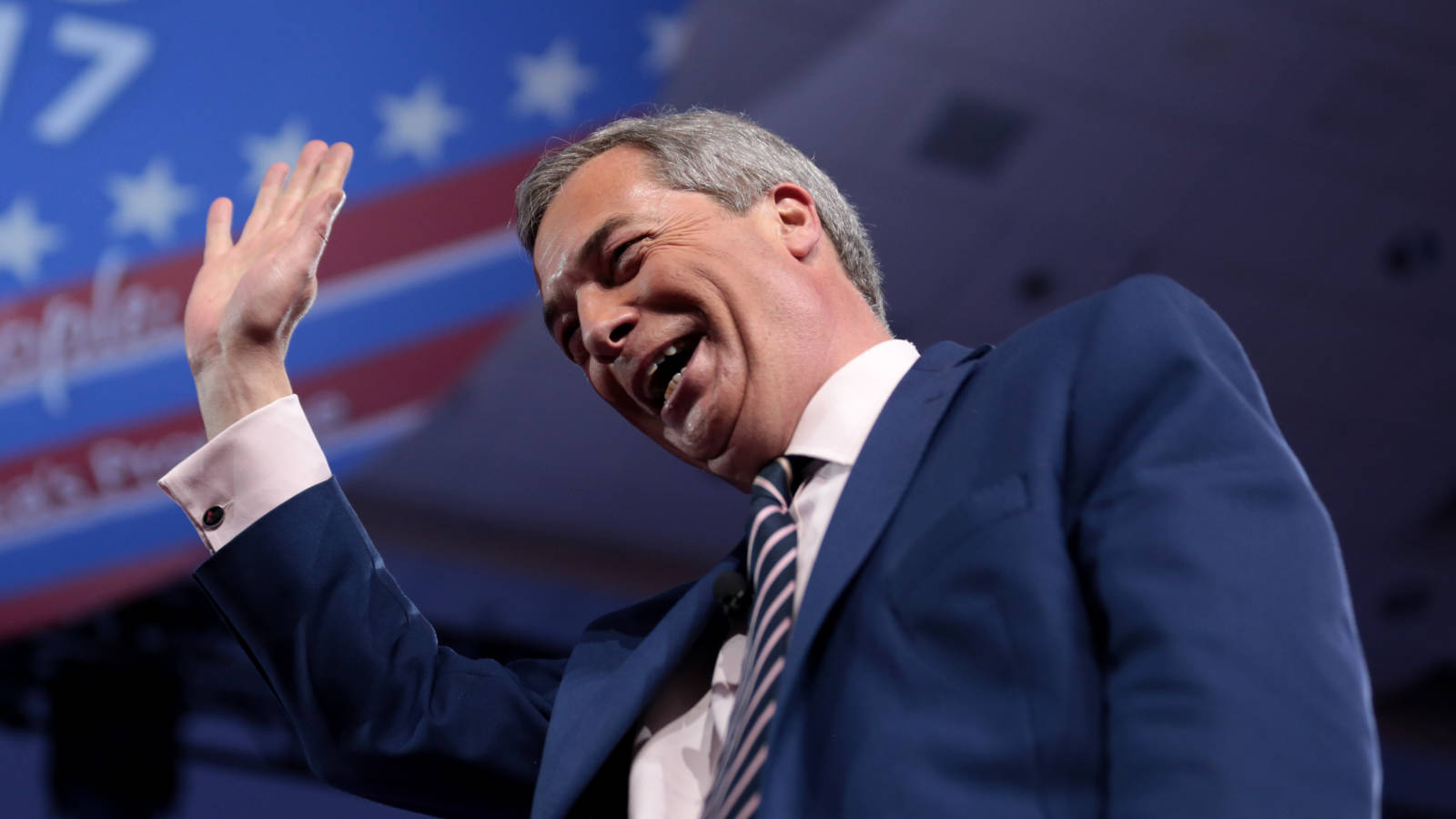
Image by: Gage Skidmore / Flickr.
FARAGE HOLDS CLACTON AS REFORM WINS BOYCOTTED BY-ELECTION
By Martin Foskett, Reporter
PUBLISHED:
UPDATED:
ENGLAND, Clacton. Reform UK leader Nigel Farage retained his parliamentary seat in the Clacton by-election, with the result declared on 14 August 2026, winning 63.34 per cent of the vote in a contest that every major political party chose to boycott.
Farage secured 22,239 votes, finishing 12,784 ahead of his nearest challenger, the satirical candidate Count Binface, who polled 26.93 per cent with 9,455 votes. Turnout was 44.37 per cent, down from 58 per cent at the 2024 general election. The result was a hold for Reform UK and represented an approximately 17.1-percentage-point increase on the 46.2 per cent share Farage won when he first took the seat from the Conservatives two years earlier. His majority grew from 8,405 in 2024 to 12,784, though the absence of mainstream opponents complicates the comparison.
The by-election was triggered by Farage’s own resignation as MP on 7 July 2026. He stepped down amid scrutiny of his financial declarations, including a £5 million gift from Christopher Harborne, a British cryptocurrency billionaire based in Thailand, which Farage had failed to register in the parliamentary register of members’ interests. The parliamentary standards commissioner opened an investigation into the donation. Farage said the by-election would allow voters in his Essex constituency to deliver their own verdict on whether the matter concerned them. According to Al Jazeera, scrutiny intensified as Reform’s rise and the growing realisation that the party might form the next government led to an examination more typically reserved for more established parties.
Every mainstream party declined to field a candidate. Labour, the Conservatives, the Liberal Democrats, the Greens and Restore Britain all withdrew, with the parties characterising the contest as a stunt, according to the Evening Standard. The boycott left Reform UK, the Social Democratic Party, Rejoin EU, and a field of independents and novelty candidates to fight the seat. The absence of any other major Westminster party meant the result could not be compared directly with conventional by-elections, where at least one major opposition party typically competes for votes.
A record 34 candidates appeared on the ballot paper, surpassing the previous high of 26 set at the Haltemprice and Howden by-election in July 2008, when Conservative MP Sir David Davis resigned over civil liberties and faced a similarly boycotted contest. The Clacton ballot paper measured nearly a metre in length. Of the 34 candidates, 20 stood as independents, also a record for a parliamentary election. There were 79,785 registered voters in the constituency, with 10,716 postal votes issued, according to the BBC.
The campaign ran for approximately five weeks, with Farage joined on the stump by senior Reform figures including deputy leader Richard Tice. The BBC reported that Reform’s home affairs spokesman, Zia Yusuf, used the campaign period to announce proposals to reward members of the public for tip-offs about employers hiring workers illegally, part of the party’s broader platform on immigration enforcement. The contest drew national and international coverage, partly because of the record number of candidates and partly because of the identity of Farage’s principal challenger.
Count Binface, a satirical candidate who campaigns wearing a bin-shaped costume and stands on a platform of comic policy proposals, finished second. His 26.93 per cent share was unusually high for a novelty candidate in a British parliamentary election. Count Binface has stood in several previous elections, including against Boris Johnson in Uxbridge and South Ruislip in 2019. In this contest, however, the absence of Labour, Conservative and Liberal Democrat candidates meant the satirical candidate effectively served as the principal opposition, a fact noted across British media coverage.
Rejoin EU, a party campaigning for Britain to rejoin the European Union, fielded John Stevens, a former Conservative MEP and the party’s deputy leader. Stevens, who lives in the neighbouring district of Colchester, told the BBC that leaving the EU was “a historic national mistake” and said he wanted to provide “a voice on the right” for voters in the constituency. He secured 1.4 per cent of the vote. Independent candidate Tony Francis, a Clacton resident who campaigned on protecting the local coastline, supporting older residents and improving transport infrastructure, polled 1.2 per cent. Other candidates included Laurence Fox of the Reclaim Party, Howling Laud Hope of the Official Monster Raving Loony Party, and William Clouston of the Social Democratic Party. The remaining 30 candidates shared under 8 per cent of the total vote between them.
An Ipsos poll conducted in July, reported by The Independent, found that 74 per cent of respondents believed the parliamentary standards commissioner should investigate whether Farage broke parliamentary rules. The same poll found that 73 per cent said the investigation should continue regardless of the by-election outcome. Only 16 per cent of respondents thought Farage was right to resign and stand for re-election, while 54 per cent believed he should resign and leave Parliament altogether. The findings suggested limited sympathy among British adults nationwide for the tactic of triggering a by-election to validate a contested mandate.
A poll published before polling day predicted Farage would secure around three-quarters of the vote, with Count Binface on 20 per cent. Farage fell short of that projection but won with a comfortable margin. According to The Guardian, he declared himself the winner while counting was still under way. Betting markets had priced a Reform victory at between 1/50 and 1/500, with Count Binface at 12/1 to 48/1, the Evening Standard reported, citing the odds comparison site Oddschecker.
The broader polling landscape offered mixed signals for Reform UK. An Ipsos survey released on the same Monday put Labour ahead nationally, with 28 per cent of respondents saying they would vote Labour at the next general election compared with 25 per cent for Reform, 18 per cent for the Conservatives and 12 per cent for the Greens, according to Al Jazeera. The figures suggested a narrowing of Reform’s lead from earlier in the year.
Reform UK deputy leader Richard Tice was also reported to be under investigation by the parliamentary standards watchdog. According to the BBC, the complaint related to a Commons debate on Israeli influence and whether Tice should have referenced his registered interests during the discussion.
Clacton is a coastal constituency in the Tendring district of Essex, comprising wards including Alton Park, Bockings Elm, Burrsville, Homelands, Frinton, Golf Green and Hamford. Farage first won the seat at the July 2024 general election, defeating the incumbent Conservative Giles Watling with a majority of 8,405. The constituency had been held by the Conservatives since 2017.
Farage has maintained that he did not knowingly breach parliamentary rules regarding the Harborne donation. The parliamentary standards commissioner’s investigation, which was suspended following Farage’s resignation, is set to resume following his return to Parliament. Following the by-election result, Farage will return to the House of Commons as the MP for Clacton.
[adinserter name=”Block 1″]