Image by:
Bring Back the Robes: Reverse Blair’s Velvet Revolution
By Martin Foskett, Reporter
PUBLISHED:
UPDATED:
The House of Lords is once again being prodded with a constitutional stick, as if it were an elderly Labrador refusing to perform for a modernising circus. The fashionable suggestion: scrap it, elect it, flatten it, digitise it, send it to the same scrapyard as the fax machine and the hereditary peer. The unfashionable suggestion: reverse the vandalism, restore the balance, and admit that Tony Blair’s constitutional tinkering left the upper chamber wobbling like a three-legged Chippendale.
Britain once possessed a second chamber so gloriously anachronistic that it worked precisely because it did not care about hashtags. The House of Lords was not elected, not excitable, and not particularly impressed by ministerial press releases. It was full of people who had already made, lost, or inherited their money, or married into someone else’s money. It did not need the state, which is precisely why the state feared it.
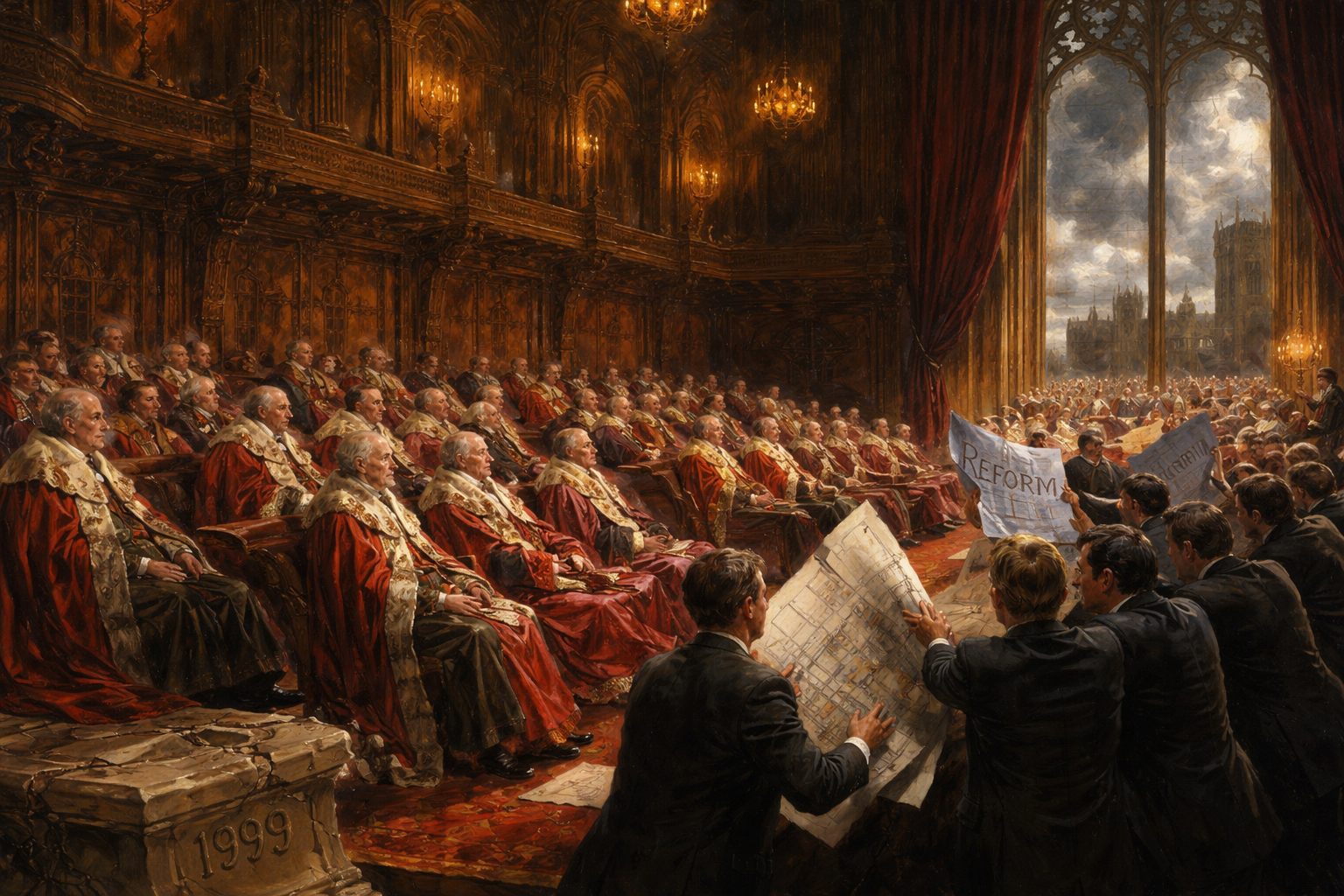
Enter the Blair years: constitutional renovation by committee, delivered with the zeal of a man rearranging a stately home while insisting he is only dusting the mantelpiece. The removal of most hereditary peers in 1999 was sold as modernisation. What it actually delivered was a House of Lords swollen with life peers, political appointments handed out like party conference lanyards. Reform, it turned out, meant more prime ministerial patronage, not less.
The hereditary system, for all its antique absurdity, had one delicious advantage: it was immune to party machines. A WhatsApp group cannot deselect a duke. A viscount does not require a focus group to decide whether to oppose a daft regulation on compost. There was something magnificently inconvenient about that.
Now, critics say the Lords are bloated. They are not wrong. It has drifted north of 800 members at points, a legislative cruise liner permanently circling the Thames. But the bloat is not the fault of ancient earldoms; it is the by-product of prime ministers sprinkling peerages like confetti over former advisers, donors, strategists, and loyal foot soldiers. The problem is not aristocracy. It is patronage.
Scrapping the House of Lords would be a constitutional act of arson. Britain does not need another elected chamber filled with career politicians rehearsing for Question Time. The country already possesses a House of Commons that specialises in noise, tribal loyalty, and occasional legislation. A second elected chamber would either duplicate that dysfunction or challenge it outright, creating gridlock. One Westminster shouting match is sufficient.
The genius of the old settlement lay in its asymmetry. The Commons was democratic, combustible, and dominant. The Lords were appointed, insulated, and revising. It scrutinised legislation with the detached boredom of a retired colonel examining the dinner bill. It asked awkward questions because it did not require votes. That detachment is priceless.
The Blair reforms were marketed as a democratic purification. In practice, they centralised power. The removal of hereditary peers did not democratise the upper chamber; it increased the Prime Minister’s influence over it. Life peerages became tools of loyalty and reward. A constitutional check was gently rebranded as a networking opportunity.
Consider the paradox. Critics argue that hereditary peers are undemocratic because they inherit their position. Yet life peers are appointed, often by party leaders. One system is accidental. The other is strategic. Which is more likely to challenge the executive?
Restoring the hereditary principle would not mean returning to powdered wigs and fox-hunting bills at dawn. It would mean reintroducing independence by accident, a class of legislators not beholden to the current occupant of Downing Street. It would reintroduce friction into a political system that increasingly mistakes speed for wisdom.
Britain’s constitution is evolutionary rather than revolutionary. It grows like ivy. It is not written on a single document; it is etched into precedent, habit, and quiet compromise. Radical reformers who promise a sleek, modern second chamber risk creating something far less British: a rival power centre with electoral legitimacy and political ambition.
And ambition is precisely what the upper house does not require.
The House of Lords, in its semi-restored, semi-gutted state, has nonetheless proved its worth. It has prompted legislative amendments, forced governments to think again, and occasionally embarrassed ministers who believed their majority was a universal solvent. It works because it is not desperate for public approval.
Elected politicians think in five-year cycles. Appointed or hereditary peers think in decades. The difference is not subtle. It is the difference between building a conservatory and preserving a cathedral.
Blair’s wider constitutional reforms followed a pattern: devolution without clarity, human rights legislation without sufficient domestic anchoring, a Supreme Court carved out of the Lords in the name of tidy separation. Each change came with a brochure promising modernity. Each change loosened a thread in Britain’s ancient constitutional fabric.
The House of Lords became a symbol of that incremental unravelling. A chamber that is only half-modernised is not modern; it is confused. It is a reform while retaining the structure of appointment. It is a hybrid creature — neither aristocratic nor democratic enough to satisfy anyone.
The fashionable solution is abolition. Tear it down. Replace it with something shiny. A senate of the regions. A proportional representation playground. Another building filled with politicians explaining why nothing can be done without more consultation.
But Britain does not lack politicians. It lacks ballast.
The hereditary peers, for all their caricatured eccentricities, provided ballast. Many rarely spoke. Some spoke rarely but well. They were not chasing careers. They had nowhere to climb. That lack of ambition made them stubbornly independent.
Critics recoil at the idea of restoring inherited legislators. It offends modern sensibilities. It appears incorrect on a PowerPoint slide. Yet democracy is not strengthened by ensuring every room is filled with people seeking election. Sometimes democracy is protected by those who do not need it.
The upper chamber’s purpose is not to reflect the nation’s mood. That is the Commons’ job. The Lords exist to slow, revise, and occasionally obstruct. It is a constitutional speed bump. In an era of hyper-legislation and permanent political theatre, speed bumps are not luxuries. They are necessities.
The deeper question is this: does Britain trust its own constitutional instincts? For centuries, the country tolerated a second chamber that was aristocratic, idiosyncratic, and occasionally absurd, because it worked. It restrained executive overreach without threatening the Commons’ supremacy.
Blair’s reforms were born of a belief that modernisation equals improvement. Yet modern Britain is not obviously more stable, more coherent, or more constitutionally secure than it was in 1997. The state is larger. The executive is stronger. The second chamber is more politically populated than ever.
Scrapping the Lords would be a triumph of aesthetic politics over practical wisdom. It would please reformers who dislike the sight of ermine but leave Britain with a blunter instrument.
Restoring the hereditary element, capped, disciplined, and structured, would be an act of constitutional humility. It would admit that independence by inheritance may, in some circumstances, be superior to dependence by appointment.
The British constitution has survived civil war, empire, industrialisation, and European integration. It does not require demolition crews armed with opinion polls. It requires restraint.
The House of Lords should not be scrapped. It should be restored. Not because it is romantic. Not because it is nostalgic. But because it performs a function modern politics struggles to replicate: indifference to popularity.
In an age addicted to applause, indifference is a form of courage.
Britain does not need fewer checks on power. It needs better ones. And sometimes, the best check is the awkward uncle in a red robe who cannot be sacked, cannot be bribed with a career ladder, and cannot be frightened by a whip’s raised eyebrow.
The real question is not whether the House of Lords looks modern. The real question is whether the executive feels comfortable without it.
If the answer is yes, that alone should be cause for concern.