Image by: Knelstrom Media
The monetary domino and the socialist boomerang
By Martin Foskett, Reporter
PUBLISHED:
UPDATED:
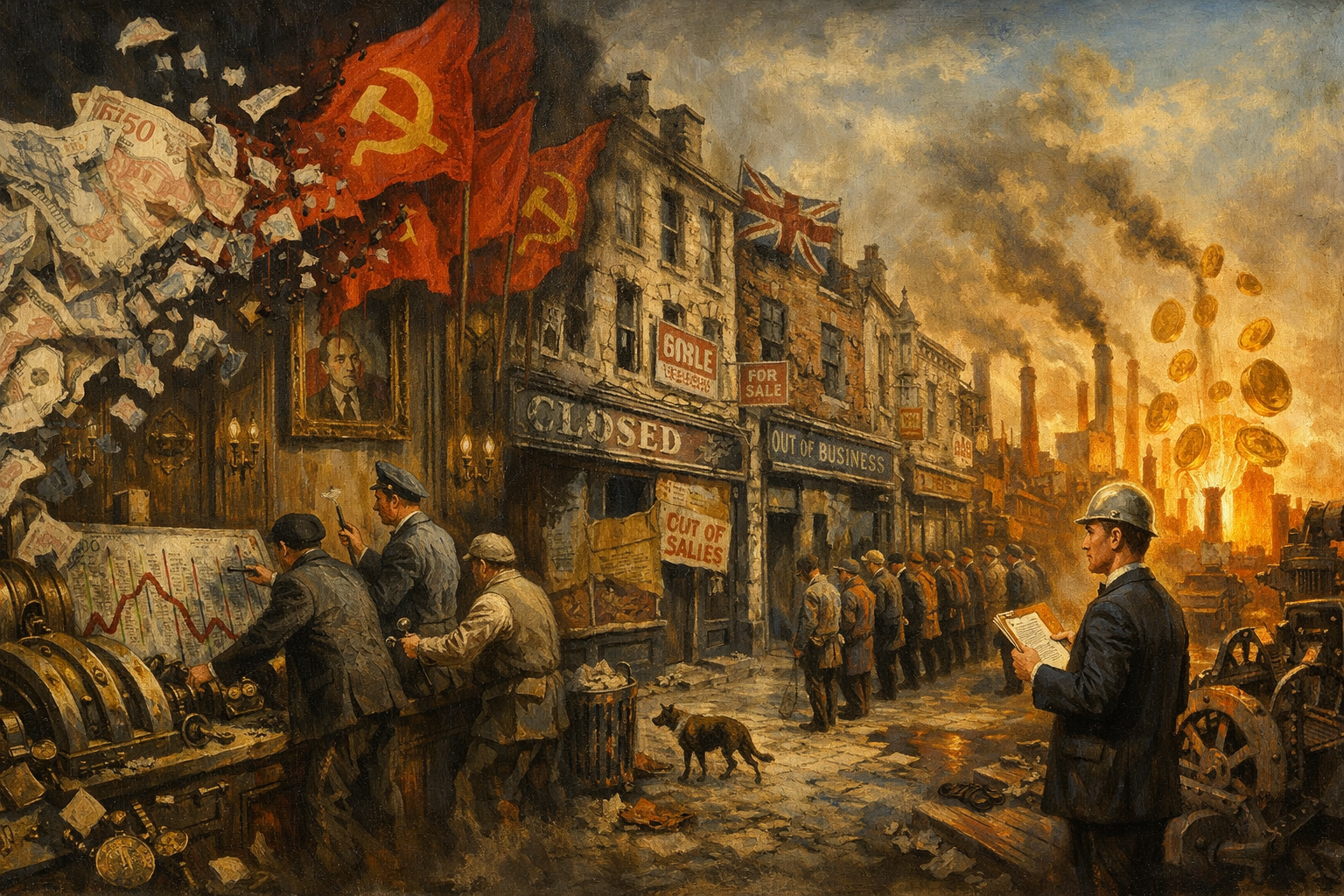
Money collapses, socialism rises. Socialism rises, society wobbles. Society wobbles, capitalism strolls back in wearing a hard hat and carrying a ledger. It is less a Theory than a recurring British pantomime — except nobody enjoys the interval and the popcorn costs £11.
Across the damp archipelago and beyond, the value of money has been quietly sanded down like a Victorian bannister in a rented flat. Official figures insist inflation is “easing”, which in Whitehall dialect means the fire is slightly smaller, but the sofa is still alight. Savers squint at their statements. Pensioners develop a new relationship with supermarket yellow stickers. Young couples perform advanced mathematics in estate agents’ windows and then laugh in the manner of people who have just been told the moon is leasehold.
The collapse of money is rarely theatrical. There are no violins. No mushroom clouds. It is subtler. It arrives as a polite dilution. A quiet confiscation by decimal point. It creeps through wages that do not stretch as far as they did last winter, through mortgages that feel like Victorian punishments, through grocery bills that resemble ransom notes. Currency becomes lighter in the hand, as if someone has replaced it with stage props.
When money weakens, politics does not step back in humility. Politics swells. Socialism, that perennial rescuer of the allegedly downtrodden and occasional strangler of arithmetic, begins to hum like a municipal boiler. The pitch is always familiar: markets have failed; the state must step in; fairness requires management; management requires power; power requires more management.
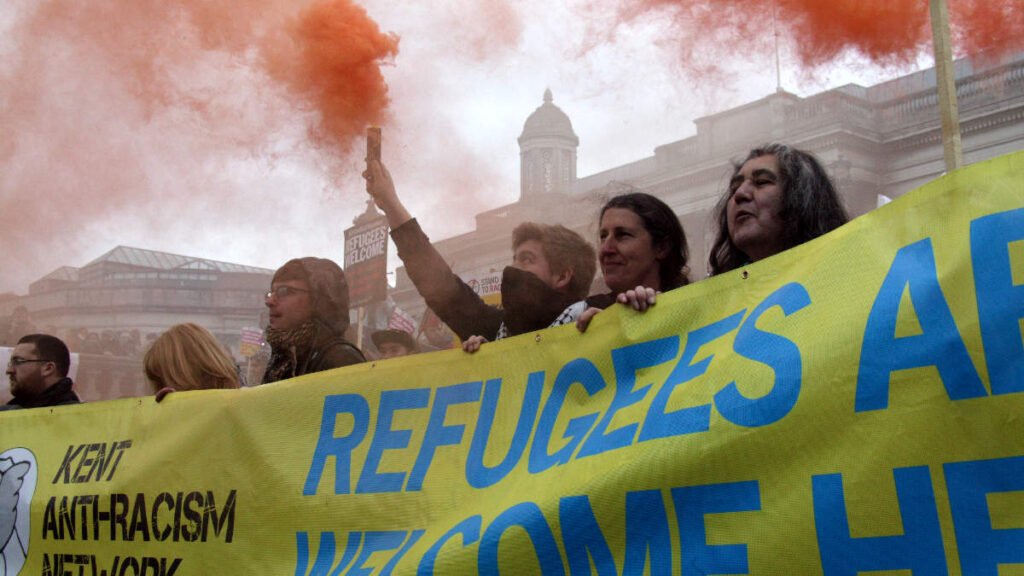
It is a seductive rhythm. When households feel squeezed, they do not demand deregulation manuals. They demand relief. They demand caps, freezes, controls, guarantees. They demand that someone in a high-visibility jacket stand in front of the economic gale and shout “Stop”.
So the machinery whirs into motion. Price controls are floated like patriotic bunting. Windfall taxes are unveiled with theatrical grimness. Nationalisation is discussed with the tone normally reserved for bringing back ration books “just for a bit”. Every problem acquires a lever. Every lever requires a committee. Every committee requires funding. Funding requires money. And money, at this stage, is already wobbling.
Socialism rises not because it is newly brilliant but because it feels emotionally tidy. It offers clarity in a fog of digits. It promises to iron the creases of capitalism with the heavy steam of authority. The slogans write themselves: protect households, stabilise markets, shield the vulnerable. The language is compassionate. The arithmetic is less so.
History, that unglamorous accountant, keeps a careful ledger. When prices are forced below reality, supply quietly packs a suitcase. When profit is treated as moral weakness, investment becomes shy. When risk is punished, innovation becomes cautious. Factories slow. Shops thin out. Builders hesitate. The economy begins to resemble a seaside arcade after the electricity has been turned off, lights dimmed, prizes locked behind glass, the smell of nostalgia lingering.
Society then performs its next predictable act. Shortages arrive not with drama but with inconvenience. Waiting lists lengthen. Quality dips. Black markets appear like weeds through concrete. Those with connections glide; those without queue. The noble intention of equality curdles into the familiar British pastime of form-filling.
And thus the second domino falls. The rise of socialism means one thing: the slow, bureaucratic suffocation of society’s natural pulse. Enterprise becomes paperwork. Ambition becomes permission-seeking. Risk becomes suspect. The culture tilts from “build” to “apply”.
At this stage, the mood changes. It is no longer righteous. It is tired.
The public, being less ideological than political Twitter might suggest, grows weary of grand designs. They want trains that run, bills that settle, wages that feel solid. They want the ordinary miracle of predictability. And when predictability vanishes under layers of well-meaning intervention, patience thins.
Society, when strained long enough, performs a curious pivot. It begins to rediscover the virtues it recently denounced. Words like “incentive” creep back into polite conversation. “Profit” loses its villain moustache. Entrepreneurs, previously regarded as suspiciously cheerful tax units, are invited onto panels to explain how things might function again.
The collapse of society, or at least its efficiency, its confidence, its sense of motion, creates an opening. Into that opening walks capitalism, unglamorous and unromantic, carrying spreadsheets rather than slogans.
Capitalism’s defenders do not promise moral perfection. They promise something plainer: coordination through price, discipline through loss, reward through value creation. They promise that if money means something again, behaviour adjusts accordingly. Savings accumulate. Investment follows. Risk re-enters the room.
The rise of capitalism means two things: the rise of society and the rise of money.
First, society. Not in a utopian fireworks display, but in the quieter renaissance of functionality. When businesses are permitted to earn, they expand. When investors believe returns will not be politically confiscated, they deploy capital. Jobs do not appear because a department authorised them, but because demand did. Shops reopen. Builders build. Inventors invent. Society hums again, not because it was commanded to, but because incentives aligned.
Second, money. Sound money is less glamorous than political theatre, but infinitely more powerful. When currency holds value, planning becomes possible. A pound saved today resembles a pound tomorrow. Pensions stop feeling like roulette. Mortgages return to being agreements rather than rollercoasters. Confidence, that delicate economic hormone, seeps back into circulation.
None of this is mystical. It is behavioural. When the rules are stable, and rewards proportionate, humans create. When rules shift, and rewards are redistributed by whim, humans retreat.
The cycle, of course, is never pure. No modern economy is a cartoon. There are safety nets and regulations, as there must be. The argument is not for Dickensian factories or top hats in counting houses. It is for proportion. For remembering that wealth must be generated before it can be distributed. For recalling that money, debased by enthusiasm for stimulus, cannot indefinitely shoulder the burden of political ambition.
In recent years, central banks have printed with the confidence of people discovering a limitless biscuit tin. Interest rates were pinned near zero as if gravity had been politely suspended. Governments borrowed at peacetime levels that would have startled previous generations. The justification was always urgent. The consequences were always deferred.
Deferred consequences are rarely cancelled. They mature, like unwelcome subscriptions. Inflation, asset bubbles, housing distortions, all bloom in the fertile soil of easy money. When the bloom fades, and citizens discover their wages lagging behind their outgoings, the temptation to reach for socialism intensifies.
It is a cycle powered by disappointment.
But disappointment is not destiny. The collapse of money need not guarantee the rise of socialism. Nor must socialism inevitably flatten society. These are tendencies, not laws of physics. Yet they are tendencies repeated often enough to warrant respect.
The durable lesson is this: money is trust made tangible. When that trust is diluted, politics grows loud. When politics grows loud, markets shrink. When markets shrink, society stiffens. When society stiffens, people remember why markets mattered.
And round it goes, like a British roundabout designed by someone with a fondness for irony.
The more dramatic the collapse of money, the louder the call for control. The more suffocating the control, the stronger the eventual backlash. Capitalism returns not as an ideology but as a remedy, not as a manifesto but as maintenance.
The trick, rarely mastered, is to break the loop before the damage compounds.
Because each revolution of this cycle leaves bruises, savings lost are not abstract. Businesses shuttered do not reopen by nostalgia alone. Skills atrophy. Confidence erodes. The social fabric, that unfashionable but vital weave of trust, effort, and exchange, frays when money ceases to mean anything solid.
When capitalism rises in the aftermath, it often does so amid rubble it did not create but must nonetheless clear.
The collapse of money means one thing; the rise of socialism.
The rise of socialism means one thing: the creaking of society.
The collapse of society means one thing: the return of capitalism.
And the rise of capitalism means two things: the revival of society and the restoration of money.
The tragedy is not the cycle’s existence. The tragedy is the refusal to learn from its repetition.
In the end, economics is less about ideology than incentives. Money that holds value disciplines power. Markets that function discipline excess. Society that thrives requires both.
Without sound money, politics fills the vacuum. Without markets, society stiffens. Without society, capitalism must rebuild what impatience dismantled.
The dominoes are always lined up. The question is whether anyone resists the urge to flick the first one.