Image by Knelstrom Media.
The world’s most peaceful battering ram clears its throat
By Martin Foskett, Reporter
PUBLISHED:
UPDATED:
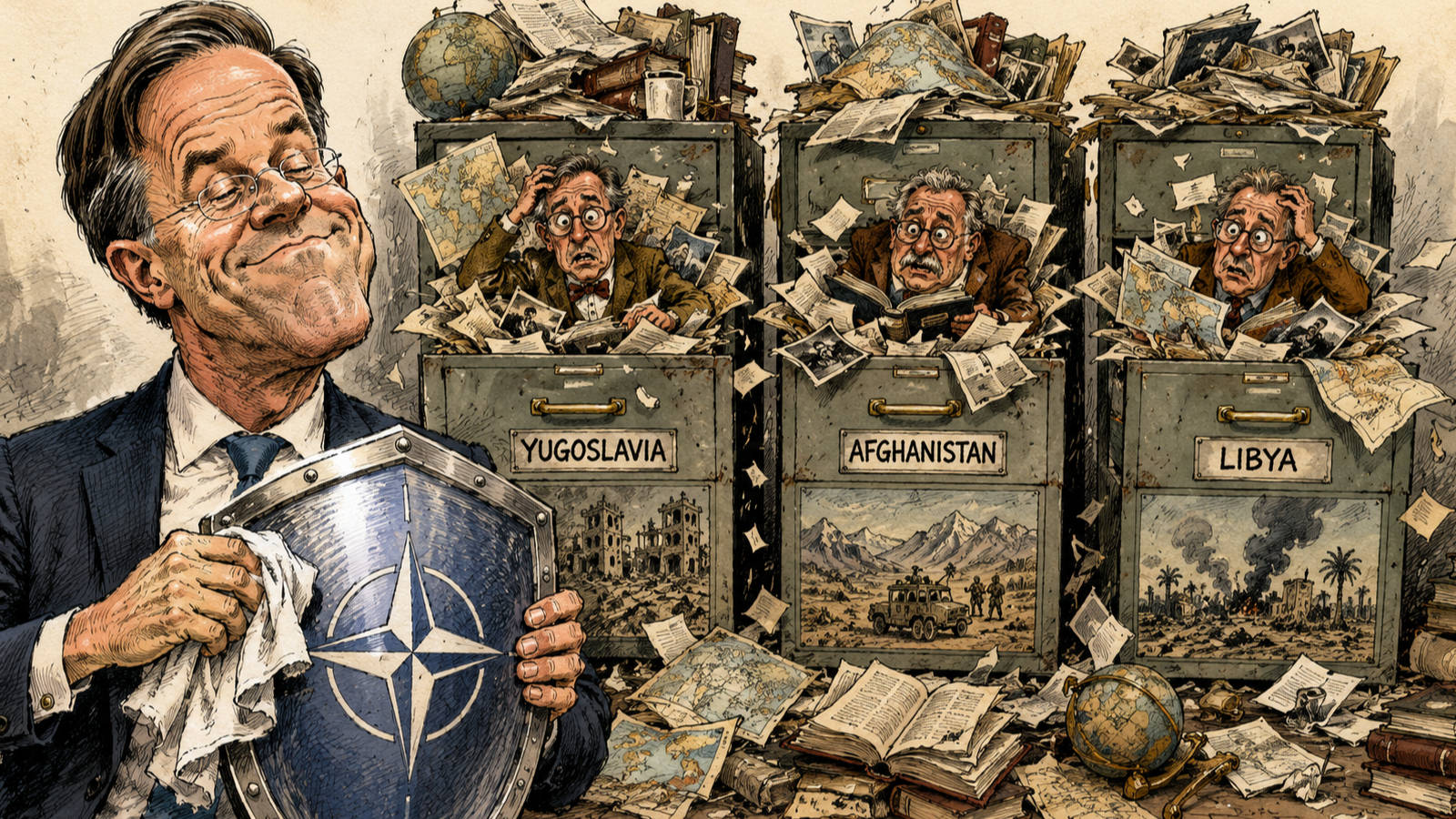
Mark Rutte stood before the microphones and declared that NATO is “a defensive alliance. We will never attack anybody.” It was one of those polished modern political statements that hang in the air with remarkable confidence, as though history has quietly agreed to leave the room for a cup of tea. I found myself mentally leafing through the past instead. Yugoslavia. Afghanistan. Libya. Funny old places to remember if nobody ever attacks anybody.
I have always admired the efficiency with which political slogans are manufactured. They arrive spotless, vacuum-packed, and ready for public consumption. Reality, meanwhile, usually turns up wearing muddy boots and carrying receipts.
Listening to Rutte, I imagined history sitting in the back row, raising eyebrows. It did not interrupt. History rarely bothers. It simply waits.
The phrase “defensive alliance” sounds reassuring. It conjures images of castle walls, watchtowers, nervous sentries peering into the darkness and citizens sleeping peacefully beneath sturdy battlements. Nobody objects to defence. Defence is sensible. Defence is prudent. Defence pays its bills on time.
Then the map begins unfolding.
The irony is that NATO’s original purpose was never especially controversial. It was created in 1949 as a collective defence alliance to deter Soviet expansion into Western Europe. During the Cold War, that mission was clear. Two opposing military blocs glared at one another across Europe and, mercifully, deterrence held.
My own view is that the alliance should have taken its bow when the curtain came down on the Cold War. The Soviet Union collapsed. The Warsaw Pact disappeared. The adversary that had justified NATO’s existence ceased to exist. That looked to me like mission accomplished.
Instead, NATO reinvented itself.
Supporters would say it adapted to a changing world. I would argue its posture fundamentally changed. Rather than existing almost exclusively to defend its members’ territory, it increasingly found itself involved in military operations beyond those borders. That evolution sits at the heart of the debate whenever politicians describe NATO today as though nothing significant changed after 1991.
I drifted first towards Yugoslavia in 1999. NATO’s air campaign against the Federal Republic of Yugoslavia was presented by its members as a humanitarian intervention aimed at stopping ethnic cleansing in Kosovo. Critics argued that the operation lacked explicit authorisation from the United Nations Security Council and questioned both its legality and its consequences. Whatever position one takes, aircraft flew, bombs fell, and military force was used well beyond the territory of NATO member states. That is an awkward memory to squeeze into a slogan polished for television.
Then Afghanistan wandered into view.
Following the terrorist attacks of 11 September 2001, NATO invoked Article 5 for the first time in its history, treating the attacks on the United States as an attack on all members. The alliance later assumed command of the International Security Assistance Force, remaining involved for nearly two decades. The mission evolved repeatedly, from counterterrorism to counterinsurgency, state-building, and military training. Trillions were spent. Thousands died. Governments changed. Governments collapsed. The Taliban eventually returned to power with astonishing speed. One can debate the necessity of the intervention, its objectives or its execution. What cannot seriously be debated is that NATO forces conducted extensive military operations in Afghanistan.
Then came Libya.
In 2011, NATO enforced a United Nations mandate intended to protect civilians during the uprising against Muammar Gaddafi. Supporters argued that intervention prevented a humanitarian catastrophe. Critics maintain that the mission expanded beyond civilian protection to include effective support for regime change, contributing to the years of instability that followed. Again, perspectives differ. Again, bombs were not imaginary.
The awkward thing about history is that it insists on existing even after the press conference has finished.
None of this means NATO was created as an offensive empire. It plainly was not. The alliance emerged during the Cold War as a collective defence pact. That remains its formal purpose. Article 5 still sits at the heart of its identity. It has deterred conflict in Europe for decades, and many member states argue it remains essential given Russia’s invasion of Ukraine and the wider security environment.
Yet institutions are defined not only by founding documents but also by what they actually do.
There is another chapter that often disappears from the official script.
Expansion.
Since the end of the Cold War, NATO has admitted a succession of former Warsaw Pact members and former Soviet republics. Those countries freely sought membership and argued, perfectly understandably, that they wanted the protection and security the alliance offered after decades of Soviet domination.
Russia viewed the process very differently.
For years, successive Russian governments argued that NATO’s steady movement eastwards represented a growing strategic threat. Western governments rejected that claim, insisting sovereign nations have every right to choose their own alliances and that NATO remains defensive.
Whether NATO enlargement enhanced European security or unnecessarily heightened tensions remains one of the defining geopolitical arguments of the post-Cold War era. It is possible to support the right of sovereign nations to choose their alliances while also recognising that the expansion itself became a major source of friction between Russia and the West.
Ignoring that debate does not make it disappear any more than ignoring Yugoslavia, Afghanistan or Libya.
That is where political language becomes wonderfully elastic.
Governments describe military action using remarkably comforting vocabulary. Operations become stabilisation. Bombing campaigns become enforcement. Missiles become precise. Wars become missions. Retreats become transitions. Failures become lessons. Before long, everybody is defending themselves several thousand miles from home.
I have wandered through enough official statements over the years to recognise the familiar perfume. It smells faintly of fresh printer ink, polished lecterns and coffee served in conference centres where everyone wears expressions suggesting they are saving civilisation between scheduled lunch breaks.
Outside those buildings, the world tends to look considerably messier.
The ordinary taxpayer is left funding equipment whose price tags resemble telephone numbers. Defence budgets swell. Contractors flourish. Conferences multiply. Acronyms breed like rabbits. Every crisis somehow requires another strategy paper printed on paper thick enough to survive artillery fire.
Free societies require security. That is beyond dispute. Markets need stability. Businesses need predictable borders. Families need confidence that hostile states cannot simply march across frontiers unchecked. Military alliances exist for reasons that are often entirely understandable.
But confidence is not strengthened by pretending awkward chapters never happened.
If political leaders believe NATO’s post-Cold War transformation was necessary, they should explain why. If they believe Yugoslavia, Afghanistan and Libya were justified uses of military force, then defend those decisions openly. If they believe enlargement strengthened Europe despite the controversy it generated, they should make that case honestly. History can withstand disagreement.
What jars is the sweeping certainty of saying, “We will never attack anybody,” as though decades of military operations and one of the most consequential strategic shifts since the end of the Cold War have somehow slipped through a clerical error.
Words matter because memory matters.
Perhaps that is the curious feature of modern politics. We increasingly live in an age where every statement arrives wrapped in immaculate certainty while the archive quietly mutters from the basement.
I suspect the archive will outlast the slogan.
The filing cabinets never clap. They remain there, gathering dust, waiting patiently for the next confident declaration that yesterday never really happened.
[adinserter name=”Block 1″]