
Knelstrom Intelligence · World Factbook
Serbia
Србија
CapitalBelgrade
Population6,549,143
GDP$100.0bn
Area88,499 km²
RegionEurope & Central Asia
Latest source check will run in the background.
Country facts
Overview
Background
In 1918, the Croats, Serbs, and Slovenes formed a kingdom known after 1929 as Yugoslavia. The monarchy remained in power until 1945, when the communist Partisans headed by Josip Broz (aka TITO) took control of the newly created Socialist Federal Republic of Yugoslavia (SFRY). After TITO died in 1980, communism in Yugoslavia gradually gave way to resurgent nationalism. In 1989, Slobodan MILOSEVIC became president of the Republic of Serbia, and his calls for Serbian domination led to the violent breakup of Yugoslavia along ethnic lines. In 1991, Croatia, Slovenia, and Macedonia declared independence, followed by Bosnia in 1992. The remaining republics of Serbia and Montenegro declared a new Federal Republic of Yugoslavia (FRY) in 1992, and MILOSEVIC led military campaigns to unite ethnic Serbs in neighboring republics into a "Greater Serbia." These actions ultimately failed, and international intervention led to the signing of the Dayton Accords in 1995.
In 1998, an ethnic Albanian insurgency in the formerly autonomous Serbian province of Kosovo resulted in a brutal Serbian counterinsurgency campaign. Serbia rejected a proposed international settlement, and NATO responded with a bombing campaign that forced Serbian forces to withdraw from Kosovo in June 1999. In 2003, the FRY became the State Union of Serbia and Montenegro, a loose federation of the two republics. In 2006, Montenegro seceded and declared itself an independent nation.
In 2008, Kosovo also declared independence -- an action Serbia still refuses to recognize. In 2013, Serbia and Kosovo signed the first agreement of principles governing the normalization of relations between the two countries. Additional agreements were reached in 2015 and 2023, but implementation remains incomplete. Serbia has been an official candidate for EU membership since 2012, and President Aleksandar VUCIC has promoted the ambitious goal of Serbia joining the EU by 2025.
Reference: 2025, 2023, 2015, 2013In 1998, an ethnic Albanian insurgency in the formerly autonomous Serbian province of Kosovo resulted in a brutal Serbian counterinsurgency campaign. Serbia rejected a proposed international settlement, and NATO responded with a bombing campaign that forced Serbian forces to withdraw from Kosovo in June 1999. In 2003, the FRY became the State Union of Serbia and Montenegro, a loose federation of the two republics. In 2006, Montenegro seceded and declared itself an independent nation.
In 2008, Kosovo also declared independence -- an action Serbia still refuses to recognize. In 2013, Serbia and Kosovo signed the first agreement of principles governing the normalization of relations between the two countries. Additional agreements were reached in 2015 and 2023, but implementation remains incomplete. Serbia has been an official candidate for EU membership since 2012, and President Aleksandar VUCIC has promoted the ambitious goal of Serbia joining the EU by 2025.
Geography
Location
Southeastern Europe, between Macedonia and Hungary
Geographic coordinates
44 00 N, 21 00 E
Map references
Europe
Area
total: 77,474 sq km
land: 77,474 sq km
water: 0 sq km
land: 77,474 sq km
water: 0 sq km
Area - comparative
slightly smaller than South Carolina
Land boundaries
total: 2,322 km
border countries: Bosnia and Herzegovina 345 km; Bulgaria 344 km; Croatia 314 km; Hungary 164 km; Kosovo 366 km; North Macedonia 101 km; Montenegro 157 km; Romania 531 km
border countries: Bosnia and Herzegovina 345 km; Bulgaria 344 km; Croatia 314 km; Hungary 164 km; Kosovo 366 km; North Macedonia 101 km; Montenegro 157 km; Romania 531 km
Coastline
0 km (landlocked)
Maritime claims
none (landlocked)
Climate
in the north, continental climate (cold winters and hot, humid summers with well-distributed rainfall); in other parts, continental and Mediterranean climate (relatively cold winters with heavy snowfall and hot, dry summers and autumns)
Terrain
extremely varied; to the north, rich fertile plains; to the east, limestone ranges and basins; to the southeast, ancient mountains and hills
Elevation
highest point: Midzor 2,169 m
lowest point: Danube and Timok Rivers 35 m
mean elevation: 442 m
lowest point: Danube and Timok Rivers 35 m
mean elevation: 442 m
Natural resources
oil, gas, coal, iron ore, copper, zinc, antimony, chromite, gold, silver, magnesium, pyrite, limestone, marble, salt, arable land
Land use
agricultural land: 40.4% (2023 est.)
agricultural land: arable land: arable land: 31% (2023 est.)
agricultural land: permanent crops: permanent crops: 2.5% (2023 est.)
agricultural land: permanent pasture: permanent pasture: 6.6% (2023 est.)
forest: 40.4% (2023 est.)
other: 27.2% (2023 est.)
Reference: 2023agricultural land: arable land: arable land: 31% (2023 est.)
agricultural land: permanent crops: permanent crops: 2.5% (2023 est.)
agricultural land: permanent pasture: permanent pasture: 6.6% (2023 est.)
forest: 40.4% (2023 est.)
other: 27.2% (2023 est.)
Irrigated land
550 sq km (2022)
Reference: 2022Major rivers (by length in km)
Dunav (Danube) (shared with Germany [s], Austria, Slovakia, Hungary, Croatia, Bulgaria, Ukraine, Moldova, and Romania [m]) - 2,888 km
note: [s] after country name indicates river source; [m] after country name indicates river mouth
note: [s] after country name indicates river source; [m] after country name indicates river mouth
Major watersheds (area sq km)
Atlantic Ocean drainage: (Black Sea) Danube (795,656 sq km)
Population distribution
a fairly even distribution throughout most of the country, with urban areas attracting larger and denser populations
Natural hazards
destructive earthquakes
Geography - note
landlocked; controls one of the major land routes from Western Europe to Turkey and the Near East
Population & Society
Nationality
noun: Serb(s)
adjective: Serbian
adjective: Serbian
Ethnic groups
Serb 83.3%, Hungarian 3.5%, Romani 2.1%, Bosniak 2%, other 5.7%, undeclared or unknown 3.4% (2011 est.)
note: note: most ethnic Albanians boycotted the 2011 census; Romani populations are usually underestimated in official statistics and may represent 5–11% of Serbia's population
Reference: 2011note: note: most ethnic Albanians boycotted the 2011 census; Romani populations are usually underestimated in official statistics and may represent 5–11% of Serbia's population
Languages
Languages: Serbian (official) 88.1%, Hungarian 3.4%, Bosnian 1.9%, Romani 1.4%, other 3.4%, undeclared or unknown 1.8% (2011 est.)
major-language sample(s): Knjiga svetskih činjenica, neophodan izvor osnovnih informacija. (Serbian)
The World Factbook, the indispensable source for basic information.
note: note: Serbian, Hungarian, Slovak, Romanian, Croatian, and Ruthenian (Rusyn) are official in the Autonomous Province of Vojvodina; most ethnic Albanians boycotted the 2011 census
Reference: 2011major-language sample(s): Knjiga svetskih činjenica, neophodan izvor osnovnih informacija. (Serbian)
The World Factbook, the indispensable source for basic information.
note: note: Serbian, Hungarian, Slovak, Romanian, Croatian, and Ruthenian (Rusyn) are official in the Autonomous Province of Vojvodina; most ethnic Albanians boycotted the 2011 census
Religions
Orthodox 84.6%, Catholic 5%, Muslim 3.1%, Protestant 1%, atheist 1.1%, other 0.8% (includes agnostics, other Christians, Eastern, Jewish), undeclared or unknown 4.5% (2011 est.)
note: note: most ethnic Albanians boycotted the 2011 census
Reference: 2011note: note: most ethnic Albanians boycotted the 2011 census
Age structure
0-14 years: 14.4% (male 492,963/female 463,995)
15-64 years: 65.6% (male 2,198,591/female 2,168,113)
65 years and over: 20% (2024 est.) (male 551,197/female 777,353)
Reference: 202415-64 years: 65.6% (male 2,198,591/female 2,168,113)
65 years and over: 20% (2024 est.) (male 551,197/female 777,353)
Dependency ratios
total dependency ratio: 52.3 (2024 est.)
youth dependency ratio: 21.9 (2024 est.)
elderly dependency ratio: 30.4 (2024 est.)
potential support ratio: 3.3 (2024 est.)
Reference: 2024youth dependency ratio: 21.9 (2024 est.)
elderly dependency ratio: 30.4 (2024 est.)
potential support ratio: 3.3 (2024 est.)
Median age
total: 43.9 years (2024 est.)
male: 42.4 years
female: 45.4 years
Reference: 2024male: 42.4 years
female: 45.4 years
Population growth rate
-0.61% (2024 est.)
Reference: 2024Birth rate
8.8 births/1,000 population (2024 est.)
Reference: 2024Death rate
14.9 deaths/1,000 population (2024 est.)
Reference: 2024Net migration rate
0 migrant(s)/1,000 population (2024 est.)
Reference: 2024Population distribution
a fairly even distribution throughout most of the country, with urban areas attracting larger and denser populations
Major urban areas - population
1.408 million BELGRADE (capital) (2023)
Reference: 2023Sex ratio
at birth: 1.06 male(s)/female
0-14 years: 1.06 male(s)/female
15-64 years: 1.01 male(s)/female
65 years and over: 0.71 male(s)/female
total population: 0.95 male(s)/female (2024 est.)
Reference: 20240-14 years: 1.06 male(s)/female
15-64 years: 1.01 male(s)/female
65 years and over: 0.71 male(s)/female
total population: 0.95 male(s)/female (2024 est.)
Mother's mean age at first birth
28.2 years (2020 est.)
note: note: data does not cover Kosovo or Metohija
Reference: 2020note: note: data does not cover Kosovo or Metohija
Maternal mortality ratio
11 deaths/100,000 live births (2023 est.)
Reference: 2023Gross reproduction rate
0.71 (2024 est.)
Reference: 2024Drinking water source
improved: urban: urban: 95.4% of population (2022 est.)
improved: rural: rural: 96.1% of population (2022 est.)
improved: total: total: 95.7% of population (2022 est.)
unimproved: urban: urban: 4.6% of population (2022 est.)
unimproved: rural: rural: 3.9% of population (2022 est.)
unimproved: total: total: 4.3% of population (2022 est.)
Reference: 2022improved: rural: rural: 96.1% of population (2022 est.)
improved: total: total: 95.7% of population (2022 est.)
unimproved: urban: urban: 4.6% of population (2022 est.)
unimproved: rural: rural: 3.9% of population (2022 est.)
unimproved: total: total: 4.3% of population (2022 est.)
Health expenditure
Health expenditure (as % of GDP): 10% of GDP (2021)
Health expenditure (as % of national budget): 13.7% of national budget (2022 est.)
Reference: 2022, 2021Health expenditure (as % of national budget): 13.7% of national budget (2022 est.)
Physician density
3.1 physicians/1,000 population (2022)
Reference: 2022Hospital bed density
5.4 beds/1,000 population (2020 est.)
Reference: 2020Sanitation facility access
improved: urban: urban: 99.7% of population (2022 est.)
improved: rural: rural: 95.6% of population (2022 est.)
improved: total: total: 97.9% of population (2022 est.)
unimproved: urban: urban: 0.3% of population (2022 est.)
unimproved: rural: rural: 4.4% of population (2022 est.)
unimproved: total: total: 2.1% of population (2022 est.)
Reference: 2022improved: rural: rural: 95.6% of population (2022 est.)
improved: total: total: 97.9% of population (2022 est.)
unimproved: urban: urban: 0.3% of population (2022 est.)
unimproved: rural: rural: 4.4% of population (2022 est.)
unimproved: total: total: 2.1% of population (2022 est.)
Obesity - adult prevalence rate
21.5% (2016)
Reference: 2016Alcohol consumption per capita
total: 7.45 liters of pure alcohol (2019 est.)
beer: 3.24 liters of pure alcohol (2019 est.)
wine: 1.62 liters of pure alcohol (2019 est.)
spirits: 2.37 liters of pure alcohol (2019 est.)
other alcohols: 0.22 liters of pure alcohol (2019 est.)
Reference: 2019beer: 3.24 liters of pure alcohol (2019 est.)
wine: 1.62 liters of pure alcohol (2019 est.)
spirits: 2.37 liters of pure alcohol (2019 est.)
other alcohols: 0.22 liters of pure alcohol (2019 est.)
Tobacco use
total: 36% (2025 est.)
male: 37.8% (2025 est.)
female: 34.5% (2025 est.)
male: 37.8% (2025 est.)
female: 34.5% (2025 est.)
Children under the age of 5 years underweight
1% (2019 est.)
Reference: 2019Currently married women (ages 15-49)
60.8% (2023 est.)
Reference: 2023Child marriage
women married by age 15: 1.2% (2019)
women married by age 18: 5.5% (2019)
Reference: 2019women married by age 18: 5.5% (2019)
School life expectancy (primary to tertiary education)
total: 15 years (2022 est.)
male: 14 years (2022 est.)
female: 16 years (2022 est.)
Reference: 2022male: 14 years (2022 est.)
female: 16 years (2022 est.)
Migration & Displacement
Immigrant/emigrant stock measures the number of international migrants resident in, or originating from, the country; it is not the same as annual immigration/emigration flows.
Net migration rate
0 migrant(s)/1,000 population (2024 est.)
Reference: 2024Refugees and internally displaced persons
refugees: 36,270 (2024 est.)
IDPs: 194,171 (2024 est.)
stateless persons: 1,715 (2024 est.)
Reference: 2024IDPs: 194,171 (2024 est.)
stateless persons: 1,715 (2024 est.)
Government & Politics
| Office | Holder | Affiliation | From | Status | Evidence |
|---|---|---|---|---|---|
| Head of state | Aleksandar Vučić | — | 2017-05-31 | Current | Reported |
Country name
conventional long form: Republic of Serbia
conventional short form: Serbia
local long form: Republika Srbija
local short form: Srbija
former: People's Republic of Serbia, Socialist Republic of Serbia
etymology: the country takes its name from the Serb people; the origin of their name is unclear but may derive from the Caucasian root word ser, meaning "man"
conventional short form: Serbia
local long form: Republika Srbija
local short form: Srbija
former: People's Republic of Serbia, Socialist Republic of Serbia
etymology: the country takes its name from the Serb people; the origin of their name is unclear but may derive from the Caucasian root word ser, meaning "man"
Government type
parliamentary republic
Capital
name: Belgrade (Beograd)
geographic coordinates: 44 50 N, 20 30 E
time difference: UTC+1 (6 hours ahead of Washington, DC, during Standard Time)
daylight saving time: +1hr, begins last Sunday in March; ends last Sunday in October
etymology: the name comes from the Serbian words beo (white) and grad (city); it probably referred to the white stone of the city fortress
geographic coordinates: 44 50 N, 20 30 E
time difference: UTC+1 (6 hours ahead of Washington, DC, during Standard Time)
daylight saving time: +1hr, begins last Sunday in March; ends last Sunday in October
etymology: the name comes from the Serbian words beo (white) and grad (city); it probably referred to the white stone of the city fortress
Administrative divisions
117 municipalities (opstine, singular - opstina) and 28 cities (gradovi, singular - grad)
municipalities: Ada*, Aleksandrovac, Aleksinac, Alibunar*, Apatin*, Arandelovac, Arilje, Babusnica, Bac*, Backa Palanka*, Backa Topola*, Backi Petrovac*, Bajina Basta, Batocina, Becej*, Bela Crkva*, Bela Palanka, Beocin*, Blace, Bogatic, Bojnik, Boljevac, Bosilegrad, Brus, Bujanovac, Cajetina, Cicevac, Coka*, Crna Trava, Cuprija, Despotovac, Dimitrov, Doljevac, Gadzin Han, Golubac, Gornji Milanovac, Indija*, Irig*, Ivanjica, Kanjiza*, Kladovo, Knic, Knjazevac, Koceljeva, Kosjeric, Kovacica*, Kovin*, Krupanj, Kucevo, Kula*, Kursumlija, Lajkovac, Lapovo, Lebane, Ljig, Ljubovija, Lucani, Majdanpek, Mali Idos*, Mali Zvornik, Malo Crnice, Medveda, Merosina, Mionica, Negotin, Nova Crnja*, Nova Varos, Novi Becej*, Novi Knezevac*, Odzaci*, Opovo*, Osecina, Paracin, Pecinci*, Petrovac na Mlavi, Plandiste*, Pozega, Presevo, Priboj, Prijepolje, Raca, Raska, Razanj, Rekovac, Ruma*, Secanj*, Senta*, Sid*, Sjenica, Smederevska Palanka, Sokobanja, Srbobran*, Sremski Karlovci*, Stara Pazova*, Surdulica, Svilajnac, Svrljig, Temerin*, Titel*, Topola, Trgoviste, Trstenik, Tutin, Ub, Varvarin, Velika Plana, Veliko Gradiste, Vladicin Han, Vladimirci, Vlasotince, Vrbas*, Vrnjacka Banja, Zabalj*, Zabari, Zagubica, Zitiste*, Zitorada
cities: Beograd (Belgrade), Bor, Cacak, Jagodina, Kikinda*, Kragujevac, Kraljevo, Krusevac, Leskovac, Loznica, Nis, Novi Pazar, Novi Sad*, Pancevo*, Pirot, Pozarevac, Prokuplje, Sabac, Smederevo, Sombor*, Sremska Mitrovica*, Subotica*, Uzice, Valjevo, Vranje, Vrsac*, Zajecar, Zrenjanin*
note: note: the northern 37 municipalities and 8 cities -- about 28% of Serbia's area -- compose the Autonomous Province of Vojvodina and are indicated with an asterisk
municipalities: Ada*, Aleksandrovac, Aleksinac, Alibunar*, Apatin*, Arandelovac, Arilje, Babusnica, Bac*, Backa Palanka*, Backa Topola*, Backi Petrovac*, Bajina Basta, Batocina, Becej*, Bela Crkva*, Bela Palanka, Beocin*, Blace, Bogatic, Bojnik, Boljevac, Bosilegrad, Brus, Bujanovac, Cajetina, Cicevac, Coka*, Crna Trava, Cuprija, Despotovac, Dimitrov, Doljevac, Gadzin Han, Golubac, Gornji Milanovac, Indija*, Irig*, Ivanjica, Kanjiza*, Kladovo, Knic, Knjazevac, Koceljeva, Kosjeric, Kovacica*, Kovin*, Krupanj, Kucevo, Kula*, Kursumlija, Lajkovac, Lapovo, Lebane, Ljig, Ljubovija, Lucani, Majdanpek, Mali Idos*, Mali Zvornik, Malo Crnice, Medveda, Merosina, Mionica, Negotin, Nova Crnja*, Nova Varos, Novi Becej*, Novi Knezevac*, Odzaci*, Opovo*, Osecina, Paracin, Pecinci*, Petrovac na Mlavi, Plandiste*, Pozega, Presevo, Priboj, Prijepolje, Raca, Raska, Razanj, Rekovac, Ruma*, Secanj*, Senta*, Sid*, Sjenica, Smederevska Palanka, Sokobanja, Srbobran*, Sremski Karlovci*, Stara Pazova*, Surdulica, Svilajnac, Svrljig, Temerin*, Titel*, Topola, Trgoviste, Trstenik, Tutin, Ub, Varvarin, Velika Plana, Veliko Gradiste, Vladicin Han, Vladimirci, Vlasotince, Vrbas*, Vrnjacka Banja, Zabalj*, Zabari, Zagubica, Zitiste*, Zitorada
cities: Beograd (Belgrade), Bor, Cacak, Jagodina, Kikinda*, Kragujevac, Kraljevo, Krusevac, Leskovac, Loznica, Nis, Novi Pazar, Novi Sad*, Pancevo*, Pirot, Pozarevac, Prokuplje, Sabac, Smederevo, Sombor*, Sremska Mitrovica*, Subotica*, Uzice, Valjevo, Vranje, Vrsac*, Zajecar, Zrenjanin*
note: note: the northern 37 municipalities and 8 cities -- about 28% of Serbia's area -- compose the Autonomous Province of Vojvodina and are indicated with an asterisk
Legal system
civil law system
Constitution
history: many previous; latest adopted 30 September 2006, approved by referendum 28-29 October 2006, effective 8 November 2006
amendment process: proposed by at least one third of deputies in the National Assembly, by the president of the republic, by the government, or by petition of at least 150,000 voters; passage of proposals and draft amendments each requires at least two-thirds majority vote in the Assembly; amendments to constitutional articles including the preamble, constitutional principles, and human and minority rights and freedoms also require passage by simple majority vote in a referendum
Reference: 2006amendment process: proposed by at least one third of deputies in the National Assembly, by the president of the republic, by the government, or by petition of at least 150,000 voters; passage of proposals and draft amendments each requires at least two-thirds majority vote in the Assembly; amendments to constitutional articles including the preamble, constitutional principles, and human and minority rights and freedoms also require passage by simple majority vote in a referendum
International law organization participation
has not submitted an ICJ jurisdiction declaration; accepts ICCt jurisdiction
Citizenship
citizenship by birth: no
citizenship by descent only: at least one parent must be a citizen of Serbia
dual citizenship recognized: yes
residency requirement for naturalization: 3 years
citizenship by descent only: at least one parent must be a citizen of Serbia
dual citizenship recognized: yes
residency requirement for naturalization: 3 years
Suffrage
18 years of age, 16 if employed; universal
Executive branch
chief of state: President Aleksandar VUCIC (since 31 May 2017)
head of government: Prime Minister Djuro MACUT (since 16 April 2025)
cabinet: Cabinet elected by the National Assembly
election/appointment process: president directly elected by absolute-majority popular vote in 2 rounds, if needed, for a 5-year term (eligible for a second term); prime minister elected by the National Assembly
most recent election date: 17 December 2023
election results: 2022: Aleksandar VUCIC reelected in first round; percent of vote - Aleksandar VUCIC (SNS) 60%, Zdravko PONOS (US) 18.9%, Milos JOVANOVIC (NADA) 6.1%, Bosko OBRADOVIC (Dveri-POKS) 4.5%, Milica DJURDJEVIC STAMENKOVSKI (SSZ) 4.3%, other 6.2%
2017: Aleksandar VUCIC elected president in first round; percent of vote - Aleksandar VUCIC (SNS) 55.1%, Sasa JANKOVIC (independent) 16.4%, Luka MAKSIMOVIC (independent) 9.4%, Vuk JEREMIC (independent) 5.7%, Vojislav SESELJ (SRS) 4.5%, other 7.3%, invalid/blank 1.6%; Prime Minister Ana BRNABIC reelected by the National Assembly on 5 October 2020; National Assembly vote - NA
expected date of next election: 2028
Reference: 2028, 2025, 2023, 2022head of government: Prime Minister Djuro MACUT (since 16 April 2025)
cabinet: Cabinet elected by the National Assembly
election/appointment process: president directly elected by absolute-majority popular vote in 2 rounds, if needed, for a 5-year term (eligible for a second term); prime minister elected by the National Assembly
most recent election date: 17 December 2023
election results: 2022: Aleksandar VUCIC reelected in first round; percent of vote - Aleksandar VUCIC (SNS) 60%, Zdravko PONOS (US) 18.9%, Milos JOVANOVIC (NADA) 6.1%, Bosko OBRADOVIC (Dveri-POKS) 4.5%, Milica DJURDJEVIC STAMENKOVSKI (SSZ) 4.3%, other 6.2%
2017: Aleksandar VUCIC elected president in first round; percent of vote - Aleksandar VUCIC (SNS) 55.1%, Sasa JANKOVIC (independent) 16.4%, Luka MAKSIMOVIC (independent) 9.4%, Vuk JEREMIC (independent) 5.7%, Vojislav SESELJ (SRS) 4.5%, other 7.3%, invalid/blank 1.6%; Prime Minister Ana BRNABIC reelected by the National Assembly on 5 October 2020; National Assembly vote - NA
expected date of next election: 2028
Legislative branch
legislature name: National Assembly (Narodna skupstina)
legislative structure: unicameral
number of seats: 250 (all directly elected)
electoral system: proportional representation
scope of elections: full renewal
term in office: 4 years
most recent election date: 12/17/2023
parties elected and seats per party: Aleksandar Vucic – Serbia Must Not Stop (129); Serbia Against Violence (65); Ivica Dacic - Prime Minister of Serbia (18); Dr Miloš Jovanović - Hope for Serbia (13); We – Voice of the People, Prof. Dr. Branimir Nestorovic (13); Other (12)
percentage of women in chamber: 37.2%
expected date of next election: December 2027
Reference: 2027, 2023legislative structure: unicameral
number of seats: 250 (all directly elected)
electoral system: proportional representation
scope of elections: full renewal
term in office: 4 years
most recent election date: 12/17/2023
parties elected and seats per party: Aleksandar Vucic – Serbia Must Not Stop (129); Serbia Against Violence (65); Ivica Dacic - Prime Minister of Serbia (18); Dr Miloš Jovanović - Hope for Serbia (13); We – Voice of the People, Prof. Dr. Branimir Nestorovic (13); Other (12)
percentage of women in chamber: 37.2%
expected date of next election: December 2027
Judicial branch
highest court(s): Supreme Court of Cassation (consists of 36 judges, including the court president); Constitutional Court (consists of 15 judges, including the court president and vice president)
judge selection and term of office: Supreme Court justices proposed by the High Judicial Council (HJC), an 11-member independent body consisting of 8 judges elected by the National Assembly and 3 ex-officio members; justices appointed by the National Assembly; Constitutional Court judges elected - 5 each by the National Assembly, the president, and the Supreme Court of Cassation; initial appointment of Supreme Court judges by the HJC is 3 years and beyond that period tenure is permanent; Constitutional Court judges elected for 9-year terms
subordinate courts: basic courts, higher courts, appellate courts; courts of special jurisdiction include the Administrative Court, commercial courts, and misdemeanor courts
judge selection and term of office: Supreme Court justices proposed by the High Judicial Council (HJC), an 11-member independent body consisting of 8 judges elected by the National Assembly and 3 ex-officio members; justices appointed by the National Assembly; Constitutional Court judges elected - 5 each by the National Assembly, the president, and the Supreme Court of Cassation; initial appointment of Supreme Court judges by the HJC is 3 years and beyond that period tenure is permanent; Constitutional Court judges elected for 9-year terms
subordinate courts: basic courts, higher courts, appellate courts; courts of special jurisdiction include the Administrative Court, commercial courts, and misdemeanor courts
Political parties
Alliance of Vojvodina Hungarians or SVM or VMSZ
Democratic Alliance of Croats in Vojvodina or DSHV
Democratic Party or DS
Ecological Uprising or EU
Green - Left Front or ZLF
Greens of Serbia or ZS
Justice and Reconciliation Party or SPP (formerly Bosniak Democratic Union of Sandzak or BDZS)
Movement for Reversal or PZP
Movement for the Restoration of the Kingdom of Serbia or POKS
Movement of Free Citizens or PSG
Movement of Socialists or PS
National Democratic Alternative or NADA (electoral coalition includes NDSS and POKS)
New Communist Party of Yugoslavia or NKPJ
New Democratic Party of Serbia or NDSS or New DSS (formerly Democratic Party of Serbia or DSS)
New Face of Serbia or NLS
Party of Democratic Action of the Sandzak or SDAS
Party of Freedom and Justice or SSP
Party of United Pensioners, Farmers, and Proletarians of Serbia – Solidarity and Justice or PUPS - Solidarity and Justice (formerly Party of United Pensioners of Serbia or PUPS)
People's Movement of Serbia or NPS
People's Movement of Serbs from Kosovo and Metohija or Fatherland
People's Peasant Party or NSS
Political Battle of the Albanians Continues
Russian Party or RS
Serbia Against Violence or SPN (electoral coalition includes DS, SSP, ZLF, Zajedno, NPS, PSG, EU, PZP, USS Sloga, NLS, Fatherland)
Serbia Must Not Stop (electoral coalitions includes SNS, SDPS, PUPS, PSS, SNP, SPO, PS, NSS, USS)
Serbian People's Party or SNP
Serbian Progressive Party or SNS
Serbian Renewal Movement or SPO
Social Democratic Party of Serbia or SDPS
Socialist Party of Serbia or SPS
Strength of Serbia or PSS
Together or ZAJEDNO
United Peasant Party or USS
United Serbia or JS
United Trade Unions of Serbia "Sloga" or USS Sloga
We - The Voice from the People or MI-GIN
Democratic Alliance of Croats in Vojvodina or DSHV
Democratic Party or DS
Ecological Uprising or EU
Green - Left Front or ZLF
Greens of Serbia or ZS
Justice and Reconciliation Party or SPP (formerly Bosniak Democratic Union of Sandzak or BDZS)
Movement for Reversal or PZP
Movement for the Restoration of the Kingdom of Serbia or POKS
Movement of Free Citizens or PSG
Movement of Socialists or PS
National Democratic Alternative or NADA (electoral coalition includes NDSS and POKS)
New Communist Party of Yugoslavia or NKPJ
New Democratic Party of Serbia or NDSS or New DSS (formerly Democratic Party of Serbia or DSS)
New Face of Serbia or NLS
Party of Democratic Action of the Sandzak or SDAS
Party of Freedom and Justice or SSP
Party of United Pensioners, Farmers, and Proletarians of Serbia – Solidarity and Justice or PUPS - Solidarity and Justice (formerly Party of United Pensioners of Serbia or PUPS)
People's Movement of Serbia or NPS
People's Movement of Serbs from Kosovo and Metohija or Fatherland
People's Peasant Party or NSS
Political Battle of the Albanians Continues
Russian Party or RS
Serbia Against Violence or SPN (electoral coalition includes DS, SSP, ZLF, Zajedno, NPS, PSG, EU, PZP, USS Sloga, NLS, Fatherland)
Serbia Must Not Stop (electoral coalitions includes SNS, SDPS, PUPS, PSS, SNP, SPO, PS, NSS, USS)
Serbian People's Party or SNP
Serbian Progressive Party or SNS
Serbian Renewal Movement or SPO
Social Democratic Party of Serbia or SDPS
Socialist Party of Serbia or SPS
Strength of Serbia or PSS
Together or ZAJEDNO
United Peasant Party or USS
United Serbia or JS
United Trade Unions of Serbia "Sloga" or USS Sloga
We - The Voice from the People or MI-GIN
Diplomatic representation in the US
chief of mission: Ambassador Dragan ŠUTANOVAC (since 24 July 2025)
chancery: 1333 16th Street, NW Washington, D.C. 20036
telephone: [1] (202) 507-8654
FAX: [1] (202) 332-3933
email address and website: info@serbiaembusa.org
http://www.washington.mfa.gov.rs/
consulate(s) general: Chicago, New York
chancery: 1333 16th Street, NW Washington, D.C. 20036
telephone: [1] (202) 507-8654
FAX: [1] (202) 332-3933
email address and website: info@serbiaembusa.org
http://www.washington.mfa.gov.rs/
consulate(s) general: Chicago, New York
Diplomatic representation from the US
chief of mission: Ambassador (vacant); Chargé d’Affaires Alexander TITOLO (since January 2025)
embassy: 92 Bulevar kneza Aleksandra Karadjordjevica, 11040 Belgrade
mailing address: 5070 Belgrade Place, Washington, DC 20521-5070
telephone: [381] (11) 706-4000
FAX: [381] (11) 706-4481
email address and website: belgradeacs@state.gov
https://rs.usembassy.gov/
embassy: 92 Bulevar kneza Aleksandra Karadjordjevica, 11040 Belgrade
mailing address: 5070 Belgrade Place, Washington, DC 20521-5070
telephone: [381] (11) 706-4000
FAX: [381] (11) 706-4481
email address and website: belgradeacs@state.gov
https://rs.usembassy.gov/
International organization participation
BIS, BSEC, CD, CE, CEI, EAPC, EBRD, EU (candidate country), FAO, G-9, IAEA, IBRD, ICAO, ICC (national committees), ICCt, ICRM, IDA, IFC, IFRCS, IHO, ILO, IMF, IMO, IMSO, Interpol, IOC, IOM, IPU, ISO, ITSO, ITU, ITUC (NGOs), MIGA, MONUSCO, NAM (observer), NSG, OAS (observer), OIF (observer), OPCW, OSCE, PCA, PFP, SELEC, UN, UNCTAD, UNESCO, UNFICYP, UNHCR, UNIDO, UNIFIL, UNMIL, UNOCI, UNTSO, UNWTO, UPU, WCO, WHO, WIPO, WMO, WTO (observer)
note: note: Serbia is an EU candidate country and must complete accession criteria before being granted full membership
note: note: Serbia is an EU candidate country and must complete accession criteria before being granted full membership
Independence
5 June 2006 (from the State Union of Serbia and Montenegro); notable earlier dates: 1217 (Serbian Kingdom established); 16 April 1346 (Serbian Empire established); 13 July 1878 (Congress of Berlin recognizes Serbian independence); 1 December 1918 (Kingdom of Serbs, Croats, and Slovenes established, later known as Yugoslavia)
Reference: 2006, 1918National holiday
Statehood Day, 15 February (1835), the day the first constitution of the country was adopted
Flag
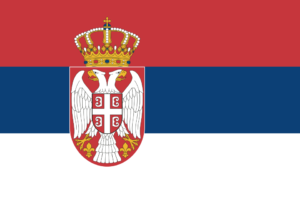
description: three equal horizontal stripes of red (top), blue, and white; the national coat of arms is shifted to the left side; the principal field of the coat of arms displays a two-headed white eagle on a red shield; a smaller red shield on the eagle is divided into four quarters by a white cross; a royal crown is on top of the coat of arms
meaning: red, blue, and white are the pan-Slav colors that represent freedom and revolutionary ideals; the eagle on a red shield represents the government; the smaller shield represents the country; the meaning and origin of the curved white symbols in each quarter are not clear
note: note: the pan-Slav colors were inspired by Russia's flag
meaning: red, blue, and white are the pan-Slav colors that represent freedom and revolutionary ideals; the eagle on a red shield represents the government; the smaller shield represents the country; the meaning and origin of the curved white symbols in each quarter are not clear
note: note: the pan-Slav colors were inspired by Russia's flag
National symbol(s)
white double-headed eagle
National color(s)
red, blue, white
National anthem(s)
title: "Boze pravde" (God of Justice)
lyrics/music: Jovan DORDEVIC/Davorin JENKO
history: adopted 1904; song originally written as part of a play in 1872, and the Serbian people have used it as an anthem in the 20th and 21st centuries
Reference: 1904lyrics/music: Jovan DORDEVIC/Davorin JENKO
history: adopted 1904; song originally written as part of a play in 1872, and the Serbian people have used it as an anthem in the 20th and 21st centuries
National heritage
total World Heritage Sites: 4 (all cultural)
selected World Heritage Site locales: Stari Ras and Sopoćani; Studenica Monastery; Gamzigrad-Romuliana, Palace of Galerius; Stećci Medieval Tombstone Graveyards
selected World Heritage Site locales: Stari Ras and Sopoćani; Studenica Monastery; Gamzigrad-Romuliana, Palace of Galerius; Stećci Medieval Tombstone Graveyards
Government & Official Links
| Institution | Official website | X / Twitter | Verification |
|---|---|---|---|
| Serbia official website | Official website | — | Reported · source Checked September 20, 2026 |
Institutional accounts only; personal accounts of political office-holders are excluded.
Legislature & Elections
Legislature
| Name | Chamber | Seats | Electoral system |
|---|---|---|---|
| National Assembly of Serbia | — | 250 | — |
Economy
Economic overview
upper middle-income Balkan economy; current EU accession candidate; hit by COVID-19; pursuing green growth development; manageable public debt; new anticorruption efforts; falling unemployment; historic Russian relations; energy import-dependent
Real GDP (purchasing power parity)
Real GDP (purchasing power parity) 2024: $177.093 billion (2024 est.)
Real GDP (purchasing power parity) 2023: $170.482 billion (2023 est.)
Real GDP (purchasing power parity) 2022: $164.166 billion (2022 est.)
note: note: data in 2021 dollars
Reference: 2024, 2023, 2022, 2021Real GDP (purchasing power parity) 2023: $170.482 billion (2023 est.)
Real GDP (purchasing power parity) 2022: $164.166 billion (2022 est.)
note: note: data in 2021 dollars
Real GDP per capita
Real GDP per capita 2024: $26,900 (2024 est.)
Real GDP per capita 2023: $25,700 (2023 est.)
Real GDP per capita 2022: $24,600 (2022 est.)
note: note: data in 2021 dollars
Reference: 2024, 2023, 2022, 2021Real GDP per capita 2023: $25,700 (2023 est.)
Real GDP per capita 2022: $24,600 (2022 est.)
note: note: data in 2021 dollars
GDP - composition, by sector of origin
agriculture: 3.1% (2024 est.)
industry: 23.3% (2024 est.)
services: 58.5% (2024 est.)
note: note: figures may not total 100% due to non-allocated consumption not captured in sector-reported data
Reference: 2024industry: 23.3% (2024 est.)
services: 58.5% (2024 est.)
note: note: figures may not total 100% due to non-allocated consumption not captured in sector-reported data
GDP - composition, by end use
household consumption: 62.7% (2024 est.)
government consumption: 17.8% (2024 est.)
investment in fixed capital: 23.6% (2024 est.)
investment in inventories: 2% (2024 est.)
exports of goods and services: 52.7% (2024 est.)
imports of goods and services: -58.8% (2024 est.)
note: note: figures may not total 100% due to rounding or gaps in data collection
Reference: 2024government consumption: 17.8% (2024 est.)
investment in fixed capital: 23.6% (2024 est.)
investment in inventories: 2% (2024 est.)
exports of goods and services: 52.7% (2024 est.)
imports of goods and services: -58.8% (2024 est.)
note: note: figures may not total 100% due to rounding or gaps in data collection
Agricultural products
maize, wheat, sugar beets, milk, sunflower seeds, soybeans, potatoes, barley, apples, plums (2023)
note: note: top ten agricultural products based on tonnage
Reference: 2023note: note: top ten agricultural products based on tonnage
Industries
automobiles, base metals, furniture, food processing, machinery, chemicals, sugar, tires, clothes, pharmaceuticals
Industrial production growth rate
2.9% (2024 est.)
note: note: annual % change in industrial value added based on constant local currency
Reference: 2024note: note: annual % change in industrial value added based on constant local currency
Labor force
3.23 million (2024 est.)
note: note: number of people ages 15 or older who are employed or seeking work
Reference: 2024note: note: number of people ages 15 or older who are employed or seeking work
Youth unemployment rate (ages 15-24)
total: 22.7% (2024 est.)
male: 21.8% (2024 est.)
female: 24.1% (2024 est.)
note: note: % of labor force ages 15-24 seeking employment
Reference: 2024male: 21.8% (2024 est.)
female: 24.1% (2024 est.)
note: note: % of labor force ages 15-24 seeking employment
Population below poverty line
20% (2021 est.)
note: note: % of population with income below national poverty line
Reference: 2021note: note: % of population with income below national poverty line
Gini Index coefficient - distribution of family income
Gini Index coefficient - distribution of family income 2022: 32.8 (2022 est.)
note: note: index (0-100) of income distribution; higher values represent greater inequality
Reference: 2022note: note: index (0-100) of income distribution; higher values represent greater inequality
Average household expenditures
on food: 24.1% of household expenditures (2023 est.)
on alcohol and tobacco: 7.8% of household expenditures (2023 est.)
Reference: 2023on alcohol and tobacco: 7.8% of household expenditures (2023 est.)
Household income or consumption by percentage share
lowest 10%: 2.4% (2022 est.)
highest 10%: 24.7% (2022 est.)
note: note: % share of income accruing to lowest and highest 10% of population
Reference: 2022highest 10%: 24.7% (2022 est.)
note: note: % share of income accruing to lowest and highest 10% of population
Remittances
Remittances 2023: 7.1% of GDP (2023 est.)
Remittances 2022: 8.5% of GDP (2022 est.)
Remittances 2021: 6.9% of GDP (2021 est.)
note: note: personal transfers and compensation between resident and non-resident individuals/households/entities
Reference: 2023, 2022, 2021Remittances 2022: 8.5% of GDP (2022 est.)
Remittances 2021: 6.9% of GDP (2021 est.)
note: note: personal transfers and compensation between resident and non-resident individuals/households/entities
Budget
revenues: $26.077 billion (2022 est.)
expenditures: $28.12 billion (2022 est.)
note: note: central government revenues (excluding grants) and expenditures converted to US dollars at average official exchange rate for year indicated
Reference: 2022expenditures: $28.12 billion (2022 est.)
note: note: central government revenues (excluding grants) and expenditures converted to US dollars at average official exchange rate for year indicated
Public debt
Public debt 2016: 73.1% of GDP (2016 est.)
Reference: 2016Taxes and other revenues
23.9% (of GDP) (2022 est.)
note: note: central government tax revenue as a % of GDP
Reference: 2022note: note: central government tax revenue as a % of GDP
Current account balance
Current account balance 2023: -$1.947 billion (2023 est.)
Current account balance 2022: -$4.457 billion (2022 est.)
Current account balance 2021: -$2.654 billion (2021 est.)
note: note: balance of payments - net trade and primary/secondary income in current dollars
Reference: 2023, 2022, 2021Current account balance 2022: -$4.457 billion (2022 est.)
Current account balance 2021: -$2.654 billion (2021 est.)
note: note: balance of payments - net trade and primary/secondary income in current dollars
Exports
Exports 2023: $44.352 billion (2023 est.)
Exports 2022: $39.905 billion (2022 est.)
Exports 2021: $34.035 billion (2021 est.)
note: note: balance of payments - exports of goods and services in current dollars
Reference: 2023, 2022, 2021Exports 2022: $39.905 billion (2022 est.)
Exports 2021: $34.035 billion (2021 est.)
note: note: balance of payments - exports of goods and services in current dollars
Exports - partners
Germany 15%, Hungary 7%, Bosnia & Herzegovina 5%, Italy 5%, Romania 5% (2023)
note: note: top five export partners based on percentage share of exports
Reference: 2023note: note: top five export partners based on percentage share of exports
Exports - commodities
insulated wire, electricity, copper ore, plastic products, electric motors (2023)
note: note: top five export commodities based on value in dollars
Reference: 2023note: note: top five export commodities based on value in dollars
Imports
Imports 2023: $48.158 billion (2023 est.)
Imports 2022: $47.395 billion (2022 est.)
Imports 2021: $39.476 billion (2021 est.)
note: note: balance of payments - imports of goods and services in current dollars
Reference: 2023, 2022, 2021Imports 2022: $47.395 billion (2022 est.)
Imports 2021: $39.476 billion (2021 est.)
note: note: balance of payments - imports of goods and services in current dollars
Imports - partners
Germany 12%, China 10%, Italy 7%, Turkey 5%, Hungary 5% (2023)
note: note: top five import partners based on percentage share of imports
Reference: 2023note: note: top five import partners based on percentage share of imports
Imports - commodities
crude petroleum, natural gas, packaged medicine, plastic products, cars (2023)
note: note: top five import commodities based on value in dollars
Reference: 2023note: note: top five import commodities based on value in dollars
Reserves of foreign exchange and gold
Reserves of foreign exchange and gold 2024: $30.484 billion (2024 est.)
Reserves of foreign exchange and gold 2023: $27.569 billion (2023 est.)
Reserves of foreign exchange and gold 2022: $20.68 billion (2022 est.)
note: note: holdings of gold (year-end prices)/foreign exchange/special drawing rights in current dollars
Reference: 2024, 2023, 2022Reserves of foreign exchange and gold 2023: $27.569 billion (2023 est.)
Reserves of foreign exchange and gold 2022: $20.68 billion (2022 est.)
note: note: holdings of gold (year-end prices)/foreign exchange/special drawing rights in current dollars
Debt - external
Debt - external 2023: $21.726 billion (2023 est.)
note: note: present value of external debt in current US dollars
Reference: 2023note: note: present value of external debt in current US dollars
Exchange rates
Currency: Serbian dinars (RSD) per US dollar -
Exchange rates 2024: 108.208 (2024 est.)
Exchange rates 2023: 108.403 (2023 est.)
Exchange rates 2022: 111.662 (2022 est.)
Exchange rates 2021: 99.396 (2021 est.)
Exchange rates 2020: 103.163 (2020 est.)
Reference: 2024, 2023, 2022, 2021Exchange rates 2024: 108.208 (2024 est.)
Exchange rates 2023: 108.403 (2023 est.)
Exchange rates 2022: 111.662 (2022 est.)
Exchange rates 2021: 99.396 (2021 est.)
Exchange rates 2020: 103.163 (2020 est.)
Trade
Current account balance
Current account balance 2023: -$1.947 billion (2023 est.)
Current account balance 2022: -$4.457 billion (2022 est.)
Current account balance 2021: -$2.654 billion (2021 est.)
note: note: balance of payments - net trade and primary/secondary income in current dollars
Reference: 2023, 2022, 2021Current account balance 2022: -$4.457 billion (2022 est.)
Current account balance 2021: -$2.654 billion (2021 est.)
note: note: balance of payments - net trade and primary/secondary income in current dollars
Exports
Exports 2023: $44.352 billion (2023 est.)
Exports 2022: $39.905 billion (2022 est.)
Exports 2021: $34.035 billion (2021 est.)
note: note: balance of payments - exports of goods and services in current dollars
Reference: 2023, 2022, 2021Exports 2022: $39.905 billion (2022 est.)
Exports 2021: $34.035 billion (2021 est.)
note: note: balance of payments - exports of goods and services in current dollars
Exports - partners
Germany 15%, Hungary 7%, Bosnia & Herzegovina 5%, Italy 5%, Romania 5% (2023)
note: note: top five export partners based on percentage share of exports
Reference: 2023note: note: top five export partners based on percentage share of exports
Exports - commodities
insulated wire, electricity, copper ore, plastic products, electric motors (2023)
note: note: top five export commodities based on value in dollars
Reference: 2023note: note: top five export commodities based on value in dollars
Imports
Imports 2023: $48.158 billion (2023 est.)
Imports 2022: $47.395 billion (2022 est.)
Imports 2021: $39.476 billion (2021 est.)
note: note: balance of payments - imports of goods and services in current dollars
Reference: 2023, 2022, 2021Imports 2022: $47.395 billion (2022 est.)
Imports 2021: $39.476 billion (2021 est.)
note: note: balance of payments - imports of goods and services in current dollars
Imports - partners
Germany 12%, China 10%, Italy 7%, Turkey 5%, Hungary 5% (2023)
note: note: top five import partners based on percentage share of imports
Reference: 2023note: note: top five import partners based on percentage share of imports
Imports - commodities
crude petroleum, natural gas, packaged medicine, plastic products, cars (2023)
note: note: top five import commodities based on value in dollars
Reference: 2023note: note: top five import commodities based on value in dollars
Energy & Resources
Electricity
installed generating capacity: 8.202 million kW (2023 est.)
consumption: 34.413 billion kWh (2023 est.)
exports: 7.351 billion kWh (2023 est.)
imports: 5.395 billion kWh (2023 est.)
transmission/distribution losses: 4.881 billion kWh (2023 est.)
Reference: 2023consumption: 34.413 billion kWh (2023 est.)
exports: 7.351 billion kWh (2023 est.)
imports: 5.395 billion kWh (2023 est.)
transmission/distribution losses: 4.881 billion kWh (2023 est.)
Electricity generation sources
fossil fuels: 65.1% of total installed capacity (2023 est.)
solar: 1% of total installed capacity (2023 est.)
wind: 2.6% of total installed capacity (2023 est.)
hydroelectricity: 30.7% of total installed capacity (2023 est.)
biomass and waste: 0.6% of total installed capacity (2023 est.)
Reference: 2023solar: 1% of total installed capacity (2023 est.)
wind: 2.6% of total installed capacity (2023 est.)
hydroelectricity: 30.7% of total installed capacity (2023 est.)
biomass and waste: 0.6% of total installed capacity (2023 est.)
Coal
production: 33.219 million metric tons (2023 est.)
consumption: 37.828 million metric tons (2023 est.)
exports: 16,000 metric tons (2023 est.)
imports: 4.542 million metric tons (2023 est.)
proven reserves: 7.112 billion metric tons (2023 est.)
Reference: 2023consumption: 37.828 million metric tons (2023 est.)
exports: 16,000 metric tons (2023 est.)
imports: 4.542 million metric tons (2023 est.)
proven reserves: 7.112 billion metric tons (2023 est.)
Petroleum
total petroleum production: 13,000 bbl/day (2023 est.)
refined petroleum consumption: 88,000 bbl/day (2023 est.)
crude oil estimated reserves: 77.5 million barrels (2021 est.)
Reference: 2023, 2021refined petroleum consumption: 88,000 bbl/day (2023 est.)
crude oil estimated reserves: 77.5 million barrels (2021 est.)
Natural gas
production: 336.605 million cubic meters (2023 est.)
consumption: 2.886 billion cubic meters (2023 est.)
imports: 2.471 billion cubic meters (2023 est.)
proven reserves: 48.139 billion cubic meters (2021 est.)
Reference: 2023, 2021consumption: 2.886 billion cubic meters (2023 est.)
imports: 2.471 billion cubic meters (2023 est.)
proven reserves: 48.139 billion cubic meters (2021 est.)
Energy consumption per capita
Total energy consumption per capita 2023: 91.884 million Btu/person (2023 est.)
Reference: 2023Infrastructure
Telephones - fixed lines
total subscriptions: 2.485 million (2023 est.)
subscriptions per 100 inhabitants: 37 (2023 est.)
Reference: 2023subscriptions per 100 inhabitants: 37 (2023 est.)
Telephones - mobile cellular
total subscriptions: 8.53 million (2023 est.)
subscriptions per 100 inhabitants: 124 (2021 est.)
Reference: 2023, 2021subscriptions per 100 inhabitants: 124 (2021 est.)
Broadband - fixed subscriptions
total: 2.08 million (2023 est.)
subscriptions per 100 inhabitants: 31 (2023 est.)
Reference: 2023subscriptions per 100 inhabitants: 31 (2023 est.)
Health
Maternal mortality ratio
11 deaths/100,000 live births (2023 est.)
Reference: 2023Health expenditure
Health expenditure (as % of GDP): 10% of GDP (2021)
Health expenditure (as % of national budget): 13.7% of national budget (2022 est.)
Reference: 2022, 2021Health expenditure (as % of national budget): 13.7% of national budget (2022 est.)
Physician density
3.1 physicians/1,000 population (2022)
Reference: 2022Hospital bed density
5.4 beds/1,000 population (2020 est.)
Reference: 2020Obesity - adult prevalence rate
21.5% (2016)
Reference: 2016Tobacco use
total: 36% (2025 est.)
male: 37.8% (2025 est.)
female: 34.5% (2025 est.)
male: 37.8% (2025 est.)
female: 34.5% (2025 est.)
Education
School life expectancy (primary to tertiary education)
total: 15 years (2022 est.)
male: 14 years (2022 est.)
female: 16 years (2022 est.)
Reference: 2022male: 14 years (2022 est.)
female: 16 years (2022 est.)
Rights, Freedoms & Society
Press & Media Freedom
V-Dem expert-coded/modelled source measures. Knelstrom does not create a press-freedom ranking or composite score.
LGBTQ+ Rights & Law
Concrete legal-status fields only; Knelstrom does not generate an LGBTQ rights score or country ranking.
Source: Wikipedia — LGBTQ rights by country or territory (CC BY-SA 4.0). Community-edited legal-status summary; retrieved by Knelstrom and not legal advice.
Crime & Justice
Legal system
civil law system
Judicial branch
highest court(s): Supreme Court of Cassation (consists of 36 judges, including the court president); Constitutional Court (consists of 15 judges, including the court president and vice president)
judge selection and term of office: Supreme Court justices proposed by the High Judicial Council (HJC), an 11-member independent body consisting of 8 judges elected by the National Assembly and 3 ex-officio members; justices appointed by the National Assembly; Constitutional Court judges elected - 5 each by the National Assembly, the president, and the Supreme Court of Cassation; initial appointment of Supreme Court judges by the HJC is 3 years and beyond that period tenure is permanent; Constitutional Court judges elected for 9-year terms
subordinate courts: basic courts, higher courts, appellate courts; courts of special jurisdiction include the Administrative Court, commercial courts, and misdemeanor courts
judge selection and term of office: Supreme Court justices proposed by the High Judicial Council (HJC), an 11-member independent body consisting of 8 judges elected by the National Assembly and 3 ex-officio members; justices appointed by the National Assembly; Constitutional Court judges elected - 5 each by the National Assembly, the president, and the Supreme Court of Cassation; initial appointment of Supreme Court judges by the HJC is 3 years and beyond that period tenure is permanent; Constitutional Court judges elected for 9-year terms
subordinate courts: basic courts, higher courts, appellate courts; courts of special jurisdiction include the Administrative Court, commercial courts, and misdemeanor courts
Military & Security
Military and security forces
Serbian Armed Forces (Vojska Srbije, VS): Army (aka Land Forces; includes Riverine Component, consisting of a naval flotilla on the Danube), Air and Air Defense Forces, Serbian Guard
Serbian Ministry of Internal Affairs: Police Directorate (2025)
note: note: the Serbian Guard is a brigade-sized unit that is directly subordinate to the Serbian Armed Forces Chief of General Staff; its duties include safeguarding key defense facilities and rendering military honors to top foreign, state, and military officials
Serbian Ministry of Internal Affairs: Police Directorate (2025)
note: note: the Serbian Guard is a brigade-sized unit that is directly subordinate to the Serbian Armed Forces Chief of General Staff; its duties include safeguarding key defense facilities and rendering military honors to top foreign, state, and military officials
Military expenditures
Military Expenditures 2024: 2.5% of GDP (2024 est.)
Military Expenditures 2023: 2.4% of GDP (2023 est.)
Military Expenditures 2022: 2.2% of GDP (2022 est.)
Military Expenditures 2021: 2.2% of GDP (2021 est.)
Military Expenditures 2020: 2% of GDP (2020 est.)
Reference: 2024, 2023, 2022, 2021Military Expenditures 2023: 2.4% of GDP (2023 est.)
Military Expenditures 2022: 2.2% of GDP (2022 est.)
Military Expenditures 2021: 2.2% of GDP (2021 est.)
Military Expenditures 2020: 2% of GDP (2020 est.)
Military and security service personnel strengths
approximately 25,000 active-duty Armed Forces (15,000 Land Forces; 5,000 Air/Air Defense; 5,000 other, including Serbian Guard) (2025)
Military equipment inventories and acquisitions
the military's inventory consists of a mix of domestically produced, Russian/Soviet-era, and Yugoslav equipment and weapons systems; in recent years, it has purchased some weapons systems from China, such as anti-aircraft missiles and armed aerial drones (2024)
Reference: 2024Military service age and obligation
18 years of age for voluntary military service for men and women; conscription abolished in 2011 (2025)
note: note: as of 2024, women made up about 11% of the military's full-time personnel
Reference: 2025, 2024, 2011note: note: as of 2024, women made up about 11% of the military's full-time personnel
Military deployments
180 Lebanon (UNIFIL) (2025)
Military - note
the Serbian military is responsible for defense and deterrence against external threats, supporting international peacekeeping operations, and providing support to civil authorities for internal security; specific areas of concerns for the military include ethnic and religious extremism, separatism, and deepening international recognition of Kosovo; Serbia has cooperated with NATO since 2006, when it joined the Partnership for Peace program, and the military trains with NATO countries, particularly other Balkan states; Serbia has participated in EU peacekeeping missions, as well as missions under the Organization for Security and Cooperation in Europe and the UN; it traditionally has maintained close security ties with Russia and has a growing security relationship with China
the modern Serbian military was established in 2006 but traces its origins back through World War II, World War I, the Balkan Wars of 1912-1913, and the Bulgarian-Serb War of 1885 to the First (1804-1813) and Second (1815-1817) Uprisings against the Ottoman Empire (2025)
Reference: 2025, 2006, 1913, 1912the modern Serbian military was established in 2006 but traces its origins back through World War II, World War I, the Balkan Wars of 1912-1913, and the Bulgarian-Serb War of 1885 to the First (1804-1813) and Second (1815-1817) Uprisings against the Ottoman Empire (2025)
International Relations
International law organization participation
has not submitted an ICJ jurisdiction declaration; accepts ICCt jurisdiction
Diplomatic representation in the US
chief of mission: Ambassador Dragan ŠUTANOVAC (since 24 July 2025)
chancery: 1333 16th Street, NW Washington, D.C. 20036
telephone: [1] (202) 507-8654
FAX: [1] (202) 332-3933
email address and website: info@serbiaembusa.org
http://www.washington.mfa.gov.rs/
consulate(s) general: Chicago, New York
chancery: 1333 16th Street, NW Washington, D.C. 20036
telephone: [1] (202) 507-8654
FAX: [1] (202) 332-3933
email address and website: info@serbiaembusa.org
http://www.washington.mfa.gov.rs/
consulate(s) general: Chicago, New York
Diplomatic representation from the US
chief of mission: Ambassador (vacant); Chargé d’Affaires Alexander TITOLO (since January 2025)
embassy: 92 Bulevar kneza Aleksandra Karadjordjevica, 11040 Belgrade
mailing address: 5070 Belgrade Place, Washington, DC 20521-5070
telephone: [381] (11) 706-4000
FAX: [381] (11) 706-4481
email address and website: belgradeacs@state.gov
https://rs.usembassy.gov/
embassy: 92 Bulevar kneza Aleksandra Karadjordjevica, 11040 Belgrade
mailing address: 5070 Belgrade Place, Washington, DC 20521-5070
telephone: [381] (11) 706-4000
FAX: [381] (11) 706-4481
email address and website: belgradeacs@state.gov
https://rs.usembassy.gov/
International organization participation
BIS, BSEC, CD, CE, CEI, EAPC, EBRD, EU (candidate country), FAO, G-9, IAEA, IBRD, ICAO, ICC (national committees), ICCt, ICRM, IDA, IFC, IFRCS, IHO, ILO, IMF, IMO, IMSO, Interpol, IOC, IOM, IPU, ISO, ITSO, ITU, ITUC (NGOs), MIGA, MONUSCO, NAM (observer), NSG, OAS (observer), OIF (observer), OPCW, OSCE, PCA, PFP, SELEC, UN, UNCTAD, UNESCO, UNFICYP, UNHCR, UNIDO, UNIFIL, UNMIL, UNOCI, UNTSO, UNWTO, UPU, WCO, WHO, WIPO, WMO, WTO (observer)
note: note: Serbia is an EU candidate country and must complete accession criteria before being granted full membership
note: note: Serbia is an EU candidate country and must complete accession criteria before being granted full membership
Treaties & Organisations
| Organisation | Status | Joined |
|---|---|---|
| Collective Security Treaty Organization (CSTO) | member | 2006-06-03 |
| United Nations (UN) | member | 2000-11-01 |
International law organization participation
has not submitted an ICJ jurisdiction declaration; accepts ICCt jurisdiction
International organization participation
BIS, BSEC, CD, CE, CEI, EAPC, EBRD, EU (candidate country), FAO, G-9, IAEA, IBRD, ICAO, ICC (national committees), ICCt, ICRM, IDA, IFC, IFRCS, IHO, ILO, IMF, IMO, IMSO, Interpol, IOC, IOM, IPU, ISO, ITSO, ITU, ITUC (NGOs), MIGA, MONUSCO, NAM (observer), NSG, OAS (observer), OIF (observer), OPCW, OSCE, PCA, PFP, SELEC, UN, UNCTAD, UNESCO, UNFICYP, UNHCR, UNIDO, UNIFIL, UNMIL, UNOCI, UNTSO, UNWTO, UPU, WCO, WHO, WIPO, WMO, WTO (observer)
note: note: Serbia is an EU candidate country and must complete accession criteria before being granted full membership
note: note: Serbia is an EU candidate country and must complete accession criteria before being granted full membership
Conflict & Security
Refugees and internally displaced persons
refugees: 36,270 (2024 est.)
IDPs: 194,171 (2024 est.)
stateless persons: 1,715 (2024 est.)
Reference: 2024IDPs: 194,171 (2024 est.)
stateless persons: 1,715 (2024 est.)
Transportation & Logistics
Civil aircraft registration country code prefix
YU
Airports
46 (2025)
Heliports
11 (2025)
Railways
total: 3,333 km (2020) 1,274 km electrified
Reference: 2020Environment
Environmental issues
air pollution around Belgrade and other industrial cities; water pollution from industrial wastes in rivers; inadequate management of domestic, industrial, and hazardous waste
International environmental agreements
party to: Air Pollution, Air Pollution-Heavy Metals, Air Pollution-Persistent Organic Pollutants, Biodiversity, Climate Change, Climate Change-Kyoto Protocol, Climate Change-Paris Agreement, Comprehensive Nuclear Test Ban, Desertification, Endangered Species, Hazardous Wastes, Law of the Sea, Marine Dumping-London Convention, Marine Life Conservation, Nuclear Test Ban, Ozone Layer Protection, Ship Pollution, Wetlands
signed, but not ratified: none of the selected agreements
signed, but not ratified: none of the selected agreements
Climate
in the north, continental climate (cold winters and hot, humid summers with well-distributed rainfall); in other parts, continental and Mediterranean climate (relatively cold winters with heavy snowfall and hot, dry summers and autumns)
Land use
agricultural land: 40.4% (2023 est.)
agricultural land: arable land: arable land: 31% (2023 est.)
agricultural land: permanent crops: permanent crops: 2.5% (2023 est.)
agricultural land: permanent pasture: permanent pasture: 6.6% (2023 est.)
forest: 40.4% (2023 est.)
other: 27.2% (2023 est.)
Reference: 2023agricultural land: arable land: arable land: 31% (2023 est.)
agricultural land: permanent crops: permanent crops: 2.5% (2023 est.)
agricultural land: permanent pasture: permanent pasture: 6.6% (2023 est.)
forest: 40.4% (2023 est.)
other: 27.2% (2023 est.)
Urbanization
urban population: 57.1% of total population (2023)
rate of urbanization: 0.04% annual rate of change (2020-25 est.)
note: note: data include Kosovo
Reference: 2023, 2020rate of urbanization: 0.04% annual rate of change (2020-25 est.)
note: note: data include Kosovo
Carbon dioxide emissions
total emissions: 44.782 million metric tonnes of CO2 (2023 est.)
from coal and metallurgical coke: 27.743 million metric tonnes of CO2 (2023 est.)
from petroleum and other liquids: 11.665 million metric tonnes of CO2 (2023 est.)
from consumed natural gas: 5.374 million metric tonnes of CO2 (2023 est.)
Reference: 2023from coal and metallurgical coke: 27.743 million metric tonnes of CO2 (2023 est.)
from petroleum and other liquids: 11.665 million metric tonnes of CO2 (2023 est.)
from consumed natural gas: 5.374 million metric tonnes of CO2 (2023 est.)
Particulate matter emissions
21.7 micrograms per cubic meter (2019 est.)
Reference: 2019Waste and recycling
municipal solid waste generated annually: 2.347 million tons (2024 est.)
percent of municipal solid waste recycled: 1% (2022 est.)
Reference: 2024, 2022percent of municipal solid waste recycled: 1% (2022 est.)
Total water withdrawal
municipal: 702 million cubic meters (2022)
industrial: 3.967 billion cubic meters (2022)
agricultural: 422 million cubic meters (2022)
Reference: 2022industrial: 3.967 billion cubic meters (2022)
agricultural: 422 million cubic meters (2022)
Total renewable water resources
162.2 billion cubic meters (2022 est.)
note: note: data includes Kosovo
Reference: 2022note: note: data includes Kosovo
Geoparks
total global geoparks and regional networks: 1
global geoparks and regional networks: Djerdap (2023)
Reference: 2023global geoparks and regional networks: Djerdap (2023)
Communications & Media
Telephones - fixed lines
total subscriptions: 2.485 million (2023 est.)
subscriptions per 100 inhabitants: 37 (2023 est.)
Reference: 2023subscriptions per 100 inhabitants: 37 (2023 est.)
Telephones - mobile cellular
total subscriptions: 8.53 million (2023 est.)
subscriptions per 100 inhabitants: 124 (2021 est.)
Reference: 2023, 2021subscriptions per 100 inhabitants: 124 (2021 est.)
Internet country code
.rs
Internet users
percent of population: 85% (2023 est.)
Reference: 2023Broadband - fixed subscriptions
total: 2.08 million (2023 est.)
subscriptions per 100 inhabitants: 31 (2023 est.)
Reference: 2023subscriptions per 100 inhabitants: 31 (2023 est.)
Historical Trends
Population
Source: World Bank WDI. Historical observations shown by reference period.
View Population data table
| Period | Value | Source |
|---|---|---|
| 2016 | 7,058,322 | world_bank_wdi |
| 2017 | 7,020,858 | world_bank_wdi |
| 2018 | 6,982,604 | world_bank_wdi |
| 2019 | 6,945,235 | world_bank_wdi |
| 2020 | 6,899,126 | world_bank_wdi |
| 2021 | 6,834,326 | world_bank_wdi |
| 2022 | 6,664,449 | world_bank_wdi |
| 2023 | 6,623,183 | world_bank_wdi |
| 2024 | 6,586,476 | world_bank_wdi |
| 2025 | 6,549,143 | world_bank_wdi |
GDP (current US$)
Source: World Bank WDI. Historical observations shown by reference period.
View GDP (current US$) data table
| Period | Value | Source |
|---|---|---|
| 2016 | $42,225,495,910 | world_bank_wdi |
| 2017 | $45,972,834,714 | world_bank_wdi |
| 2018 | $52,787,520,249 | world_bank_wdi |
| 2019 | $53,864,693,665 | world_bank_wdi |
| 2020 | $55,874,017,669 | world_bank_wdi |
| 2021 | $66,159,884,073 | world_bank_wdi |
| 2022 | $66,809,895,701 | world_bank_wdi |
| 2023 | $81,343,999,280 | world_bank_wdi |
| 2024 | $90,088,366,320 | world_bank_wdi |
| 2025 | $99,953,324,473 | world_bank_wdi |
International migrant stock (immigrants)
Source: World Bank WDI. Historical observations shown by reference period.
View International migrant stock (immigrants) data table
| Period | Value | Source |
|---|---|---|
| 2020 | 733,091 | world_bank_wdi |
| 2024 | 712,550 | world_bank_wdi |
International emigrant stock
Source: World Bank WDI. Historical observations shown by reference period.
View International emigrant stock data table
| Period | Value | Source |
|---|---|---|
| 1990 | 366,262 | un_migrant_stock_2024 |
| 1995 | 428,537 | un_migrant_stock_2024 |
| 2000 | 476,586 | un_migrant_stock_2024 |
| 2005 | 510,878 | un_migrant_stock_2024 |
| 2010 | 620,292 | un_migrant_stock_2024 |
| 2015 | 775,447 | un_migrant_stock_2024 |
| 2020 | 859,370 | un_migrant_stock_2024 |
| 2024 | 963,307 | un_migrant_stock_2024 |
Net migration
Source: World Bank WDI. Historical observations shown by reference period.
View Net migration data table
| Period | Value | Source |
|---|---|---|
| 2016 | -18,322 | world_bank_wdi |
| 2017 | -18,651 | world_bank_wdi |
| 2018 | -18,883 | world_bank_wdi |
| 2019 | -18,891 | world_bank_wdi |
| 2020 | -10,220 | world_bank_wdi |
| 2021 | -8,974 | world_bank_wdi |
| 2022 | 40,118 | world_bank_wdi |
| 2023 | 4,348 | world_bank_wdi |
| 2024 | -8,132 | world_bank_wdi |
| 2025 | -13,086 | world_bank_wdi |
Sources & Methodology
Current statistical observations include their reference period and provenance. Reference fields from approved source datasets are attributed below. Missing information is left unknown rather than inferred.
| Indicator | Value | Period | Source | Status |
|---|---|---|---|---|
| Population | 6,549,143 | 2025 | World Bank — World Development Indicators | Verified |
| UN Population Division population estimate | 6,641,964 | 2026 | UN Population Division Data Portal | Estimated |
| Wikidata population (fallback) | 6,605,168 | 2024 | Wikidata | Reported |
| International migrant stock (immigrants) | 712,550 | 2024 | World Bank — World Development Indicators | Verified |
| International migrant stock | 10.6% | 2024 | World Bank — World Development Indicators | Verified |
| International emigrant stock | 963,307 | 2024 | UN DESA International Migrant Stock 2024 | Estimated |
| Net migration | -13,086 | 2025 | World Bank — World Development Indicators | Verified |
| Refugees hosted | 40,863 | 2025 | UNHCR Refugee Population Statistics | Verified |
| Asylum seekers hosted | 134 | 2025 | UNHCR Refugee Population Statistics | Verified |
| Refugees from this country | 29,665 | 2025 | World Bank — World Development Indicators | Verified |
| Asylum seekers from this country | 3,695 | 2025 | World Bank — World Development Indicators | Verified |
| Freedom of expression & alternative information index | 0.424 | 2025 | Varieties of Democracy (V-Dem) Country-Year Dataset v16 | Estimated |
| Government censorship effort — media | -1.939 | 2025 | Varieties of Democracy (V-Dem) Country-Year Dataset v16 | Estimated |
| Harassment of journalists | -0.051 | 2025 | Varieties of Democracy (V-Dem) Country-Year Dataset v16 | Estimated |
| Print/broadcast media critical of government | -0.387 | 2025 | Varieties of Democracy (V-Dem) Country-Year Dataset v16 | Estimated |
| Range of perspectives in major media | -0.278 | 2025 | Varieties of Democracy (V-Dem) Country-Year Dataset v16 | Estimated |
| Media bias | -0.120 | 2025 | Varieties of Democracy (V-Dem) Country-Year Dataset v16 | Estimated |
| Media self-censorship | -0.653 | 2025 | Varieties of Democracy (V-Dem) Country-Year Dataset v16 | Estimated |
| Same-sex sexual activity | Yes Legal from 1858, when nominally a vassal of the Ottoman Empire to 1860, and again since 1994 (As part of Yugoslavia); equal age of consent since 2006; + UN decl. sign. | current | Wikipedia — LGBTQ rights by country or territory | Reported |
| Recognition of same-sex relationships | No | current | Wikipedia — LGBTQ rights by country or territory | Reported |
| Same-sex marriage | No Constitutional ban since 2006 | current | Wikipedia — LGBTQ rights by country or territory | Reported |
| Same-sex adoption | No LGBT individuals may adopt, but not same-sex couples | current | Wikipedia — LGBTQ rights by country or territory | Reported |
| Open military service | Yes | current | Wikipedia — LGBTQ rights by country or territory | Reported |
| Sexual-orientation anti-discrimination law | Yes Bans all anti-gay discrimination | current | Wikipedia — LGBTQ rights by country or territory | Reported |
| Gender identity / expression law | Yes Legal after 1 year of hormone therapy, surgery no longer required since 2019 | current | Wikipedia — LGBTQ rights by country or territory | Reported |
| GDP (current US$) | $99,953,324,473 | 2025 | World Bank — World Development Indicators | Verified |
| GDP per capita (current US$) | $15,262 | 2025 | World Bank — World Development Indicators | Verified |
| GDP growth | 2.0% | 2025 | World Bank — World Development Indicators | Verified |
| Inflation, consumer prices | 3.9% | 2025 | World Bank — World Development Indicators | Verified |
| Unemployment | 7.1% | 2025 | World Bank — World Development Indicators | Verified |
| Income level | Upper middle income | current | World Bank — World Development Indicators | Verified |
| Life expectancy at birth | 76.0 years | 2024 | World Bank — World Development Indicators | Verified |
| Fertility rate | 1.6 | 2024 | World Bank — World Development Indicators | Verified |
| Urban population | 62.6% | 2025 | World Bank — World Development Indicators | Verified |
| Individuals using the Internet | 87.7% | 2024 | World Bank — World Development Indicators | Verified |
| Exports of goods and services | 54.3% | 2025 | World Bank — World Development Indicators | Verified |
| Imports of goods and services | 58.6% | 2025 | World Bank — World Development Indicators | Verified |
| Trade | 112.9% | 2025 | World Bank — World Development Indicators | Verified |
| Adult literacy rate | 99.3% | 2022 | World Bank — World Development Indicators | Verified |
| Secondary school enrolment, gross | 89.8% | 2024 | World Bank — World Development Indicators | Verified |
| Government education expenditure | 3.4% | 2023 | World Bank — World Development Indicators | Verified |
| Access to electricity | 100.0% | 2024 | World Bank — World Development Indicators | Verified |
| Electric power consumption | 5,090 kWh/person | 2023 | World Bank — World Development Indicators | Verified |
| Renewable energy consumption | 27.2% | 2021 | World Bank — World Development Indicators | Verified |
| Current health expenditure | 8.0% | 2023 | World Bank — World Development Indicators | Verified |
| Infant mortality rate | 4.6 per 1,000 | 2024 | World Bank — World Development Indicators | Verified |
| Forest area | 32.4% | 2023 | World Bank — World Development Indicators | Verified |
| Mobile cellular subscriptions | 123.8 per 100 | 2024 | World Bank — World Development Indicators | Verified |
| Fixed broadband subscriptions | 33.4 per 100 | 2024 | World Bank — World Development Indicators | Verified |
| Secure Internet servers | 12,942 per million | 2024 | World Bank — World Development Indicators | Verified |
| Latitude | 44.8024° | current | World Bank — World Development Indicators | Verified |
| Longitude | 20.4656° | current | World Bank — World Development Indicators | Verified |
| Latitude (Wikidata) | 43.9500° | current | Wikidata | Reported |
| Longitude (Wikidata) | 20.9333° | current | Wikidata | Reported |
| Time zone | UTC+01:00 | current | Wikidata | Reported |
Data attribution
Credits below are generated from sources actually used by this country profile. Source-specific terms take precedence.
- CIA World Factbook, final 2025 country profile (structured via factbook.json). Accessed September 20, 2026. U.S. Government public-domain data; retained as a reference source where a newer approved field is not available. Source · Terms/licence
- Source: Eurostat (dataset/datacode: demo_pjan) Accessed October 13, 2026. Knelstrom presentation/formatting may differ from the source. Source · Terms/licence
- United Nations, Department of Economic and Social Affairs, Population Division, International Migrant Stock 2024; data access/processing via Our World in Data. Accessed September 20, 2026. Underlying UN dataset used under CC BY 3.0 IGO. Source · Terms/licence
- United Nations, Department of Economic and Social Affairs, Population Division, World Population Prospects (WPP indicator 49) Accessed September 19, 2026. Used under CC BY 3.0 IGO; current-year WPP population values are presented as estimates/projections where applicable. Source · Terms/licence
- UNHCR Refugee Population Statistics Database. Accessed October 13, 2026. Used under CC BY 4.0 except where a dataset identifies a different source or licence. Source · Terms/licence
- Varieties of Democracy (V-Dem), Country-Year Dataset v16 (variables: v2mebias, v2mecenefm, v2mecrit, v2meharjrn, v2merange, v2meslfcen, v2x_freexp_altinf) Accessed September 20, 2026. Used under CC BY-SA 4.0; V-Dem measures are expert-coded/modelled and no V-Dem endorsement is implied. Source · Terms/licence
- Wikidata structured data (CC0). Accessed September 20, 2026. Attribution is provided by Knelstrom for provenance although CC0 does not require it. Source · Terms/licence
- Wikipedia, “LGBTQ rights by country or territory” (source revision/data fields: Wikipedia revision 1374406645 — Gender identity / expression law, Wikipedia revision 1374406645 — Open military service, Wikipedia revision 1374406645 — Recognition of same-sex relationships, Wikipedia revision 1374406645 — Same-sex adoption, Wikipedia revision 1374406645 — Same-sex marriage, Wikipedia revision 1374406645 — Same-sex sexual activity, Wikipedia revision 1374406645 — Sexual-orientation anti-discrimination law) Accessed October 18, 2026. Used under CC BY-SA 4.0. Knelstrom changes formatting and presents the imported material as a community-edited legal-status summary, not legal advice or a Knelstrom rights score. Source · Terms/licence
- World Bank, World Development Indicators (series: AG.LND.FRST.ZS, country_metadata, EG.ELC.ACCS.ZS, EG.FEC.RNEW.ZS, EG.USE.ELEC.KH.PC, FP.CPI.TOTL.ZG, IT.CEL.SETS.P2, IT.NET.BBND.P2, IT.NET.SECR.P6, IT.NET.USER.ZS, NE.EXP.GNFS.ZS, NE.IMP.GNFS.ZS, NE.TRD.GNFS.ZS, NY.GDP.MKTP.CD, NY.GDP.MKTP.KD.ZG, NY.GDP.PCAP.CD, SE.ADT.LITR.ZS, SE.SEC.ENRR, SE.XPD.TOTL.GD.ZS, SH.XPD.CHEX.GD.ZS, SL.UEM.TOTL.ZS, SM.POP.ASYS.EO, SM.POP.NETM, SM.POP.RHCR.EO, SM.POP.TOTL, SM.POP.TOTL.ZS, SP.DYN.IMRT.IN, SP.DYN.LE00.IN, SP.DYN.TFRT.IN, SP.POP.TOTL, SP.URB.TOTL.IN.ZS) Accessed October 13, 2026. Data used under CC BY 4.0; Knelstrom presentation/formatting may differ from the source. Source · Terms/licence
- Country flag from Wikimedia Commons. https://commons.wikimedia.org/wiki/File%3AFlag_of_Serbia.svg
Knelstrom does not imply endorsement by any listed data provider.
Last automated statistical refresh: 2026-10-13 20:48:32