
Knelstrom Intelligence · World Factbook
Rwanda
Republic of Rwanda
CapitalKigali
Population14,569,341
GDP$16.4bn
Area26,338 km²
RegionSub-Saharan Africa
Latest source check will run in the background.
Country facts
Overview
Background
Rwanda -- a small and centralized country dominated by rugged hills and fertile volcanic soil -- has exerted disproportionate influence over the African Great Lakes region for centuries. A Rwandan kingdom increasingly dominated the region from the mid-18th century onward, with the Tutsi monarchs gradually extending the power of the royal court into peripheral areas and expanding their borders through military conquest. While the current ethnic labels Hutu and Tutsi predate colonial rule, their flexibility and importance have varied significantly over time and often manifested more as a hierarchical class distinction than an ethnic or cultural distinction. The majority Hutu and minority Tutsi have long shared a common language and culture, and intermarriage was frequent.
The Rwandan royal court centered on the Tutsi king (mwami), who relied on an extensive network of political, cultural, and economic relationships. Social categories became more rigid during the reign of RWABUGIRI (1860-1895), who focused on aggressive expansion and solidifying Rwanda’s bureaucratic structures. German colonial conquest began in the late 1890s, but the territory was ceded to Belgian forces in 1916 during World War I. Both European nations quickly realized the benefits of ruling through the already centralized Rwandan Tutsi kingdom. Colonial rule reinforced existing trends toward autocratic and exclusionary rule, leading to the elimination of traditional positions of authority for Hutus. Belgian administrators significantly increased requirements for communal labor and instituted harsh taxes, which fed the population's frustration. Changing political attitudes in Belgium contributed to colonial and Catholic officials shifting their support from Tutsi to Hutu leaders in the years leading up to independence.
Simmering resentment of minority rule exploded in 1959, three years before independence from Belgium, when Hutus overthrew the Tutsi king. Thousands of Tutsis were killed over the next several years, and some 150,000 were driven into exile in neighboring countries. Army Chief of Staff Juvenal HABYARIMANA seized power in a coup in 1973 and ruled Rwanda as a single-party state for two decades. HABYARIMANA increasingly discriminated against Tutsis, and extremist Hutu factions gained prominence after multiple parties were introduced in the early 1990s. The children of Tutsi exiles later formed a rebel group, the Rwandan Patriotic Front (RPF) and began a civil war in 1990. The civil war exacerbated ethnic tensions and culminated in the shooting down of HABYARIMANA’s private jet in 1994. The event sparked a state-orchestrated genocide in which Rwandans killed more than 800,000 of their fellow citizens, including approximately three-quarters of the Tutsi population. The genocide ended later the same year when the predominantly Tutsi RPF, operating out of Uganda and northern Rwanda, defeated the national army and Hutu militias and established an RPF-led government of national unity. Rwanda held its first local elections in 1999 and its first post-genocide presidential and legislative elections in 2003, formalizing President Paul KAGAME’s de facto role as head of government. KAGAME was formally elected in 2010, and again in 2017 after changing the constitution to allow him to run for a third term.
Reference: 2017, 2010, 2003, 1999The Rwandan royal court centered on the Tutsi king (mwami), who relied on an extensive network of political, cultural, and economic relationships. Social categories became more rigid during the reign of RWABUGIRI (1860-1895), who focused on aggressive expansion and solidifying Rwanda’s bureaucratic structures. German colonial conquest began in the late 1890s, but the territory was ceded to Belgian forces in 1916 during World War I. Both European nations quickly realized the benefits of ruling through the already centralized Rwandan Tutsi kingdom. Colonial rule reinforced existing trends toward autocratic and exclusionary rule, leading to the elimination of traditional positions of authority for Hutus. Belgian administrators significantly increased requirements for communal labor and instituted harsh taxes, which fed the population's frustration. Changing political attitudes in Belgium contributed to colonial and Catholic officials shifting their support from Tutsi to Hutu leaders in the years leading up to independence.
Simmering resentment of minority rule exploded in 1959, three years before independence from Belgium, when Hutus overthrew the Tutsi king. Thousands of Tutsis were killed over the next several years, and some 150,000 were driven into exile in neighboring countries. Army Chief of Staff Juvenal HABYARIMANA seized power in a coup in 1973 and ruled Rwanda as a single-party state for two decades. HABYARIMANA increasingly discriminated against Tutsis, and extremist Hutu factions gained prominence after multiple parties were introduced in the early 1990s. The children of Tutsi exiles later formed a rebel group, the Rwandan Patriotic Front (RPF) and began a civil war in 1990. The civil war exacerbated ethnic tensions and culminated in the shooting down of HABYARIMANA’s private jet in 1994. The event sparked a state-orchestrated genocide in which Rwandans killed more than 800,000 of their fellow citizens, including approximately three-quarters of the Tutsi population. The genocide ended later the same year when the predominantly Tutsi RPF, operating out of Uganda and northern Rwanda, defeated the national army and Hutu militias and established an RPF-led government of national unity. Rwanda held its first local elections in 1999 and its first post-genocide presidential and legislative elections in 2003, formalizing President Paul KAGAME’s de facto role as head of government. KAGAME was formally elected in 2010, and again in 2017 after changing the constitution to allow him to run for a third term.
Geography
Location
Central Africa, east of the Democratic Republic of the Congo, north of Burundi
Geographic coordinates
2 00 S, 30 00 E
Map references
Africa
Area
total: 26,338 sq km
land: 24,668 sq km
water: 1,670 sq km
land: 24,668 sq km
water: 1,670 sq km
Area - comparative
slightly smaller than Maryland
Land boundaries
total: 930 km
border countries: Burundi 315 km; Democratic Republic of the Congo 221 km; Tanzania 222 km; Uganda 172 km
border countries: Burundi 315 km; Democratic Republic of the Congo 221 km; Tanzania 222 km; Uganda 172 km
Coastline
0 km (landlocked)
Maritime claims
none (landlocked)
Climate
temperate; two rainy seasons (February to April, November to January); mild in mountains with frost and snow possible
Terrain
mostly grassy uplands and hills; relief is mountainous with altitude declining from west to east
Elevation
highest point: Volcan Karisimbi 4,519 m
lowest point: Rusizi River 950 m
mean elevation: 1,598 m
lowest point: Rusizi River 950 m
mean elevation: 1,598 m
Natural resources
gold, cassiterite (tin ore), wolframite (tungsten ore), methane, hydropower, arable land
Land use
agricultural land: 76.3% (2023 est.)
agricultural land: arable land: arable land: 47% (2023 est.)
agricultural land: permanent crops: permanent crops: 13.7% (2023 est.)
agricultural land: permanent pasture: permanent pasture: 15.6% (2023 est.)
forest: 24.5% (2023 est.)
other: 0% (2023 est.)
Reference: 2023agricultural land: arable land: arable land: 47% (2023 est.)
agricultural land: permanent crops: permanent crops: 13.7% (2023 est.)
agricultural land: permanent pasture: permanent pasture: 15.6% (2023 est.)
forest: 24.5% (2023 est.)
other: 0% (2023 est.)
Irrigated land
96 sq km (2012)
Reference: 2012Major lakes (area sq km)
fresh water lake(s): Lake Kivu (shared with Democratic Republic of Congo) - 2,220 sq km
Major rivers (by length in km)
Nile river source (shared with Tanzania, Uganda, South Sudan, Sudan, and Egypt [m]) - 6,650 km
note: [s] after country name indicates river source; [m] after country name indicates river mouth
note: [s] after country name indicates river source; [m] after country name indicates river mouth
Major watersheds (area sq km)
Atlantic Ocean drainage: Congo (3,730,881 sq km), (Mediterranean Sea) Nile (3,254,853 sq km)
Population distribution
one of Africa's most densely populated countries; large concentrations tend to be in the central regions and along the shore of Lake Kivu in the west, as shown in this population distribution map
Natural hazards
periodic droughts; the volcanic Virunga Mountains are in the northwest along the border with Democratic Republic of the Congo
volcanism: Visoke (3,711 m), on the border with the Democratic Republic of the Congo, is the country's only historically active volcano
volcanism: Visoke (3,711 m), on the border with the Democratic Republic of the Congo, is the country's only historically active volcano
Geography - note
landlocked; most of the country is intensively cultivated and rugged, with the population predominantly rural
Population & Society
Nationality
noun: Rwandan(s)
adjective: Rwandan
adjective: Rwandan
Ethnic groups
Hutu, Tutsi, Twa
Languages
Languages: Kinyarwanda (official, universal Bantu vernacular) 93.2%, French (official)
major-language sample(s): Inkoranya nzimbuzi y'isi, isoko fatizo y'amakuru y'ibanze. (Kinyarwanda)
The World Factbook, the indispensable source for basic information.
major-language sample(s): Inkoranya nzimbuzi y'isi, isoko fatizo y'amakuru y'ibanze. (Kinyarwanda)
The World Factbook, the indispensable source for basic information.
Religions
Christian 95.9% (Protestant 57.7% [includes Adventist 12.6%], Roman Catholic 38.2%), Muslim 2.1%, other 1% (includes traditional, Jehovah's Witness), none 1.1% (2019-20 est.)
Reference: 2019Age structure
0-14 years: 37.2% (male 2,561,884/female 2,508,218)
15-64 years: 59.7% (male 3,954,608/female 4,179,844)
65 years and over: 3.1% (2024 est.) (male 168,163/female 250,585)
Reference: 202415-64 years: 59.7% (male 3,954,608/female 4,179,844)
65 years and over: 3.1% (2024 est.) (male 168,163/female 250,585)
Dependency ratios
total dependency ratio: 67.5 (2024 est.)
youth dependency ratio: 62.3 (2024 est.)
elderly dependency ratio: 5.1 (2024 est.)
potential support ratio: 19.4 (2024 est.)
Reference: 2024youth dependency ratio: 62.3 (2024 est.)
elderly dependency ratio: 5.1 (2024 est.)
potential support ratio: 19.4 (2024 est.)
Median age
total: 20.8 years (2024 est.)
male: 20.1 years
female: 21.5 years
Reference: 2024male: 20.1 years
female: 21.5 years
Population growth rate
1.62% (2024 est.)
Reference: 2024Birth rate
25 births/1,000 population (2024 est.)
Reference: 2024Death rate
5.7 deaths/1,000 population (2024 est.)
Reference: 2024Net migration rate
-3.1 migrant(s)/1,000 population (2024 est.)
Reference: 2024Population distribution
one of Africa's most densely populated countries; large concentrations tend to be in the central regions and along the shore of Lake Kivu in the west, as shown in this population distribution map
Major urban areas - population
1.248 million KIGALI (capital) (2023)
Reference: 2023Sex ratio
at birth: 1.03 male(s)/female
0-14 years: 1.02 male(s)/female
15-64 years: 0.95 male(s)/female
65 years and over: 0.67 male(s)/female
total population: 0.96 male(s)/female (2024 est.)
Reference: 20240-14 years: 1.02 male(s)/female
15-64 years: 0.95 male(s)/female
65 years and over: 0.67 male(s)/female
total population: 0.96 male(s)/female (2024 est.)
Mother's mean age at first birth
23 years (2019/20 est.)
note: note: data represents median age at first birth among women 25-49
Reference: 2019note: note: data represents median age at first birth among women 25-49
Maternal mortality ratio
229 deaths/100,000 live births (2023 est.)
Reference: 2023Gross reproduction rate
1.54 (2024 est.)
Reference: 2024Drinking water source
improved: urban: urban: 88.1% of population (2022 est.)
improved: rural: rural: 60.1% of population (2022 est.)
improved: total: total: 65.1% of population (2022 est.)
unimproved: urban: urban: 11.9% of population (2022 est.)
unimproved: rural: rural: 39.9% of population (2022 est.)
unimproved: total: total: 34.9% of population (2022 est.)
Reference: 2022improved: rural: rural: 60.1% of population (2022 est.)
improved: total: total: 65.1% of population (2022 est.)
unimproved: urban: urban: 11.9% of population (2022 est.)
unimproved: rural: rural: 39.9% of population (2022 est.)
unimproved: total: total: 34.9% of population (2022 est.)
Health expenditure
Health expenditure (as % of GDP): 7.3% of GDP (2021)
Health expenditure (as % of national budget): 9.5% of national budget (2022 est.)
Reference: 2022, 2021Health expenditure (as % of national budget): 9.5% of national budget (2022 est.)
Physician density
0.09 physicians/1,000 population (2022)
Reference: 2022Hospital bed density
0.7 beds/1,000 population (2020 est.)
Reference: 2020Sanitation facility access
improved: urban: urban: 91.4% of population (2022 est.)
improved: rural: rural: 87% of population (2022 est.)
improved: total: total: 87.8% of population (2022 est.)
unimproved: urban: urban: 8.6% of population (2022 est.)
unimproved: rural: rural: 13% of population (2022 est.)
unimproved: total: total: 12.2% of population (2022 est.)
Reference: 2022improved: rural: rural: 87% of population (2022 est.)
improved: total: total: 87.8% of population (2022 est.)
unimproved: urban: urban: 8.6% of population (2022 est.)
unimproved: rural: rural: 13% of population (2022 est.)
unimproved: total: total: 12.2% of population (2022 est.)
Obesity - adult prevalence rate
5.8% (2016)
Reference: 2016Alcohol consumption per capita
total: 6.35 liters of pure alcohol (2019 est.)
beer: 0.23 liters of pure alcohol (2019 est.)
wine: 0.03 liters of pure alcohol (2019 est.)
spirits: 0.09 liters of pure alcohol (2019 est.)
other alcohols: 6 liters of pure alcohol (2019 est.)
Reference: 2019beer: 0.23 liters of pure alcohol (2019 est.)
wine: 0.03 liters of pure alcohol (2019 est.)
spirits: 0.09 liters of pure alcohol (2019 est.)
other alcohols: 6 liters of pure alcohol (2019 est.)
Tobacco use
total: 11.4% (2025 est.)
male: 17% (2025 est.)
female: 6.3% (2025 est.)
male: 17% (2025 est.)
female: 6.3% (2025 est.)
Children under the age of 5 years underweight
7.7% (2020 est.)
Reference: 2020Currently married women (ages 15-49)
50.4% (2023 est.)
Reference: 2023Child marriage
women married by age 15: 0.3% (2020)
women married by age 18: 5.5% (2020)
men married by age 18: 0.4% (2020)
Reference: 2020women married by age 18: 5.5% (2020)
men married by age 18: 0.4% (2020)
Education expenditure
Education expenditure (% GDP): 4.7% of GDP (2024 est.)
Education expenditure (% national budget): 13.9% national budget (2025 est.)
Reference: 2025, 2024Education expenditure (% national budget): 13.9% national budget (2025 est.)
School life expectancy (primary to tertiary education)
total: 13 years (2023 est.)
male: 13 years (2023 est.)
female: 13 years (2023 est.)
Reference: 2023male: 13 years (2023 est.)
female: 13 years (2023 est.)
Migration & Displacement
Immigrant/emigrant stock measures the number of international migrants resident in, or originating from, the country; it is not the same as annual immigration/emigration flows.
Net migration rate
-3.1 migrant(s)/1,000 population (2024 est.)
Reference: 2024Refugees and internally displaced persons
refugees: 128,561 (2024 est.)
IDPs: 21,948 (2024 est.)
stateless persons: 14,500 (2024 est.)
Reference: 2024IDPs: 21,948 (2024 est.)
stateless persons: 14,500 (2024 est.)
Government & Politics
| Office | Holder | Affiliation | From | Status | Evidence |
|---|---|---|---|---|---|
| Head of government | Justin Nsengiyumva | — | 2025-07-25 | Current | Reported |
| Head of state | Paul Kagame | — | 2000-03-24 | Current | Reported |
Country name
conventional long form: Republic of Rwanda
conventional short form: Rwanda
local long form: Republika y'u Rwanda
local short form: Rwanda
former: Kingdom of Rwanda, Ruanda, German East Africa
etymology: the country is named for a local people, but the meaning of their own name is obscure
conventional short form: Rwanda
local long form: Republika y'u Rwanda
local short form: Rwanda
former: Kingdom of Rwanda, Ruanda, German East Africa
etymology: the country is named for a local people, but the meaning of their own name is obscure
Capital
name: Kigali
geographic coordinates: 1 57 S, 30 03 E
time difference: UTC+2 (7 hours ahead of Washington, DC, during Standard Time)
etymology: the city takes its name from nearby Mount Kigali; the name is composed of the Bantu prefix ki- and the Rwandan word gali, meaning "broad," which is probably meant to describe the terrain
geographic coordinates: 1 57 S, 30 03 E
time difference: UTC+2 (7 hours ahead of Washington, DC, during Standard Time)
etymology: the city takes its name from nearby Mount Kigali; the name is composed of the Bantu prefix ki- and the Rwandan word gali, meaning "broad," which is probably meant to describe the terrain
Administrative divisions
4 provinces (provinces, singular - province (French); intara for singular and plural (Kinyarwanda)) and 1 city* (ville (French); umujyi (Kinyarwanda)); Est (Eastern), Kigali*, Nord (Northern), Ouest (Western), Sud (Southern)
Legal system
mixed system of civil law, based on German and Belgian models, and customary law; Supreme Court reviews legislative acts
Constitution
history: several previous; latest adopted by referendum 26 May 2003, effective 4 June 2003
amendment process: proposed by the president of the republic (with Council of Ministers approval) or by two-thirds majority vote of both houses of Parliament; passage requires at least three-quarters majority vote in both houses; changes to constitutional articles on national sovereignty, the presidential term, the form and system of government, and political pluralism also require approval in a referendum
Reference: 2003amendment process: proposed by the president of the republic (with Council of Ministers approval) or by two-thirds majority vote of both houses of Parliament; passage requires at least three-quarters majority vote in both houses; changes to constitutional articles on national sovereignty, the presidential term, the form and system of government, and political pluralism also require approval in a referendum
International law organization participation
has not submitted an ICJ jurisdiction declaration; non-party state to the ICCt
Citizenship
citizenship by birth: no
citizenship by descent only: the father must be a citizen of Rwanda; if the father is stateless or unknown, the mother must be a citizen
dual citizenship recognized: no
residency requirement for naturalization: 10 years
citizenship by descent only: the father must be a citizen of Rwanda; if the father is stateless or unknown, the mother must be a citizen
dual citizenship recognized: no
residency requirement for naturalization: 10 years
Suffrage
18 years of age; universal
Executive branch
chief of state: President Paul KAGAME (since 22 April 2000)
head of government: Prime Minister Justin NSENGIYUMVA (since 23 July 2025)
cabinet: Council of Ministers appointed by the president
election/appointment process: president directly elected by simple-majority popular vote for a 5-year term (eligible for a second term); prime minister appointed by the president
most recent election date: 4 August 2017
election results: 2024: Paul KAGAME reelected president; Paul KAGAME (RPF) 99.2%, Frank HABINEZA (DGPR) 0.5%, Philippe MPAYIMANA (independent) 0.3%
2017: Paul KAGAME reelected president; Paul KAGAME (RPF) 98.8%, Philippe MPAYIMANA (independent), other 1.2%
expected date of next election: 15 July 2029
note: note: a constitutional amendment in 2016 reduced the presidential term from 7 to 5 years but included an exception that allowed President KAGAME to serve another 7-year term in 2017, potentially followed by two additional 5-year terms
Reference: 2029, 2025, 2024, 2017head of government: Prime Minister Justin NSENGIYUMVA (since 23 July 2025)
cabinet: Council of Ministers appointed by the president
election/appointment process: president directly elected by simple-majority popular vote for a 5-year term (eligible for a second term); prime minister appointed by the president
most recent election date: 4 August 2017
election results: 2024: Paul KAGAME reelected president; Paul KAGAME (RPF) 99.2%, Frank HABINEZA (DGPR) 0.5%, Philippe MPAYIMANA (independent) 0.3%
2017: Paul KAGAME reelected president; Paul KAGAME (RPF) 98.8%, Philippe MPAYIMANA (independent), other 1.2%
expected date of next election: 15 July 2029
note: note: a constitutional amendment in 2016 reduced the presidential term from 7 to 5 years but included an exception that allowed President KAGAME to serve another 7-year term in 2017, potentially followed by two additional 5-year terms
Legislative branch
legislature name: Parlement (Parliament)
legislative structure: bicameral
legislative structure: bicameral
Legislative branch - lower chamber
chamber name: Chamber of Deputies (Chambre des Députés)
number of seats: 80 (53 directly elected; 27 indirectly elected)
electoral system: proportional representation
scope of elections: full renewal
term in office: 5 years
most recent election date: 7/15/2024 to 7/16/2024
parties elected and seats per party: Rwandan Patriotic Front (FPR) and its allies (37); Liberal Party (PL) (5); Social Democratic Party (PSD) (5); Other (6)
percentage of women in chamber: 63.8%
expected date of next election: July 2029
note: note: 24 women are selected for seats by special-interest groups, and 3 members are selected by youth and disability organizations
Reference: 2029, 2024number of seats: 80 (53 directly elected; 27 indirectly elected)
electoral system: proportional representation
scope of elections: full renewal
term in office: 5 years
most recent election date: 7/15/2024 to 7/16/2024
parties elected and seats per party: Rwandan Patriotic Front (FPR) and its allies (37); Liberal Party (PL) (5); Social Democratic Party (PSD) (5); Other (6)
percentage of women in chamber: 63.8%
expected date of next election: July 2029
note: note: 24 women are selected for seats by special-interest groups, and 3 members are selected by youth and disability organizations
Legislative branch - upper chamber
chamber name: Senate (Sénat)
number of seats: 26 (18 indirectly elected; 8 appointed)
scope of elections: full renewal
term in office: 5 years
most recent election date: 9/16/2024 to 9/16/2024
percentage of women in chamber: 53.8%
expected date of next election: September 2029
Reference: 2029, 2024number of seats: 26 (18 indirectly elected; 8 appointed)
scope of elections: full renewal
term in office: 5 years
most recent election date: 9/16/2024 to 9/16/2024
percentage of women in chamber: 53.8%
expected date of next election: September 2029
Judicial branch
highest court(s): Supreme Court (consists of the chief and deputy chief justices and 5 judges; normally organized into 3-judge panels); High Court (consists of the court president, vice president, and a minimum of 24 judges and organized into 5 chambers)
judge selection and term of office: Supreme Court judges nominated by the president after consultation with the Cabinet and the Superior Council of the Judiciary (SCJ), a 27-member body of judges, other judicial officials, and legal professionals, and approved by the Senate; chief and deputy chief justices appointed for 8-year nonrenewable terms; tenure of judges NA; High Court president and vice president appointed by the president of the republic upon approval by the Senate; judges appointed by the Supreme Court chief justice upon approval of the SCJ; judge tenure NA
subordinate courts: High Court of the Republic; commercial courts including the High Commercial Court; intermediate courts; primary courts; and military specialized courts
judge selection and term of office: Supreme Court judges nominated by the president after consultation with the Cabinet and the Superior Council of the Judiciary (SCJ), a 27-member body of judges, other judicial officials, and legal professionals, and approved by the Senate; chief and deputy chief justices appointed for 8-year nonrenewable terms; tenure of judges NA; High Court president and vice president appointed by the president of the republic upon approval by the Senate; judges appointed by the Supreme Court chief justice upon approval of the SCJ; judge tenure NA
subordinate courts: High Court of the Republic; commercial courts including the High Commercial Court; intermediate courts; primary courts; and military specialized courts
Political parties
Democratic Green Party of Rwanda or DGPR
Liberal Party or PL
Party for Progress and Concord or PPC
Rwandan Patriotic Front or RPF
Rwandan Patriotic Front Coalition (includes RPF, PPC, PSP, UDPR, PDI, PSR, PDC)
Social Democratic Party or PSD
Social Party Imberakuri or PS-Imberakuri
Liberal Party or PL
Party for Progress and Concord or PPC
Rwandan Patriotic Front or RPF
Rwandan Patriotic Front Coalition (includes RPF, PPC, PSP, UDPR, PDI, PSR, PDC)
Social Democratic Party or PSD
Social Party Imberakuri or PS-Imberakuri
Diplomatic representation in the US
chief of mission: Ambassador Mathilde MUKANTABANA (since 18 July 2013)
chancery: 1714 New Hampshire Avenue NW, Washington, DC 20009
telephone: [1] (202) 232-2882
FAX: [1] (202) 232-4544
email address and website: info@rwandaembassy.org
https://rwandaembassy.org/
Reference: 2013chancery: 1714 New Hampshire Avenue NW, Washington, DC 20009
telephone: [1] (202) 232-2882
FAX: [1] (202) 232-4544
email address and website: info@rwandaembassy.org
https://rwandaembassy.org/
Diplomatic representation from the US
chief of mission: Ambassador Eric KNEEDLER (since 3 October 2023)
embassy: 2657 Avenue de la Gendarmerie (Kaciyiru), P. O. Box 28 Kigali
mailing address: 2210 Kigali Place, Washington DC 20521-2210
telephone: [250] 252 596-400
FAX: [250] 252 580-325
email address and website: consularkigali@state.gov
https://rw.usembassy.gov/
Reference: 2023embassy: 2657 Avenue de la Gendarmerie (Kaciyiru), P. O. Box 28 Kigali
mailing address: 2210 Kigali Place, Washington DC 20521-2210
telephone: [250] 252 596-400
FAX: [250] 252 580-325
email address and website: consularkigali@state.gov
https://rw.usembassy.gov/
International organization participation
ACP, AfDB, AU, CEPGL, COMESA, EAC, EADB, FAO, G-77, IAEA, IBRD, ICAO, ICRM, IDA, IFAD, IFC, IFRCS, ILO, IMF, Interpol, IOC, IOM, IPU, ISO, ITSO, ITU, ITUC (NGOs), MIGA, MINUSMA, NAM, OIF, OPCW, PCA, UN, UNCTAD, UNESCO, UNHCR, UNIDO, UNISFA, UNMISS, UNOOSA, UNWTO, UPU, WCO, WHO, WIPO, WMO, WTO
Independence
1 July 1962 (from Belgium-administered UN trusteeship)
Reference: 1962National holiday
Independence Day, 1 July (1962)
Reference: 1962Flag
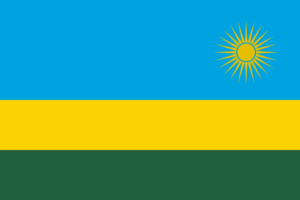
description: three horizontal bands of sky blue (top, double-width), yellow, and green, with a golden sun with 24 rays on the right end of the blue band
meaning: blue stands for happiness and peace, yellow for economic development and mineral wealth, and green for hope for prosperity and natural resources; the sun symbolizes unity and enlightenment
meaning: blue stands for happiness and peace, yellow for economic development and mineral wealth, and green for hope for prosperity and natural resources; the sun symbolizes unity and enlightenment
National symbol(s)
traditional woven basket with peaked lid
National color(s)
blue, yellow, green
National anthem(s)
title: "Rwanda nziza" (Rwanda, Our Beautiful Country)
lyrics/music: Faustin MURIGO/Jean-Bosco HASHAKAIMANA
history: adopted 2001
Reference: 2001lyrics/music: Faustin MURIGO/Jean-Bosco HASHAKAIMANA
history: adopted 2001
National heritage
total World Heritage Sites: 2 (1 cultural, 1 natural)
selected World Heritage Site locales: Memorial sites of the Genocide: Nyamata, Murambi, Gisozi and Bisesero (c); Nyungwe National Park (n)
selected World Heritage Site locales: Memorial sites of the Genocide: Nyamata, Murambi, Gisozi and Bisesero (c); Nyungwe National Park (n)
Government & Official Links
| Institution | Official website | X / Twitter | Verification |
|---|---|---|---|
| Rwanda official website | Official website | — | Reported · source Checked September 20, 2026 |
Institutional accounts only; personal accounts of political office-holders are excluded.
Legislature & Elections
Legislature
| Name | Chamber | Seats | Electoral system |
|---|---|---|---|
| Parliament of Rwanda | — | — | — |
Economy
Economic overview
fast-growing Sub-Saharan economy; major public investments; trade and tourism hit hard by COVID-19; increasing poverty after 2 decades of declines; Ugandan competition for regional influence; major coffee exporter; contested GDP figures
Real GDP (purchasing power parity)
Real GDP (purchasing power parity) 2024: $46.543 billion (2024 est.)
Real GDP (purchasing power parity) 2023: $42.743 billion (2023 est.)
Real GDP (purchasing power parity) 2022: $39.485 billion (2022 est.)
note: note: data in 2021 dollars
Reference: 2024, 2023, 2022, 2021Real GDP (purchasing power parity) 2023: $42.743 billion (2023 est.)
Real GDP (purchasing power parity) 2022: $39.485 billion (2022 est.)
note: note: data in 2021 dollars
Real GDP per capita
Real GDP per capita 2024: $3,300 (2024 est.)
Real GDP per capita 2023: $3,100 (2023 est.)
Real GDP per capita 2022: $2,900 (2022 est.)
note: note: data in 2021 dollars
Reference: 2024, 2023, 2022, 2021Real GDP per capita 2023: $3,100 (2023 est.)
Real GDP per capita 2022: $2,900 (2022 est.)
note: note: data in 2021 dollars
GDP - composition, by sector of origin
agriculture: 24.6% (2024 est.)
industry: 21% (2024 est.)
services: 47.6% (2024 est.)
note: note: figures may not total 100% due to non-allocated consumption not captured in sector-reported data
Reference: 2024industry: 21% (2024 est.)
services: 47.6% (2024 est.)
note: note: figures may not total 100% due to non-allocated consumption not captured in sector-reported data
GDP - composition, by end use
household consumption: 64.9% (2024 est.)
government consumption: 17.1% (2024 est.)
investment in fixed capital: 29.1% (2024 est.)
investment in inventories: -3.2% (2024 est.)
exports of goods and services: 30.8% (2024 est.)
imports of goods and services: -39.1% (2024 est.)
note: note: figures may not total 100% due to rounding or gaps in data collection
Reference: 2024government consumption: 17.1% (2024 est.)
investment in fixed capital: 29.1% (2024 est.)
investment in inventories: -3.2% (2024 est.)
exports of goods and services: 30.8% (2024 est.)
imports of goods and services: -39.1% (2024 est.)
note: note: figures may not total 100% due to rounding or gaps in data collection
Agricultural products
bananas, cassava, sweet potatoes, plantains, potatoes, maize, beans, pumpkins/squash, taro, sorghum (2023)
note: note: top ten agricultural products based on tonnage
Reference: 2023note: note: top ten agricultural products based on tonnage
Industries
cement, agricultural products, small-scale beverages, soap, furniture, shoes, plastic goods, textiles, cigarettes
Industrial production growth rate
10% (2024 est.)
note: note: annual % change in industrial value added based on constant local currency
Reference: 2024note: note: annual % change in industrial value added based on constant local currency
Labor force
5.671 million (2024 est.)
note: note: number of people ages 15 or older who are employed or seeking work
Reference: 2024note: note: number of people ages 15 or older who are employed or seeking work
Youth unemployment rate (ages 15-24)
total: 17.5% (2024 est.)
male: 15.8% (2024 est.)
female: 19.4% (2024 est.)
note: note: % of labor force ages 15-24 seeking employment
Reference: 2024male: 15.8% (2024 est.)
female: 19.4% (2024 est.)
note: note: % of labor force ages 15-24 seeking employment
Population below poverty line
38.2% (2016 est.)
note: note: % of population with income below national poverty line
Reference: 2016note: note: % of population with income below national poverty line
Gini Index coefficient - distribution of family income
Gini Index coefficient - distribution of family income 2016: 43.7 (2016 est.)
note: note: index (0-100) of income distribution; higher values represent greater inequality
Reference: 2016note: note: index (0-100) of income distribution; higher values represent greater inequality
Household income or consumption by percentage share
lowest 10%: 2.4% (2016 est.)
highest 10%: 35.6% (2016 est.)
note: note: % share of income accruing to lowest and highest 10% of population
Reference: 2016highest 10%: 35.6% (2016 est.)
note: note: % share of income accruing to lowest and highest 10% of population
Remittances
Remittances 2023: 3.6% of GDP (2023 est.)
Remittances 2022: 3.6% of GDP (2022 est.)
Remittances 2021: 3.5% of GDP (2021 est.)
note: note: personal transfers and compensation between resident and non-resident individuals/households/entities
Reference: 2023, 2022, 2021Remittances 2022: 3.6% of GDP (2022 est.)
Remittances 2021: 3.5% of GDP (2021 est.)
note: note: personal transfers and compensation between resident and non-resident individuals/households/entities
Budget
revenues: $3.41 billion (2023 est.)
expenditures: $3.996 billion (2023 est.)
note: note: central government revenues (excluding grants) and expenditures converted to US dollars at average official exchange rate for year indicated
Reference: 2023expenditures: $3.996 billion (2023 est.)
note: note: central government revenues (excluding grants) and expenditures converted to US dollars at average official exchange rate for year indicated
Public debt
Public debt 2016: 37.3% of GDP (2016 est.)
Reference: 2016Taxes and other revenues
13.5% (of GDP) (2023 est.)
note: note: central government tax revenue as a % of GDP
Reference: 2023note: note: central government tax revenue as a % of GDP
Current account balance
Current account balance 2023: -$1.654 billion (2023 est.)
Current account balance 2022: -$1.246 billion (2022 est.)
Current account balance 2021: -$1.209 billion (2021 est.)
note: note: balance of payments - net trade and primary/secondary income in current dollars
Reference: 2023, 2022, 2021Current account balance 2022: -$1.246 billion (2022 est.)
Current account balance 2021: -$1.209 billion (2021 est.)
note: note: balance of payments - net trade and primary/secondary income in current dollars
Exports
Exports 2023: $3.509 billion (2023 est.)
Exports 2022: $2.993 billion (2022 est.)
Exports 2021: $2.11 billion (2021 est.)
note: note: balance of payments - exports of goods and services in current dollars
Reference: 2023, 2022, 2021Exports 2022: $2.993 billion (2022 est.)
Exports 2021: $2.11 billion (2021 est.)
note: note: balance of payments - exports of goods and services in current dollars
Exports - partners
UAE 66%, China 10%, USA 3%, Kenya 3%, Thailand 2% (2023)
note: note: top five export partners based on percentage share of exports
Reference: 2023note: note: top five export partners based on percentage share of exports
Exports - commodities
gold, rare earth ores, coffee, tea, tin ores (2023)
note: note: top five export commodities based on value in dollars
Reference: 2023note: note: top five export commodities based on value in dollars
Imports
Imports 2023: $5.783 billion (2023 est.)
Imports 2022: $4.978 billion (2022 est.)
Imports 2021: $3.856 billion (2021 est.)
note: note: balance of payments - imports of goods and services in current dollars
Reference: 2023, 2022, 2021Imports 2022: $4.978 billion (2022 est.)
Imports 2021: $3.856 billion (2021 est.)
note: note: balance of payments - imports of goods and services in current dollars
Imports - partners
China 19%, Kenya 14%, Uganda 13%, Tanzania 9%, UAE 7% (2023)
note: note: top five import partners based on percentage share of imports
Reference: 2023note: note: top five import partners based on percentage share of imports
Imports - commodities
broadcasting equipment, fish, corn, packaged medicine, plastic products (2023)
note: note: top five import commodities based on value in dollars
Reference: 2023note: note: top five import commodities based on value in dollars
Reserves of foreign exchange and gold
Reserves of foreign exchange and gold 2024: $2.406 billion (2024 est.)
Reserves of foreign exchange and gold 2023: $1.834 billion (2023 est.)
Reserves of foreign exchange and gold 2022: $1.726 billion (2022 est.)
note: note: holdings of gold (year-end prices)/foreign exchange/special drawing rights in current dollars
Reference: 2024, 2023, 2022Reserves of foreign exchange and gold 2023: $1.834 billion (2023 est.)
Reserves of foreign exchange and gold 2022: $1.726 billion (2022 est.)
note: note: holdings of gold (year-end prices)/foreign exchange/special drawing rights in current dollars
Debt - external
Debt - external 2023: $5.531 billion (2023 est.)
note: note: present value of external debt in current US dollars
Reference: 2023note: note: present value of external debt in current US dollars
Exchange rates
Currency: Rwandan francs (RWF) per US dollar -
Exchange rates 2024: 1,318.128 (2024 est.)
Exchange rates 2023: 1,160.099 (2023 est.)
Exchange rates 2022: 1,030.308 (2022 est.)
Exchange rates 2021: 988.625 (2021 est.)
Exchange rates 2020: 943.278 (2020 est.)
Reference: 2024, 2023, 2022, 2021Exchange rates 2024: 1,318.128 (2024 est.)
Exchange rates 2023: 1,160.099 (2023 est.)
Exchange rates 2022: 1,030.308 (2022 est.)
Exchange rates 2021: 988.625 (2021 est.)
Exchange rates 2020: 943.278 (2020 est.)
Trade
Current account balance
Current account balance 2023: -$1.654 billion (2023 est.)
Current account balance 2022: -$1.246 billion (2022 est.)
Current account balance 2021: -$1.209 billion (2021 est.)
note: note: balance of payments - net trade and primary/secondary income in current dollars
Reference: 2023, 2022, 2021Current account balance 2022: -$1.246 billion (2022 est.)
Current account balance 2021: -$1.209 billion (2021 est.)
note: note: balance of payments - net trade and primary/secondary income in current dollars
Exports
Exports 2023: $3.509 billion (2023 est.)
Exports 2022: $2.993 billion (2022 est.)
Exports 2021: $2.11 billion (2021 est.)
note: note: balance of payments - exports of goods and services in current dollars
Reference: 2023, 2022, 2021Exports 2022: $2.993 billion (2022 est.)
Exports 2021: $2.11 billion (2021 est.)
note: note: balance of payments - exports of goods and services in current dollars
Exports - partners
UAE 66%, China 10%, USA 3%, Kenya 3%, Thailand 2% (2023)
note: note: top five export partners based on percentage share of exports
Reference: 2023note: note: top five export partners based on percentage share of exports
Exports - commodities
gold, rare earth ores, coffee, tea, tin ores (2023)
note: note: top five export commodities based on value in dollars
Reference: 2023note: note: top five export commodities based on value in dollars
Imports
Imports 2023: $5.783 billion (2023 est.)
Imports 2022: $4.978 billion (2022 est.)
Imports 2021: $3.856 billion (2021 est.)
note: note: balance of payments - imports of goods and services in current dollars
Reference: 2023, 2022, 2021Imports 2022: $4.978 billion (2022 est.)
Imports 2021: $3.856 billion (2021 est.)
note: note: balance of payments - imports of goods and services in current dollars
Imports - partners
China 19%, Kenya 14%, Uganda 13%, Tanzania 9%, UAE 7% (2023)
note: note: top five import partners based on percentage share of imports
Reference: 2023note: note: top five import partners based on percentage share of imports
Imports - commodities
broadcasting equipment, fish, corn, packaged medicine, plastic products (2023)
note: note: top five import commodities based on value in dollars
Reference: 2023note: note: top five import commodities based on value in dollars
Energy & Resources
Electricity
installed generating capacity: 294,000 kW (2023 est.)
consumption: 876.401 million kWh (2023 est.)
exports: 8.674 million kWh (2023 est.)
imports: 32 million kWh (2023 est.)
transmission/distribution losses: 197.606 million kWh (2023 est.)
Reference: 2023consumption: 876.401 million kWh (2023 est.)
exports: 8.674 million kWh (2023 est.)
imports: 32 million kWh (2023 est.)
transmission/distribution losses: 197.606 million kWh (2023 est.)
Electricity generation sources
fossil fuels: 43.6% of total installed capacity (2023 est.)
solar: 3.4% of total installed capacity (2023 est.)
hydroelectricity: 52.8% of total installed capacity (2023 est.)
biomass and waste: 0.2% of total installed capacity (2023 est.)
Reference: 2023solar: 3.4% of total installed capacity (2023 est.)
hydroelectricity: 52.8% of total installed capacity (2023 est.)
biomass and waste: 0.2% of total installed capacity (2023 est.)
Coal
consumption: 123,000 metric tons (2023 est.)
imports: 89,000 metric tons (2023 est.)
Reference: 2023imports: 89,000 metric tons (2023 est.)
Petroleum
refined petroleum consumption: 9,000 bbl/day (2023 est.)
Reference: 2023Natural gas
production: 63.666 million cubic meters (2023 est.)
consumption: 63.696 million cubic meters (2023 est.)
proven reserves: 56.634 billion cubic meters (2021 est.)
Reference: 2023, 2021consumption: 63.696 million cubic meters (2023 est.)
proven reserves: 56.634 billion cubic meters (2021 est.)
Energy consumption per capita
Total energy consumption per capita 2023: 1.808 million Btu/person (2023 est.)
Reference: 2023Infrastructure
Telephones - fixed lines
total subscriptions: 8,000 (2023 est.)
subscriptions per 100 inhabitants: (2023 est.) less than 1
Reference: 2023subscriptions per 100 inhabitants: (2023 est.) less than 1
Telephones - mobile cellular
total subscriptions: 12.8 million (2023 est.)
subscriptions per 100 inhabitants: 80 (2022 est.)
Reference: 2023, 2022subscriptions per 100 inhabitants: 80 (2022 est.)
Broadband - fixed subscriptions
total: 62,000 (2023 est.)
subscriptions per 100 inhabitants: (2023 est.) less than 1
Reference: 2023subscriptions per 100 inhabitants: (2023 est.) less than 1
Health
Maternal mortality ratio
229 deaths/100,000 live births (2023 est.)
Reference: 2023Health expenditure
Health expenditure (as % of GDP): 7.3% of GDP (2021)
Health expenditure (as % of national budget): 9.5% of national budget (2022 est.)
Reference: 2022, 2021Health expenditure (as % of national budget): 9.5% of national budget (2022 est.)
Physician density
0.09 physicians/1,000 population (2022)
Reference: 2022Hospital bed density
0.7 beds/1,000 population (2020 est.)
Reference: 2020Obesity - adult prevalence rate
5.8% (2016)
Reference: 2016Tobacco use
total: 11.4% (2025 est.)
male: 17% (2025 est.)
female: 6.3% (2025 est.)
male: 17% (2025 est.)
female: 6.3% (2025 est.)
Education
Education expenditure
Education expenditure (% GDP): 4.7% of GDP (2024 est.)
Education expenditure (% national budget): 13.9% national budget (2025 est.)
Reference: 2025, 2024Education expenditure (% national budget): 13.9% national budget (2025 est.)
School life expectancy (primary to tertiary education)
total: 13 years (2023 est.)
male: 13 years (2023 est.)
female: 13 years (2023 est.)
Reference: 2023male: 13 years (2023 est.)
female: 13 years (2023 est.)
Rights, Freedoms & Society
Press & Media Freedom
V-Dem expert-coded/modelled source measures. Knelstrom does not create a press-freedom ranking or composite score.
LGBTQ+ Rights & Law
Concrete legal-status fields only; Knelstrom does not generate an LGBTQ rights score or country ranking.
Source: Wikipedia — LGBTQ rights by country or territory (CC BY-SA 4.0). Community-edited legal-status summary; retrieved by Knelstrom and not legal advice.
Crime & Justice
Legal system
mixed system of civil law, based on German and Belgian models, and customary law; Supreme Court reviews legislative acts
Judicial branch
highest court(s): Supreme Court (consists of the chief and deputy chief justices and 5 judges; normally organized into 3-judge panels); High Court (consists of the court president, vice president, and a minimum of 24 judges and organized into 5 chambers)
judge selection and term of office: Supreme Court judges nominated by the president after consultation with the Cabinet and the Superior Council of the Judiciary (SCJ), a 27-member body of judges, other judicial officials, and legal professionals, and approved by the Senate; chief and deputy chief justices appointed for 8-year nonrenewable terms; tenure of judges NA; High Court president and vice president appointed by the president of the republic upon approval by the Senate; judges appointed by the Supreme Court chief justice upon approval of the SCJ; judge tenure NA
subordinate courts: High Court of the Republic; commercial courts including the High Commercial Court; intermediate courts; primary courts; and military specialized courts
judge selection and term of office: Supreme Court judges nominated by the president after consultation with the Cabinet and the Superior Council of the Judiciary (SCJ), a 27-member body of judges, other judicial officials, and legal professionals, and approved by the Senate; chief and deputy chief justices appointed for 8-year nonrenewable terms; tenure of judges NA; High Court president and vice president appointed by the president of the republic upon approval by the Senate; judges appointed by the Supreme Court chief justice upon approval of the SCJ; judge tenure NA
subordinate courts: High Court of the Republic; commercial courts including the High Commercial Court; intermediate courts; primary courts; and military specialized courts
Military & Security
Military and security forces
Rwanda Defense Force (RDF; Ingabo z’u Rwanda): Rwanda Army (Rwanda Land Force), Rwanda Air Force (Force Aerienne Rwandaise, FAR), Rwanda Reserve Force, Special Units
Ministry of Internal Security: Rwanda National Police (2025)
Ministry of Internal Security: Rwanda National Police (2025)
Military expenditures
Military Expenditures 2024: 1.3% of GDP (2024 est.)
Military Expenditures 2023: 1.3% of GDP (2023 est.)
Military Expenditures 2022: 1.4% of GDP (2022 est.)
Military Expenditures 2021: 1.4% of GDP (2021 est.)
Military Expenditures 2020: 1.3% of GDP (2020 est.)
Reference: 2024, 2023, 2022, 2021Military Expenditures 2023: 1.3% of GDP (2023 est.)
Military Expenditures 2022: 1.4% of GDP (2022 est.)
Military Expenditures 2021: 1.4% of GDP (2021 est.)
Military Expenditures 2020: 1.3% of GDP (2020 est.)
Military and security service personnel strengths
approximately 30-35,000 active Rwanda Defense Forces (2025)
Military equipment inventories and acquisitions
the RDF's inventory includes a mix of older and some modern equipment from suppliers such as China, France, Israel, Russia and the former Soviet Union, South Africa, and Turkey (2024)
Reference: 2024Military service age and obligation
18 years of age for men and women for voluntary military service; no conscription; Rwandan citizenship is required; enlistment is either as contract (5-years, renewable twice) or career professional (2024)
note: note: as of 2022, women comprised approximately 6% of the Rwanda Defense Force
Reference: 2024, 2022note: note: as of 2022, women comprised approximately 6% of the Rwanda Defense Force
Military deployments
approximately 3,200 Central African Republic (about 2,200 under MINUSCA, plus some 700 police; approximately 1,000 under a bi-lateral agreement); estimated 3-4,000 Democratic Republic of the Congo; estimated 3,000 Mozambique (bilateral agreement to assist with combating an insurgency; includes both military and police forces); 2,600 (plus about 450 police) South Sudan (UNMISS) (2025)
Military - note
the principle responsibilities of the Rwanda Defense Force (RDF) are ensuring territorial integrity and national sovereignty and preventing infiltrations of illegal armed groups from neighboring countries, particularly the Democratic Republic of the Congo (DRC); since 2021, Rwanda has deployed RDF troops to the border region with the DRC to combat the rebel Democratic Forces for the Liberation of Rwanda (FDLR), which it has accused the DRC of backing; Rwanda has been accused by the DRC, the UN, and the US of deploying RDF troops in the DRC and providing material support to the March 23 Movement (M23, aka Congolese Revolutionary Army) rebel group; the RDF also participates in UN and regional military operations, as well as multinational exercises; it has deployed several thousand RDF troops and police personnel to Mozambique to assist in combating an insurgency since 2021; Rwanda has mutual defense treaties with Kenya and Uganda
the Rwandan Armed Forces (FAR) were established following independence in 1962; after the 1990-1994 civil war and genocide, the victorious Tutsi-dominated Rwandan Patriotic Front's military wing, the Rwandan Patriotic Army (RPA), became the country's military force; the RPA participated in the First (1996-1997) and Second (1998-2003) Congolese Wars; the RPA was renamed the Rwanda Defense Force (RDF) in 2003, by which time it had assumed a more national character with the inclusion of many former Hutu officers as well as newly recruited soldiers (2025)
Reference: 2025, 2021, 2003, 1998the Rwandan Armed Forces (FAR) were established following independence in 1962; after the 1990-1994 civil war and genocide, the victorious Tutsi-dominated Rwandan Patriotic Front's military wing, the Rwandan Patriotic Army (RPA), became the country's military force; the RPA participated in the First (1996-1997) and Second (1998-2003) Congolese Wars; the RPA was renamed the Rwanda Defense Force (RDF) in 2003, by which time it had assumed a more national character with the inclusion of many former Hutu officers as well as newly recruited soldiers (2025)
International Relations
International law organization participation
has not submitted an ICJ jurisdiction declaration; non-party state to the ICCt
Diplomatic representation in the US
chief of mission: Ambassador Mathilde MUKANTABANA (since 18 July 2013)
chancery: 1714 New Hampshire Avenue NW, Washington, DC 20009
telephone: [1] (202) 232-2882
FAX: [1] (202) 232-4544
email address and website: info@rwandaembassy.org
https://rwandaembassy.org/
Reference: 2013chancery: 1714 New Hampshire Avenue NW, Washington, DC 20009
telephone: [1] (202) 232-2882
FAX: [1] (202) 232-4544
email address and website: info@rwandaembassy.org
https://rwandaembassy.org/
Diplomatic representation from the US
chief of mission: Ambassador Eric KNEEDLER (since 3 October 2023)
embassy: 2657 Avenue de la Gendarmerie (Kaciyiru), P. O. Box 28 Kigali
mailing address: 2210 Kigali Place, Washington DC 20521-2210
telephone: [250] 252 596-400
FAX: [250] 252 580-325
email address and website: consularkigali@state.gov
https://rw.usembassy.gov/
Reference: 2023embassy: 2657 Avenue de la Gendarmerie (Kaciyiru), P. O. Box 28 Kigali
mailing address: 2210 Kigali Place, Washington DC 20521-2210
telephone: [250] 252 596-400
FAX: [250] 252 580-325
email address and website: consularkigali@state.gov
https://rw.usembassy.gov/
International organization participation
ACP, AfDB, AU, CEPGL, COMESA, EAC, EADB, FAO, G-77, IAEA, IBRD, ICAO, ICRM, IDA, IFAD, IFC, IFRCS, ILO, IMF, Interpol, IOC, IOM, IPU, ISO, ITSO, ITU, ITUC (NGOs), MIGA, MINUSMA, NAM, OIF, OPCW, PCA, UN, UNCTAD, UNESCO, UNHCR, UNIDO, UNISFA, UNMISS, UNOOSA, UNWTO, UPU, WCO, WHO, WIPO, WMO, WTO
Treaties & Organisations
| Organisation | Status | Joined |
|---|---|---|
| African Union (AU) | member | — |
| Commonwealth of Nations (Commonwealth) | member | 2009-11-29 |
| United Nations (UN) | member | 1962-09-18 |
| World Trade Organization (WTO) | member | — |
International law organization participation
has not submitted an ICJ jurisdiction declaration; non-party state to the ICCt
International organization participation
ACP, AfDB, AU, CEPGL, COMESA, EAC, EADB, FAO, G-77, IAEA, IBRD, ICAO, ICRM, IDA, IFAD, IFC, IFRCS, ILO, IMF, Interpol, IOC, IOM, IPU, ISO, ITSO, ITU, ITUC (NGOs), MIGA, MINUSMA, NAM, OIF, OPCW, PCA, UN, UNCTAD, UNESCO, UNHCR, UNIDO, UNISFA, UNMISS, UNOOSA, UNWTO, UPU, WCO, WHO, WIPO, WMO, WTO
Conflict & Security
Refugees and internally displaced persons
refugees: 128,561 (2024 est.)
IDPs: 21,948 (2024 est.)
stateless persons: 14,500 (2024 est.)
Reference: 2024IDPs: 21,948 (2024 est.)
stateless persons: 14,500 (2024 est.)
Trafficking in persons
tier rating: Tier 2 Watch List — the government did not demonstrate overall increasing efforts to eliminate trafficking compared with the previous reporting period, therefore Rwanda remained on Tier 2 Watch List for the second consecutive year; for more details, go to: https://www.state.gov/reports/2025-trafficking-in-persons-report/rwanda
Transportation & Logistics
Civil aircraft registration country code prefix
9XR
Airports
8 (2025)
Environment
Environmental issues
deforestation; overgrazing; land degradation; soil erosion; a decline in soil fertility (soil exhaustion); wetland degradation and loss of biodiversity; widespread poaching
International environmental agreements
party to: Biodiversity, Climate Change, Climate Change-Kyoto Protocol, Comprehensive Nuclear Test Ban, Desertification, Endangered Species, Hazardous Wastes, Nuclear Test Ban, Ozone Layer Protection, Wetlands
signed, but not ratified: Law of the Sea
signed, but not ratified: Law of the Sea
Climate
temperate; two rainy seasons (February to April, November to January); mild in mountains with frost and snow possible
Land use
agricultural land: 76.3% (2023 est.)
agricultural land: arable land: arable land: 47% (2023 est.)
agricultural land: permanent crops: permanent crops: 13.7% (2023 est.)
agricultural land: permanent pasture: permanent pasture: 15.6% (2023 est.)
forest: 24.5% (2023 est.)
other: 0% (2023 est.)
Reference: 2023agricultural land: arable land: arable land: 47% (2023 est.)
agricultural land: permanent crops: permanent crops: 13.7% (2023 est.)
agricultural land: permanent pasture: permanent pasture: 15.6% (2023 est.)
forest: 24.5% (2023 est.)
other: 0% (2023 est.)
Urbanization
urban population: 17.9% of total population (2023)
rate of urbanization: 3.07% annual rate of change (2020-25 est.)
Reference: 2023, 2020rate of urbanization: 3.07% annual rate of change (2020-25 est.)
Carbon dioxide emissions
total emissions: 1.645 million metric tonnes of CO2 (2023 est.)
from coal and metallurgical coke: 226,000 metric tonnes of CO2 (2023 est.)
from petroleum and other liquids: 1.295 million metric tonnes of CO2 (2023 est.)
from consumed natural gas: 124,000 metric tonnes of CO2 (2023 est.)
Reference: 2023from coal and metallurgical coke: 226,000 metric tonnes of CO2 (2023 est.)
from petroleum and other liquids: 1.295 million metric tonnes of CO2 (2023 est.)
from consumed natural gas: 124,000 metric tonnes of CO2 (2023 est.)
Particulate matter emissions
35.7 micrograms per cubic meter (2019 est.)
Reference: 2019Waste and recycling
municipal solid waste generated annually: 4.385 million tons (2024 est.)
percent of municipal solid waste recycled: 11.5% (2022 est.)
Reference: 2024, 2022percent of municipal solid waste recycled: 11.5% (2022 est.)
Total water withdrawal
municipal: 230 million cubic meters (2022 est.)
industrial: 10 million cubic meters (2022 est.)
agricultural: 361 million cubic meters (2022 est.)
Reference: 2022industrial: 10 million cubic meters (2022 est.)
agricultural: 361 million cubic meters (2022 est.)
Total renewable water resources
13.3 billion cubic meters (2022 est.)
Reference: 2022Communications & Media
Telephones - fixed lines
total subscriptions: 8,000 (2023 est.)
subscriptions per 100 inhabitants: (2023 est.) less than 1
Reference: 2023subscriptions per 100 inhabitants: (2023 est.) less than 1
Telephones - mobile cellular
total subscriptions: 12.8 million (2023 est.)
subscriptions per 100 inhabitants: 80 (2022 est.)
Reference: 2023, 2022subscriptions per 100 inhabitants: 80 (2022 est.)
Broadcast media
13 TV stations; 35 radio stations, including international broadcasters; government owns most popular TV and radio stations; regional satellite-based TV available
Internet country code
.rw
Internet users
percent of population: 34% (2023 est.)
Reference: 2023Broadband - fixed subscriptions
total: 62,000 (2023 est.)
subscriptions per 100 inhabitants: (2023 est.) less than 1
Reference: 2023subscriptions per 100 inhabitants: (2023 est.) less than 1
Historical Trends
Population
Source: World Bank WDI. Historical observations shown by reference period.
View Population data table
| Period | Value | Source |
|---|---|---|
| 2016 | 11,919,183 | world_bank_wdi |
| 2017 | 12,202,060 | world_bank_wdi |
| 2018 | 12,487,996 | world_bank_wdi |
| 2019 | 12,776,103 | world_bank_wdi |
| 2020 | 13,065,837 | world_bank_wdi |
| 2021 | 13,355,260 | world_bank_wdi |
| 2022 | 13,651,030 | world_bank_wdi |
| 2023 | 13,954,471 | world_bank_wdi |
| 2024 | 14,256,567 | world_bank_wdi |
| 2025 | 14,569,341 | world_bank_wdi |
GDP (current US$)
Source: World Bank WDI. Historical observations shown by reference period.
View GDP (current US$) data table
| Period | Value | Source |
|---|---|---|
| 2016 | $8,596,812,241 | world_bank_wdi |
| 2017 | $9,164,345,443 | world_bank_wdi |
| 2018 | $9,650,161,136 | world_bank_wdi |
| 2019 | $10,519,272,170 | world_bank_wdi |
| 2020 | $10,487,146,253 | world_bank_wdi |
| 2021 | $11,252,894,910 | world_bank_wdi |
| 2022 | $13,747,404,814 | world_bank_wdi |
| 2023 | $14,806,501,437 | world_bank_wdi |
| 2024 | $15,111,064,182 | world_bank_wdi |
| 2025 | $16,372,132,990 | world_bank_wdi |
International migrant stock (immigrants)
Source: World Bank WDI. Historical observations shown by reference period.
View International migrant stock (immigrants) data table
| Period | Value | Source |
|---|---|---|
| 2020 | 513,907 | world_bank_wdi |
| 2024 | 513,316 | world_bank_wdi |
International emigrant stock
Source: World Bank WDI. Historical observations shown by reference period.
View International emigrant stock data table
| Period | Value | Source |
|---|---|---|
| 1990 | 584,280 | un_migrant_stock_2024 |
| 1995 | 2,109,879 | un_migrant_stock_2024 |
| 2000 | 346,850 | un_migrant_stock_2024 |
| 2005 | 293,186 | un_migrant_stock_2024 |
| 2010 | 334,656 | un_migrant_stock_2024 |
| 2015 | 496,392 | un_migrant_stock_2024 |
| 2020 | 486,754 | un_migrant_stock_2024 |
| 2024 | 539,046 | un_migrant_stock_2024 |
Net migration
Source: World Bank WDI. Historical observations shown by reference period.
View Net migration data table
| Period | Value | Source |
|---|---|---|
| 2016 | -24,474 | world_bank_wdi |
| 2017 | -25,634 | world_bank_wdi |
| 2018 | -25,323 | world_bank_wdi |
| 2019 | -24,492 | world_bank_wdi |
| 2020 | -22,251 | world_bank_wdi |
| 2021 | -21,492 | world_bank_wdi |
| 2022 | -9,001 | world_bank_wdi |
| 2023 | -9,001 | world_bank_wdi |
| 2024 | -15,582 | world_bank_wdi |
| 2025 | 6,282 | world_bank_wdi |
Sources & Methodology
Current statistical observations include their reference period and provenance. Reference fields from approved source datasets are attributed below. Missing information is left unknown rather than inferred.
| Indicator | Value | Period | Source | Status |
|---|---|---|---|---|
| Population | 14,569,341 | 2025 | World Bank — World Development Indicators | Verified |
| UN Population Division population estimate | 14,889,693 | 2026 | UN Population Division Data Portal | Estimated |
| Wikidata population (fallback) | 14,569,341 | 2025 | Wikidata | Reported |
| International migrant stock (immigrants) | 513,316 | 2024 | World Bank — World Development Indicators | Verified |
| International migrant stock | 3.6% | 2024 | World Bank — World Development Indicators | Verified |
| International emigrant stock | 539,046 | 2024 | UN DESA International Migrant Stock 2024 | Estimated |
| Net migration | 6,282 | 2025 | World Bank — World Development Indicators | Verified |
| Refugees hosted | 115,794 | 2025 | UNHCR Refugee Population Statistics | Verified |
| Asylum seekers hosted | 15,251 | 2025 | UNHCR Refugee Population Statistics | Verified |
| Refugees from this country | 244,415 | 2025 | World Bank — World Development Indicators | Verified |
| Asylum seekers from this country | 20,214 | 2025 | World Bank — World Development Indicators | Verified |
| Freedom of expression & alternative information index | 0.170 | 2025 | Varieties of Democracy (V-Dem) Country-Year Dataset v16 | Estimated |
| Government censorship effort — media | 0.176 | 2025 | Varieties of Democracy (V-Dem) Country-Year Dataset v16 | Estimated |
| Harassment of journalists | -1.396 | 2025 | Varieties of Democracy (V-Dem) Country-Year Dataset v16 | Estimated |
| Print/broadcast media critical of government | -1.227 | 2025 | Varieties of Democracy (V-Dem) Country-Year Dataset v16 | Estimated |
| Range of perspectives in major media | -0.923 | 2025 | Varieties of Democracy (V-Dem) Country-Year Dataset v16 | Estimated |
| Media bias | -1.597 | 2025 | Varieties of Democracy (V-Dem) Country-Year Dataset v16 | Estimated |
| Media self-censorship | -1.308 | 2025 | Varieties of Democracy (V-Dem) Country-Year Dataset v16 | Estimated |
| Same-sex sexual activity | Yes Legal (No laws against same-sex sexual activity have ever existed in the country); + UN decl. sign. | current | Wikipedia — LGBTQ rights by country or territory | Reported |
| Recognition of same-sex relationships | No | current | Wikipedia — LGBTQ rights by country or territory | Reported |
| Same-sex marriage | No Constitutional ban since 2003 | current | Wikipedia — LGBTQ rights by country or territory | Reported |
| Same-sex adoption | No | current | Wikipedia — LGBTQ rights by country or territory | Reported |
| Sexual-orientation anti-discrimination law | Yes / No Limited protections. | current | Wikipedia — LGBTQ rights by country or territory | Reported |
| Gender identity / expression law | No | current | Wikipedia — LGBTQ rights by country or territory | Reported |
| GDP (current US$) | $16,372,132,990 | 2025 | World Bank — World Development Indicators | Verified |
| GDP per capita (current US$) | $1,124 | 2025 | World Bank — World Development Indicators | Verified |
| GDP growth | 9.4% | 2025 | World Bank — World Development Indicators | Verified |
| Inflation, consumer prices | 5.9% | 2025 | World Bank — World Development Indicators | Verified |
| Unemployment | 11.4% | 2025 | World Bank — World Development Indicators | Verified |
| Income level | Low income | current | World Bank — World Development Indicators | Verified |
| Life expectancy at birth | 68.0 years | 2024 | World Bank — World Development Indicators | Verified |
| Fertility rate | 3.6 | 2024 | World Bank — World Development Indicators | Verified |
| Urban population | 30.9% | 2025 | World Bank — World Development Indicators | Verified |
| Individuals using the Internet | 31.7% | 2024 | World Bank — World Development Indicators | Verified |
| Exports of goods and services | 21.6% | 2025 | World Bank — World Development Indicators | Verified |
| Imports of goods and services | 35.1% | 2025 | World Bank — World Development Indicators | Verified |
| Trade | 56.7% | 2025 | World Bank — World Development Indicators | Verified |
| Adult literacy rate | 78.8% | 2022 | World Bank — World Development Indicators | Verified |
| Secondary school enrolment, gross | 48.8% | 2024 | World Bank — World Development Indicators | Verified |
| Government education expenditure | 4.6% | 2024 | World Bank — World Development Indicators | Verified |
| Access to electricity | 72.0% | 2024 | World Bank — World Development Indicators | Verified |
| Electric power consumption | 77 kWh/person | 2023 | World Bank — World Development Indicators | Verified |
| Renewable energy consumption | 79.9% | 2022 | World Bank — World Development Indicators | Verified |
| Current health expenditure | 5.1% | 2023 | World Bank — World Development Indicators | Verified |
| Infant mortality rate | 29.4 per 1,000 | 2024 | World Bank — World Development Indicators | Verified |
| Forest area | 11.3% | 2023 | World Bank — World Development Indicators | Verified |
| Mobile cellular subscriptions | 93.2 per 100 | 2024 | World Bank — World Development Indicators | Verified |
| Fixed broadband subscriptions | 0.6 per 100 | 2024 | World Bank — World Development Indicators | Verified |
| Secure Internet servers | 161 per million | 2024 | World Bank — World Development Indicators | Verified |
| Latitude | -1.9533° | current | World Bank — World Development Indicators | Verified |
| Longitude | 30.0587° | current | World Bank — World Development Indicators | Verified |
| Latitude (Wikidata) | -2.0000° | current | Wikidata | Reported |
| Longitude (Wikidata) | 30.0000° | current | Wikidata | Reported |
| Time zone | UTC+02:00, Africa/Kigali | current | Wikidata | Reported |
| Form of government | semi-presidential system | current | Wikidata | Reported |
Data attribution
Credits below are generated from sources actually used by this country profile. Source-specific terms take precedence.
- CIA World Factbook, final 2025 country profile (structured via factbook.json). Accessed September 20, 2026. U.S. Government public-domain data; retained as a reference source where a newer approved field is not available. Source · Terms/licence
- United Nations, Department of Economic and Social Affairs, Population Division, International Migrant Stock 2024; data access/processing via Our World in Data. Accessed September 20, 2026. Underlying UN dataset used under CC BY 3.0 IGO. Source · Terms/licence
- United Nations, Department of Economic and Social Affairs, Population Division, World Population Prospects (WPP indicator 49) Accessed September 19, 2026. Used under CC BY 3.0 IGO; current-year WPP population values are presented as estimates/projections where applicable. Source · Terms/licence
- UNHCR Refugee Population Statistics Database. Accessed October 13, 2026. Used under CC BY 4.0 except where a dataset identifies a different source or licence. Source · Terms/licence
- Varieties of Democracy (V-Dem), Country-Year Dataset v16 (variables: v2mebias, v2mecenefm, v2mecrit, v2meharjrn, v2merange, v2meslfcen, v2x_freexp_altinf) Accessed September 20, 2026. Used under CC BY-SA 4.0; V-Dem measures are expert-coded/modelled and no V-Dem endorsement is implied. Source · Terms/licence
- Wikidata structured data (CC0). Accessed September 20, 2026. Attribution is provided by Knelstrom for provenance although CC0 does not require it. Source · Terms/licence
- Wikipedia, “LGBTQ rights by country or territory” (source revision/data fields: Wikipedia revision 1374406645 — Gender identity / expression law, Wikipedia revision 1374406645 — Recognition of same-sex relationships, Wikipedia revision 1374406645 — Same-sex adoption, Wikipedia revision 1374406645 — Same-sex marriage, Wikipedia revision 1374406645 — Same-sex sexual activity, Wikipedia revision 1374406645 — Sexual-orientation anti-discrimination law) Accessed October 18, 2026. Used under CC BY-SA 4.0. Knelstrom changes formatting and presents the imported material as a community-edited legal-status summary, not legal advice or a Knelstrom rights score. Source · Terms/licence
- World Bank, World Development Indicators (series: AG.LND.FRST.ZS, country_metadata, EG.ELC.ACCS.ZS, EG.FEC.RNEW.ZS, EG.USE.ELEC.KH.PC, FP.CPI.TOTL.ZG, IT.CEL.SETS.P2, IT.NET.BBND.P2, IT.NET.SECR.P6, IT.NET.USER.ZS, NE.EXP.GNFS.ZS, NE.IMP.GNFS.ZS, NE.TRD.GNFS.ZS, NY.GDP.MKTP.CD, NY.GDP.MKTP.KD.ZG, NY.GDP.PCAP.CD, SE.ADT.LITR.ZS, SE.SEC.ENRR, SE.XPD.TOTL.GD.ZS, SH.XPD.CHEX.GD.ZS, SL.UEM.TOTL.ZS, SM.POP.ASYS.EO, SM.POP.NETM, SM.POP.RHCR.EO, SM.POP.TOTL, SM.POP.TOTL.ZS, SP.DYN.IMRT.IN, SP.DYN.LE00.IN, SP.DYN.TFRT.IN, SP.POP.TOTL, SP.URB.TOTL.IN.ZS) Accessed October 13, 2026. Data used under CC BY 4.0; Knelstrom presentation/formatting may differ from the source. Source · Terms/licence
- Country flag from Wikimedia Commons. https://commons.wikimedia.org/wiki/File%3AFlag_of_Rwanda.svg
Knelstrom does not imply endorsement by any listed data provider.
Last automated statistical refresh: 2026-10-13 20:48:32