
Knelstrom Intelligence · World Factbook
Burundi
Republic of Burundi
CapitalGitega
Population14,390,003
GDP$3.4bn
Area27,834 km²
RegionSub-Saharan Africa
Latest source check will run in the background.
Country facts
Overview
Background
Established in the 1600s, the Burundi Kingdom has had borders similar to those of modern Burundi since the 1800s. Burundi’s two major ethnic groups, the majority Hutu and minority Tutsi, share a common language and culture and largely lived in peaceful cohabitation under Tutsi monarchs in pre-colonial Burundi. Regional, class, and clan distinctions contributed to social status in the Burundi Kingdom, yielding a complex class structure. German colonial rule in the late 19th and early 20th centuries and Belgian rule after World War I preserved Burundi’s monarchy. Seeking to simplify administration, Belgian colonial officials reduced the number of chiefdoms and eliminated most Hutu chiefs from positions of power. In 1961, the Burundian Tutsi king’s oldest son, Louis RWAGASORE, was murdered by a competing political faction shortly before he was set to become prime minister, triggering increased political competition that contributed to later instability.
Burundi gained its independence from Belgium in 1962 as the Kingdom of Burundi. Revolution in neighboring Rwanda stoked ethnic polarization as the Tutsi increasingly feared violence and loss of political power. A failed Hutu-led coup in 1965 triggered a purge of Hutu officials and set the stage for Tutsi officers to overthrow the monarchy in 1966 and establish a Tutsi-dominated republic. A Hutu rebellion in 1972 resulted in the deaths of several thousand Tutsi civilians and sparked brutal Tutsi-led military reprisals against Hutu civilians which ultimately killed 100,000-200,000 people. International pressure led to a new constitution in 1992 and democratic elections in 1993. Tutsi military officers feared Hutu domination and assassinated Burundi's first democratically elected president, Hutu Melchior NDADAYE, in 1993 after only 100 days in office, sparking a civil war. In 1994, his successor, Cyprien NTARYAMIRA, died when the Rwandan president’s plane he was traveling on was shot down, which triggered the Rwandan genocide and further entrenched ethnic conflict in Burundi. The internationally brokered Arusha Agreement, signed in 2000, and subsequent cease-fire agreements with armed movements ended the 1993-2005 civil war. Burundi’s second democratic elections were held in 2005, resulting in the election of Pierre NKURUNZIZA as president. He was reelected in 2010 and again in 2015 after a controversial court decision allowed him to circumvent a term limit. President Evariste NDAYISHIMIYE -- from NKURUNZIZA’s ruling party -- was elected in 2020.
Reference: 2020, 2015, 2010, 2005Burundi gained its independence from Belgium in 1962 as the Kingdom of Burundi. Revolution in neighboring Rwanda stoked ethnic polarization as the Tutsi increasingly feared violence and loss of political power. A failed Hutu-led coup in 1965 triggered a purge of Hutu officials and set the stage for Tutsi officers to overthrow the monarchy in 1966 and establish a Tutsi-dominated republic. A Hutu rebellion in 1972 resulted in the deaths of several thousand Tutsi civilians and sparked brutal Tutsi-led military reprisals against Hutu civilians which ultimately killed 100,000-200,000 people. International pressure led to a new constitution in 1992 and democratic elections in 1993. Tutsi military officers feared Hutu domination and assassinated Burundi's first democratically elected president, Hutu Melchior NDADAYE, in 1993 after only 100 days in office, sparking a civil war. In 1994, his successor, Cyprien NTARYAMIRA, died when the Rwandan president’s plane he was traveling on was shot down, which triggered the Rwandan genocide and further entrenched ethnic conflict in Burundi. The internationally brokered Arusha Agreement, signed in 2000, and subsequent cease-fire agreements with armed movements ended the 1993-2005 civil war. Burundi’s second democratic elections were held in 2005, resulting in the election of Pierre NKURUNZIZA as president. He was reelected in 2010 and again in 2015 after a controversial court decision allowed him to circumvent a term limit. President Evariste NDAYISHIMIYE -- from NKURUNZIZA’s ruling party -- was elected in 2020.
Geography
Location
Central Africa, east of the Democratic Republic of the Congo, west of Tanzania
Geographic coordinates
3 30 S, 30 00 E
Map references
Africa
Area
total: 27,830 sq km
land: 25,680 sq km
water: 2,150 sq km
land: 25,680 sq km
water: 2,150 sq km
Area - comparative
slightly smaller than Maryland
Land boundaries
total: 1,140 km
border countries: Democratic Republic of the Congo 236 km; Rwanda 315 km; Tanzania 589 km
border countries: Democratic Republic of the Congo 236 km; Rwanda 315 km; Tanzania 589 km
Coastline
0 km (landlocked)
Maritime claims
none (landlocked)
Climate
equatorial; high plateau with considerable altitude variation (772 m to 2,670 m above sea level); average annual temperature varies with altitude from 23 to 17 degrees Celsius but is generally moderate; average annual rainfall is about 150 cm with two wet seasons (February to May and September to November) and two dry seasons (June to August and December to January)
Terrain
hilly and mountainous, dropping to a plateau in east, some plains
Elevation
highest point: unnamed elevation on Mukike Range 2,685 m
lowest point: Lake Tanganyika 772 m
mean elevation: 1,504 m
lowest point: Lake Tanganyika 772 m
mean elevation: 1,504 m
Natural resources
nickel, uranium, rare earth oxides, peat, cobalt, copper, platinum, vanadium, arable land, hydropower, niobium, tantalum, gold, tin, tungsten, kaolin, limestone
Land use
agricultural land: 83.9% (2023 est.)
agricultural land: arable land: arable land: 51.4% (2023 est.)
agricultural land: permanent crops: permanent crops: 13.6% (2023 est.)
agricultural land: permanent pasture: permanent pasture: 18.8% (2023 est.)
forest: 10.9% (2023 est.)
other: 5.2% (2023 est.)
Reference: 2023agricultural land: arable land: arable land: 51.4% (2023 est.)
agricultural land: permanent crops: permanent crops: 13.6% (2023 est.)
agricultural land: permanent pasture: permanent pasture: 18.8% (2023 est.)
forest: 10.9% (2023 est.)
other: 5.2% (2023 est.)
Irrigated land
230 sq km (2012)
Reference: 2012Major lakes (area sq km)
fresh water lake(s): Lake Tanganyika (shared with Democratic Republic of Congo, Tanzania, and Zambia) - 32,000 sq km
Major watersheds (area sq km)
Atlantic Ocean drainage: Congo (3,730,881 sq km), (Mediterranean Sea) Nile (3,254,853 sq km)
Population distribution
one of Africa's most densely populated countries; concentrations tend to be in the north and along the northern shore of Lake Tanganyika in the west; most people live on farms near areas of fertile volcanic soil, as shown in this population distribution map
Natural hazards
flooding; landslides; drought
Geography - note
landlocked; straddles crest of the Nile-Congo watershed; the Kagera, which drains into Lake Victoria, is the most remote headstream of the White Nile
Population & Society
Nationality
noun: Burundian(s)
adjective: Burundian
adjective: Burundian
Ethnic groups
Hutu, Tutsi, Twa, South Asian
Languages
Languages: Kirundi (official), French (official), English (official, least spoken), Swahili (2008 est.)
major-language sample(s): Igitabo Mpuzamakungu c'ibimenyetso bifatika, isoko ntabanduka ku nkuru z'urufatiro. (Kirundi)
The World Factbook, the indispensable source for basic information.
note: note: data represent languages read and written by people 10 years of age or older; spoken Kirundi is nearly universal
Reference: 2008major-language sample(s): Igitabo Mpuzamakungu c'ibimenyetso bifatika, isoko ntabanduka ku nkuru z'urufatiro. (Kirundi)
The World Factbook, the indispensable source for basic information.
note: note: data represent languages read and written by people 10 years of age or older; spoken Kirundi is nearly universal
Religions
Christian 93.9% (Roman Catholic 58.6%, Protestant 35.3% [includes Adventist 2.7% and other Protestant religions 32.6%]), Muslim 3.4%, other 1.3%, none 1.3% (2016-17 est.)
Reference: 2016Age structure
0-14 years: 42.3% (male 2,895,275/female 2,848,286)
15-64 years: 54.4% (male 3,662,688/female 3,727,022)
65 years and over: 3.4% (2024 est.) (male 197,493/female 259,338)
Reference: 202415-64 years: 54.4% (male 3,662,688/female 3,727,022)
65 years and over: 3.4% (2024 est.) (male 197,493/female 259,338)
Dependency ratios
total dependency ratio: 83.9 (2024 est.)
youth dependency ratio: 77.7 (2024 est.)
elderly dependency ratio: 6.2 (2024 est.)
potential support ratio: 16.2 (2024 est.)
Reference: 2024youth dependency ratio: 77.7 (2024 est.)
elderly dependency ratio: 6.2 (2024 est.)
potential support ratio: 16.2 (2024 est.)
Median age
total: 18.4 years (2024 est.)
male: 18 years
female: 18.7 years
Reference: 2024male: 18 years
female: 18.7 years
Population growth rate
2.81% (2024 est.)
Reference: 2024Birth rate
34.6 births/1,000 population (2024 est.)
Reference: 2024Death rate
5.7 deaths/1,000 population (2024 est.)
Reference: 2024Net migration rate
-0.7 migrant(s)/1,000 population (2024 est.)
Reference: 2024Population distribution
one of Africa's most densely populated countries; concentrations tend to be in the north and along the northern shore of Lake Tanganyika in the west; most people live on farms near areas of fertile volcanic soil, as shown in this population distribution map
Major urban areas - population
1.207 million BUJUMBURA (capital) (2023)
Reference: 2023Sex ratio
at birth: 1.03 male(s)/female
0-14 years: 1.02 male(s)/female
15-64 years: 0.98 male(s)/female
65 years and over: 0.76 male(s)/female
total population: 0.99 male(s)/female (2024 est.)
Reference: 20240-14 years: 1.02 male(s)/female
15-64 years: 0.98 male(s)/female
65 years and over: 0.76 male(s)/female
total population: 0.99 male(s)/female (2024 est.)
Mother's mean age at first birth
21.5 years (2016/17 est.)
note: note: data represents median age at first birth among women 25-49
Reference: 2016note: note: data represents median age at first birth among women 25-49
Maternal mortality ratio
392 deaths/100,000 live births (2023 est.)
Reference: 2023Gross reproduction rate
2.41 (2024 est.)
Reference: 2024Drinking water source
improved: urban: urban: 90.7% of population (2022 est.)
improved: rural: rural: 57.7% of population (2022 est.)
improved: total: total: 62.4% of population (2022 est.)
unimproved: urban: urban: 9.3% of population (2022 est.)
unimproved: rural: rural: 42.3% of population (2022 est.)
unimproved: total: total: 37.6% of population (2022 est.)
Reference: 2022improved: rural: rural: 57.7% of population (2022 est.)
improved: total: total: 62.4% of population (2022 est.)
unimproved: urban: urban: 9.3% of population (2022 est.)
unimproved: rural: rural: 42.3% of population (2022 est.)
unimproved: total: total: 37.6% of population (2022 est.)
Health expenditure
Health expenditure (as % of GDP): 9.1% of GDP (2021)
Health expenditure (as % of national budget): 4.7% of national budget (2022 est.)
Reference: 2022, 2021Health expenditure (as % of national budget): 4.7% of national budget (2022 est.)
Physician density
0.08 physicians/1,000 population (2022)
Reference: 2022Sanitation facility access
improved: urban: urban: 87.4% of population (2022 est.)
improved: rural: rural: 53.7% of population (2022 est.)
improved: total: total: 58.6% of population (2022 est.)
unimproved: urban: urban: 12.6% of population (2022 est.)
unimproved: rural: rural: 46.3% of population (2022 est.)
unimproved: total: total: 41.4% of population (2022 est.)
Reference: 2022improved: rural: rural: 53.7% of population (2022 est.)
improved: total: total: 58.6% of population (2022 est.)
unimproved: urban: urban: 12.6% of population (2022 est.)
unimproved: rural: rural: 46.3% of population (2022 est.)
unimproved: total: total: 41.4% of population (2022 est.)
Obesity - adult prevalence rate
5.4% (2016)
Reference: 2016Alcohol consumption per capita
total: 4.07 liters of pure alcohol (2019 est.)
beer: 1.84 liters of pure alcohol (2019 est.)
wine: 0 liters of pure alcohol (2019 est.)
spirits: 0 liters of pure alcohol (2019 est.)
other alcohols: 2.23 liters of pure alcohol (2019 est.)
Reference: 2019beer: 1.84 liters of pure alcohol (2019 est.)
wine: 0 liters of pure alcohol (2019 est.)
spirits: 0 liters of pure alcohol (2019 est.)
other alcohols: 2.23 liters of pure alcohol (2019 est.)
Tobacco use
total: 9.1% (2025 est.)
male: 14% (2025 est.)
female: 4.3% (2025 est.)
male: 14% (2025 est.)
female: 4.3% (2025 est.)
Children under the age of 5 years underweight
28.3% (2024 est.)
Reference: 2024Currently married women (ages 15-49)
54.1% (2023 est.)
Reference: 2023Child marriage
women married by age 15: 2.8% (2017)
women married by age 18: 19% (2017)
men married by age 18: 1.4% (2017)
Reference: 2017women married by age 18: 19% (2017)
men married by age 18: 1.4% (2017)
School life expectancy (primary to tertiary education)
total: 10 years (2018 est.)
male: 10 years (2018 est.)
female: 10 years (2018 est.)
Reference: 2018male: 10 years (2018 est.)
female: 10 years (2018 est.)
Migration & Displacement
Immigrant/emigrant stock measures the number of international migrants resident in, or originating from, the country; it is not the same as annual immigration/emigration flows.
Net migration rate
-0.7 migrant(s)/1,000 population (2024 est.)
Reference: 2024Refugees and internally displaced persons
refugees: 91,164 (2024 est.)
IDPs: 92,174 (2024 est.)
stateless persons: 791 (2024 est.)
Reference: 2024IDPs: 92,174 (2024 est.)
stateless persons: 791 (2024 est.)
Government & Politics
| Office | Holder | Affiliation | From | Status | Evidence |
|---|---|---|---|---|---|
| Head of government | Gervais Ndirakobuca | — | 2023-09-07 | Current | Reported |
| Head of state | Évariste Ndayishimiye | — | 2020-06-18 | Current | Reported |
Country name
conventional long form: Republic of Burundi
conventional short form: Burundi
local long form: République du Burundi (French)/ Republika y'u Burundi (Kirundi)
local short form: Burundi
former: Urundi, German East Africa, Ruanda-Urundi, Kingdom of Burundi
etymology: name dates from 1966 and is derived from the name of the local Bantu people, the Rundi or Barundi; ba- is the prefix for the people, and bu- is the prefix for the country; the former name, Urundi, is the Swahili version
Reference: 1966conventional short form: Burundi
local long form: République du Burundi (French)/ Republika y'u Burundi (Kirundi)
local short form: Burundi
former: Urundi, German East Africa, Ruanda-Urundi, Kingdom of Burundi
etymology: name dates from 1966 and is derived from the name of the local Bantu people, the Rundi or Barundi; ba- is the prefix for the people, and bu- is the prefix for the country; the former name, Urundi, is the Swahili version
Capital
name: Gitega (political capital), Bujumbura (commercial capital)
geographic coordinates: 3 25 S, 29 55 E
time difference: UTC+2 (7 hours ahead of Washington, DC, during Standard Time)
etymology: the origin of the name Bujumbura is unclear, but "bu-" is a Bantu prefix meaning "place"
note: note: in January 2019, the Burundian parliament voted to make Gitega the political capital of the country while Bujumbura would remain its economic capital; as of 2023, the government's move to Gitega remains incomplete
Reference: 2023, 2019geographic coordinates: 3 25 S, 29 55 E
time difference: UTC+2 (7 hours ahead of Washington, DC, during Standard Time)
etymology: the origin of the name Bujumbura is unclear, but "bu-" is a Bantu prefix meaning "place"
note: note: in January 2019, the Burundian parliament voted to make Gitega the political capital of the country while Bujumbura would remain its economic capital; as of 2023, the government's move to Gitega remains incomplete
Administrative divisions
5 provinces: Buhumuza, Bujumbura, Burunga, Butanyerera, Gitega
Legal system
mixed legal system of Belgian civil law and customary law
Constitution
history: several previous, ratified by referendum 28 February 2005
amendment process: proposed by the president of the republic after consultation with the government or by absolute majority support of the membership in both houses of Parliament; passage requires at least two-thirds majority vote by the Senate membership and at least four-fifths majority vote by the National Assembly; the president can opt to submit amendment bills to a referendum; constitutional articles including those on national unity, the secularity of Burundi, its democratic form of government, and its sovereignty cannot be amended
Reference: 2005amendment process: proposed by the president of the republic after consultation with the government or by absolute majority support of the membership in both houses of Parliament; passage requires at least two-thirds majority vote by the Senate membership and at least four-fifths majority vote by the National Assembly; the president can opt to submit amendment bills to a referendum; constitutional articles including those on national unity, the secularity of Burundi, its democratic form of government, and its sovereignty cannot be amended
International law organization participation
has not submitted an ICJ jurisdiction declaration; withdrew from ICCt in October 2017
Reference: 2017Citizenship
citizenship by birth: no
citizenship by descent only: the father must be a citizen of Burundi
dual citizenship recognized: no
residency requirement for naturalization: 10 years
citizenship by descent only: the father must be a citizen of Burundi
dual citizenship recognized: no
residency requirement for naturalization: 10 years
Suffrage
18 years of age; universal
Executive branch
chief of state: President Evariste NDAYISHIMIYE (since 18 June 2020)
head of government: Prime Minister Nestor NTAHONTUYE (since 5 August 2025)
cabinet: Council of Ministers appointed by president
election/appointment process: president directly elected by absolute-majority popular vote in 2 rounds, if needed, for a 7-year term (eligible for a second term); vice presidents nominated by the president, endorsed by Parliament
most recent election date: 20 May 2020
election results: 2020: Evariste NDAYISHIMIYE elected president; percent of vote - Evariste NDAYISHIMIYE (CNDD-FDD) 71.5%, Agathon RWASA (CNL) 25.2%, Gaston SINDIMWO (UPRONA) 1.7%, other 1.6%
2015: Pierre NKURUNZIZA reelected president; percent of vote - Pierre NKURUNZIZA (CNDD-FDD) 69.4%, Agathon RWASA (Hope of Burundians - Amizerio y'ABARUNDI) 19%, other 11.6%
expected date of next election: May 2027
Reference: 2027, 2025, 2020, 2015head of government: Prime Minister Nestor NTAHONTUYE (since 5 August 2025)
cabinet: Council of Ministers appointed by president
election/appointment process: president directly elected by absolute-majority popular vote in 2 rounds, if needed, for a 7-year term (eligible for a second term); vice presidents nominated by the president, endorsed by Parliament
most recent election date: 20 May 2020
election results: 2020: Evariste NDAYISHIMIYE elected president; percent of vote - Evariste NDAYISHIMIYE (CNDD-FDD) 71.5%, Agathon RWASA (CNL) 25.2%, Gaston SINDIMWO (UPRONA) 1.7%, other 1.6%
2015: Pierre NKURUNZIZA reelected president; percent of vote - Pierre NKURUNZIZA (CNDD-FDD) 69.4%, Agathon RWASA (Hope of Burundians - Amizerio y'ABARUNDI) 19%, other 11.6%
expected date of next election: May 2027
Legislative branch
legislature name: Parliament (Parlement)
legislative structure: bicameral
legislative structure: bicameral
Legislative branch - lower chamber
chamber name: National Assembly (Inama Nshingamateka)
number of seats: 111 (all directly elected)
electoral system: proportional representation
scope of elections: full renewal
term in office: 5 years
most recent election date: 6/5/2025
parties elected and seats per party: National Council for the Defense of Democracy - Front for the Defense of Democracy (CNDD-FDD) (108); Other (3)
percentage of women in chamber: 39.6%
expected date of next election: June 2030
note: note: 60% of seats in the National Assembly are allocated to Hutus and 40% to Tutsis; 3 seats are reserved for Twas; 30% of total seats are reserved for women
Reference: 2030, 2025number of seats: 111 (all directly elected)
electoral system: proportional representation
scope of elections: full renewal
term in office: 5 years
most recent election date: 6/5/2025
parties elected and seats per party: National Council for the Defense of Democracy - Front for the Defense of Democracy (CNDD-FDD) (108); Other (3)
percentage of women in chamber: 39.6%
expected date of next election: June 2030
note: note: 60% of seats in the National Assembly are allocated to Hutus and 40% to Tutsis; 3 seats are reserved for Twas; 30% of total seats are reserved for women
Legislative branch - upper chamber
chamber name: Senate (Inama Nkenguzamateka)
number of seats: 13 (all indirectly elected)
scope of elections: full renewal
term in office: 5 years
most recent election date: 7/23/2025
parties elected and seats per party: National Council for the Defense of Democracy - Front for the Defense of Democracy (CNDD-FDD) (10)
percentage of women in chamber: 46.2%
expected date of next election: July 2030
note: note: 3 seats in the Senate are reserved for Twas, and 30% of all votes are reserved for women
Reference: 2030, 2025number of seats: 13 (all indirectly elected)
scope of elections: full renewal
term in office: 5 years
most recent election date: 7/23/2025
parties elected and seats per party: National Council for the Defense of Democracy - Front for the Defense of Democracy (CNDD-FDD) (10)
percentage of women in chamber: 46.2%
expected date of next election: July 2030
note: note: 3 seats in the Senate are reserved for Twas, and 30% of all votes are reserved for women
Judicial branch
highest court(s): Supreme Court (consists of 9 judges and organized into judicial, administrative, and cassation chambers); Constitutional Court (consists of 7 members)
judge selection and term of office: Supreme Court judges nominated by the Judicial Service Commission, a 15-member body of judicial and legal profession officials), appointed by the president and confirmed by the Senate; judge tenure NA; Constitutional Court judges appointed by the president and confirmed by the Senate and serve 6-year nonrenewable terms
subordinate courts: Courts of Appeal; County Courts; Courts of Residence; Martial Court; Commercial Court
judge selection and term of office: Supreme Court judges nominated by the Judicial Service Commission, a 15-member body of judicial and legal profession officials), appointed by the president and confirmed by the Senate; judge tenure NA; Constitutional Court judges appointed by the president and confirmed by the Senate and serve 6-year nonrenewable terms
subordinate courts: Courts of Appeal; County Courts; Courts of Residence; Martial Court; Commercial Court
Political parties
Council for Democracy and the Sustainable Development of Burundi or CODEBU
Front for Democracy in Burundi-Sahwanya or FRODEBU-Sahwanya
National Council for the Defense of Democracy - Front for the Defense of Democracy or CNDD-FDD
National Congress for Liberty or CNL
National Liberation Forces or FNL
Union for National Progress (Union pour le Progress Nationale) or UPRONA
Front for Democracy in Burundi-Sahwanya or FRODEBU-Sahwanya
National Council for the Defense of Democracy - Front for the Defense of Democracy or CNDD-FDD
National Congress for Liberty or CNL
National Liberation Forces or FNL
Union for National Progress (Union pour le Progress Nationale) or UPRONA
Diplomatic representation in the US
chief of mission: Ambassador Jean Bosco BAREGE (since 27 February 2024)
chancery: 2233 Wisconsin Avenue NW, Washington, DC 20007
telephone: [1] (202) 342-2574
FAX: [1] (202) 342-2578
email address and website: burundiembusadc@gmail.com
Burundi Embassy Washington D.C. (burundiembassy-usa.com)
Reference: 2024chancery: 2233 Wisconsin Avenue NW, Washington, DC 20007
telephone: [1] (202) 342-2574
FAX: [1] (202) 342-2578
email address and website: burundiembusadc@gmail.com
Burundi Embassy Washington D.C. (burundiembassy-usa.com)
Diplomatic representation from the US
chief of mission: Ambassador Lisa PETERSON (since 27 June 2024)
embassy: No 50 Avenue Des Etats-Unis, 110-01-02, Bujumbura
mailing address: 2100 Bujumbura Place, Washington DC 20521-2100
telephone: [257] 22-207-000
FAX: [257] 22-222-926
email address and website: BujumburaC@state.gov
https://bi.usembassy.gov/
Reference: 2024embassy: No 50 Avenue Des Etats-Unis, 110-01-02, Bujumbura
mailing address: 2100 Bujumbura Place, Washington DC 20521-2100
telephone: [257] 22-207-000
FAX: [257] 22-222-926
email address and website: BujumburaC@state.gov
https://bi.usembassy.gov/
International organization participation
ACP, AfDB, ATMIS, AU, CEMAC, CEPGL, CICA, COMESA, EAC, FAO, G-77, IBRD, ICAO, ICGLR, ICRM, IDA, IFAD, IFC, IFRCS, ILO, IMF, Interpol, IOC, IOM, IPU, ISO (correspondent), ITU, ITUC (NGOs), MIGA, NAM, OIF, OPCW, UN, UNCTAD, UNESCO, UNHRC, UNIDO, UNISFA, UNMISS, UNWTO, UPU, WCO, WHO, WIPO, WMO, WTO
Independence
1 July 1962 (from UN trusteeship under Belgian administration)
Reference: 1962National holiday
Independence Day, 1 July (1962)
Reference: 1962Flag
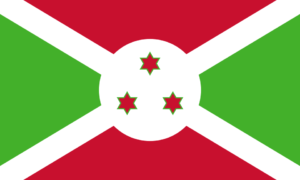
description: divided by a white diagonal cross into red triangles (top and bottom) and green triangles (on each side) with a white disk at the center bearing three six-pointed red stars outlined in green and arranged in a triangular design
meaning: green stands for hope and optimism, white for purity and peace, and red for the blood shed in the struggle for independence; the three stars represent the major ethnic groups (Hutu, Twa, Tutsi), as well as unity, work, and progress
meaning: green stands for hope and optimism, white for purity and peace, and red for the blood shed in the struggle for independence; the three stars represent the major ethnic groups (Hutu, Twa, Tutsi), as well as unity, work, and progress
National symbol(s)
lion
National color(s)
red, white, green
National anthem(s)
title: "Burundi Bwacu" (Our Beloved Burundi)
lyrics/music: Jean-Baptiste NTAHOKAJA/Marc BARENGAYABO
history: adopted 1962
Reference: 1962lyrics/music: Jean-Baptiste NTAHOKAJA/Marc BARENGAYABO
history: adopted 1962
Government & Official Links
| Institution | Official website | X / Twitter | Verification |
|---|---|---|---|
| Burundi official website | Official website | — | Reported · source Checked September 20, 2026 |
Institutional accounts only; personal accounts of political office-holders are excluded.
Legislature & Elections
Legislature
| Name | Chamber | Seats | Electoral system |
|---|---|---|---|
| Parliament of Burundi | — | — | — |
Economy
Economic overview
highly agrarian, low-income Sub-Saharan economy; declining foreign assistance; increasing fiscal insolvencies; dense and still growing population; COVID-19 weakened economic recovery and flipped two years of deflation
Real GDP (purchasing power parity)
Real GDP (purchasing power parity) 2024: $11.739 billion (2024 est.)
Real GDP (purchasing power parity) 2023: $11.343 billion (2023 est.)
Real GDP (purchasing power parity) 2022: $11.048 billion (2022 est.)
note: note: data in 2021 dollars
Reference: 2024, 2023, 2022, 2021Real GDP (purchasing power parity) 2023: $11.343 billion (2023 est.)
Real GDP (purchasing power parity) 2022: $11.048 billion (2022 est.)
note: note: data in 2021 dollars
Real GDP per capita
Real GDP per capita 2024: $800 (2024 est.)
Real GDP per capita 2023: $800 (2023 est.)
Real GDP per capita 2022: $800 (2022 est.)
note: note: data in 2021 dollars
Reference: 2024, 2023, 2022, 2021Real GDP per capita 2023: $800 (2023 est.)
Real GDP per capita 2022: $800 (2022 est.)
note: note: data in 2021 dollars
GDP - composition, by sector of origin
agriculture: 25.3% (2023 est.)
industry: 9.6% (2023 est.)
services: 49% (2023 est.)
note: note: figures may not total 100% due to non-allocated consumption not captured in sector-reported data
Reference: 2023industry: 9.6% (2023 est.)
services: 49% (2023 est.)
note: note: figures may not total 100% due to non-allocated consumption not captured in sector-reported data
GDP - composition, by end use
household consumption: 75.9% (2023 est.)
government consumption: 30.7% (2023 est.)
investment in fixed capital: 13.1% (2023 est.)
investment in inventories: 0% (2023 est.)
exports of goods and services: 5.3% (2023 est.)
imports of goods and services: -24.4% (2023 est.)
note: note: figures may not total 100% due to rounding or gaps in data collection
Reference: 2023government consumption: 30.7% (2023 est.)
investment in fixed capital: 13.1% (2023 est.)
investment in inventories: 0% (2023 est.)
exports of goods and services: 5.3% (2023 est.)
imports of goods and services: -24.4% (2023 est.)
note: note: figures may not total 100% due to rounding or gaps in data collection
Agricultural products
cassava, bananas, sweet potatoes, beans, maize, vegetables, potatoes, rice, sugarcane, fruits (2023)
note: note: top ten agricultural products based on tonnage
Reference: 2023note: note: top ten agricultural products based on tonnage
Industries
light consumer goods (sugar, shoes, soap, beer); cement, assembly of imported components; public works construction; food processing (fruits)
Industrial production growth rate
-0.2% (2024 est.)
note: note: annual % change in industrial value added based on constant local currency
Reference: 2024note: note: annual % change in industrial value added based on constant local currency
Labor force
6.107 million (2024 est.)
note: note: number of people ages 15 or older who are employed or seeking work
Reference: 2024note: note: number of people ages 15 or older who are employed or seeking work
Youth unemployment rate (ages 15-24)
total: 1.6% (2024 est.)
male: 2.1% (2024 est.)
female: 1.2% (2024 est.)
note: note: % of labor force ages 15-24 seeking employment
Reference: 2024male: 2.1% (2024 est.)
female: 1.2% (2024 est.)
note: note: % of labor force ages 15-24 seeking employment
Population below poverty line
51% (2020 est.)
note: note: % of population with income below national poverty line
Reference: 2020note: note: % of population with income below national poverty line
Gini Index coefficient - distribution of family income
Gini Index coefficient - distribution of family income 2020: 37.5 (2020 est.)
note: note: index (0-100) of income distribution; higher values represent greater inequality
Reference: 2020note: note: index (0-100) of income distribution; higher values represent greater inequality
Household income or consumption by percentage share
lowest 10%: 2.9% (2020 est.)
highest 10%: 29.9% (2020 est.)
note: note: % share of income accruing to lowest and highest 10% of population
Reference: 2020highest 10%: 29.9% (2020 est.)
note: note: % share of income accruing to lowest and highest 10% of population
Remittances
Remittances 2023: 7.5% of GDP (2023 est.)
Remittances 2022: 4.9% of GDP (2022 est.)
Remittances 2021: 6.1% of GDP (2021 est.)
note: note: personal transfers and compensation between resident and non-resident individuals/households/entities
Reference: 2023, 2022, 2021Remittances 2022: 4.9% of GDP (2022 est.)
Remittances 2021: 6.1% of GDP (2021 est.)
note: note: personal transfers and compensation between resident and non-resident individuals/households/entities
Budget
revenues: $713.694 million (2021 est.)
expenditures: $737.898 million (2021 est.)
note: note: central government revenues and expenses (excluding grants/extrabudgetary units/social security funds) converted to US dollars at average official exchange rate for year indicated
Reference: 2021expenditures: $737.898 million (2021 est.)
note: note: central government revenues and expenses (excluding grants/extrabudgetary units/social security funds) converted to US dollars at average official exchange rate for year indicated
Public debt
Public debt 2016: 48.4% of GDP (2016 est.)
Reference: 2016Taxes and other revenues
15.6% (of GDP) (2021 est.)
note: note: central government tax revenue as a % of GDP
Reference: 2021note: note: central government tax revenue as a % of GDP
Current account balance
Current account balance 2023: -$625.597 million (2023 est.)
Current account balance 2022: -$621.969 million (2022 est.)
Current account balance 2021: -$393.88 million (2021 est.)
note: note: balance of payments - net trade and primary/secondary income in current dollars
Reference: 2023, 2022, 2021Current account balance 2022: -$621.969 million (2022 est.)
Current account balance 2021: -$393.88 million (2021 est.)
note: note: balance of payments - net trade and primary/secondary income in current dollars
Exports
Exports 2023: $378.229 million (2023 est.)
Exports 2022: $333.637 million (2022 est.)
Exports 2021: $302.752 million (2021 est.)
note: note: balance of payments - exports of goods and services in current dollars
Reference: 2023, 2022, 2021Exports 2022: $333.637 million (2022 est.)
Exports 2021: $302.752 million (2021 est.)
note: note: balance of payments - exports of goods and services in current dollars
Exports - partners
UAE 59%, Uganda 8%, China 5%, Germany 5%, USA 3% (2023)
note: note: top five export partners based on percentage share of exports
Reference: 2023note: note: top five export partners based on percentage share of exports
Exports - commodities
gold, coffee, tea, tin ores, iron bars (2023)
note: note: top five export commodities based on value in dollars
Reference: 2023note: note: top five export commodities based on value in dollars
Imports
Imports 2023: $1.433 billion (2023 est.)
Imports 2022: $1.42 billion (2022 est.)
Imports 2021: $1.166 billion (2021 est.)
note: note: balance of payments - imports of goods and services in current dollars
Reference: 2023, 2022, 2021Imports 2022: $1.42 billion (2022 est.)
Imports 2021: $1.166 billion (2021 est.)
note: note: balance of payments - imports of goods and services in current dollars
Imports - partners
Tanzania 26%, China 15%, Uganda 10%, Kenya 10%, India 6% (2023)
note: note: top five import partners based on percentage share of imports
Reference: 2023note: note: top five import partners based on percentage share of imports
Imports - commodities
fertilizers, cement, packaged medicine, plastic products, cars (2023)
note: note: top five import commodities based on value in dollars
Reference: 2023note: note: top five import commodities based on value in dollars
Reserves of foreign exchange and gold
Reserves of foreign exchange and gold 2023: $90.35 million (2023 est.)
Reserves of foreign exchange and gold 2022: $158.53 million (2022 est.)
Reserves of foreign exchange and gold 2021: $266.164 million (2021 est.)
note: note: holdings of gold (year-end prices)/foreign exchange/special drawing rights in current dollars
Reference: 2023, 2022, 2021Reserves of foreign exchange and gold 2022: $158.53 million (2022 est.)
Reserves of foreign exchange and gold 2021: $266.164 million (2021 est.)
note: note: holdings of gold (year-end prices)/foreign exchange/special drawing rights in current dollars
Debt - external
Debt - external 2023: $805.174 million (2023 est.)
note: note: present value of external debt in current US dollars
Reference: 2023note: note: present value of external debt in current US dollars
Exchange rates
Currency: Burundi francs (BIF) per US dollar -
Exchange rates 2023: 2,574.052 (2023 est.)
Exchange rates 2022: 2,034.307 (2022 est.)
Exchange rates 2021: 1,975.951 (2021 est.)
Exchange rates 2020: 1,915.046 (2020 est.)
Exchange rates 2019: 1,845.623 (2019 est.)
Reference: 2023, 2022, 2021, 2020Exchange rates 2023: 2,574.052 (2023 est.)
Exchange rates 2022: 2,034.307 (2022 est.)
Exchange rates 2021: 1,975.951 (2021 est.)
Exchange rates 2020: 1,915.046 (2020 est.)
Exchange rates 2019: 1,845.623 (2019 est.)
Trade
Current account balance
Current account balance 2023: -$625.597 million (2023 est.)
Current account balance 2022: -$621.969 million (2022 est.)
Current account balance 2021: -$393.88 million (2021 est.)
note: note: balance of payments - net trade and primary/secondary income in current dollars
Reference: 2023, 2022, 2021Current account balance 2022: -$621.969 million (2022 est.)
Current account balance 2021: -$393.88 million (2021 est.)
note: note: balance of payments - net trade and primary/secondary income in current dollars
Exports
Exports 2023: $378.229 million (2023 est.)
Exports 2022: $333.637 million (2022 est.)
Exports 2021: $302.752 million (2021 est.)
note: note: balance of payments - exports of goods and services in current dollars
Reference: 2023, 2022, 2021Exports 2022: $333.637 million (2022 est.)
Exports 2021: $302.752 million (2021 est.)
note: note: balance of payments - exports of goods and services in current dollars
Exports - partners
UAE 59%, Uganda 8%, China 5%, Germany 5%, USA 3% (2023)
note: note: top five export partners based on percentage share of exports
Reference: 2023note: note: top five export partners based on percentage share of exports
Exports - commodities
gold, coffee, tea, tin ores, iron bars (2023)
note: note: top five export commodities based on value in dollars
Reference: 2023note: note: top five export commodities based on value in dollars
Imports
Imports 2023: $1.433 billion (2023 est.)
Imports 2022: $1.42 billion (2022 est.)
Imports 2021: $1.166 billion (2021 est.)
note: note: balance of payments - imports of goods and services in current dollars
Reference: 2023, 2022, 2021Imports 2022: $1.42 billion (2022 est.)
Imports 2021: $1.166 billion (2021 est.)
note: note: balance of payments - imports of goods and services in current dollars
Imports - partners
Tanzania 26%, China 15%, Uganda 10%, Kenya 10%, India 6% (2023)
note: note: top five import partners based on percentage share of imports
Reference: 2023note: note: top five import partners based on percentage share of imports
Imports - commodities
fertilizers, cement, packaged medicine, plastic products, cars (2023)
note: note: top five import commodities based on value in dollars
Reference: 2023note: note: top five import commodities based on value in dollars
Energy & Resources
Electricity
installed generating capacity: 131,000 kW (2023 est.)
consumption: 444.018 million kWh (2023 est.)
imports: 100 million kWh (2023 est.)
transmission/distribution losses: 39.994 million kWh (2023 est.)
Reference: 2023consumption: 444.018 million kWh (2023 est.)
imports: 100 million kWh (2023 est.)
transmission/distribution losses: 39.994 million kWh (2023 est.)
Electricity generation sources
fossil fuels: 31.2% of total installed capacity (2023 est.)
solar: 0.5% of total installed capacity (2023 est.)
hydroelectricity: 66.7% of total installed capacity (2023 est.)
biomass and waste: 1.6% of total installed capacity (2023 est.)
Reference: 2023solar: 0.5% of total installed capacity (2023 est.)
hydroelectricity: 66.7% of total installed capacity (2023 est.)
biomass and waste: 1.6% of total installed capacity (2023 est.)
Coal
consumption: 1,000 metric tons (2023 est.)
imports: 10,000 metric tons (2023 est.)
Reference: 2023imports: 10,000 metric tons (2023 est.)
Petroleum
refined petroleum consumption: 6,000 bbl/day (2023 est.)
Reference: 2023Energy consumption per capita
Total energy consumption per capita 2023: 946,000 Btu/person (2023 est.)
Reference: 2023Infrastructure
Telephones - fixed lines
total subscriptions: 14,000 (2023 est.)
subscriptions per 100 inhabitants: (2023 est.) less than 1
Reference: 2023subscriptions per 100 inhabitants: (2023 est.) less than 1
Telephones - mobile cellular
total subscriptions: 8.65 million (2023 est.)
subscriptions per 100 inhabitants: 58 (2022 est.)
Reference: 2023, 2022subscriptions per 100 inhabitants: 58 (2022 est.)
Broadband - fixed subscriptions
total: 3,000 (2023 est.)
subscriptions per 100 inhabitants: (2023 est.) less than 1
Reference: 2023subscriptions per 100 inhabitants: (2023 est.) less than 1
Health
Maternal mortality ratio
392 deaths/100,000 live births (2023 est.)
Reference: 2023Health expenditure
Health expenditure (as % of GDP): 9.1% of GDP (2021)
Health expenditure (as % of national budget): 4.7% of national budget (2022 est.)
Reference: 2022, 2021Health expenditure (as % of national budget): 4.7% of national budget (2022 est.)
Physician density
0.08 physicians/1,000 population (2022)
Reference: 2022Obesity - adult prevalence rate
5.4% (2016)
Reference: 2016Tobacco use
total: 9.1% (2025 est.)
male: 14% (2025 est.)
female: 4.3% (2025 est.)
male: 14% (2025 est.)
female: 4.3% (2025 est.)
Education
School life expectancy (primary to tertiary education)
total: 10 years (2018 est.)
male: 10 years (2018 est.)
female: 10 years (2018 est.)
Reference: 2018male: 10 years (2018 est.)
female: 10 years (2018 est.)
Rights, Freedoms & Society
Press & Media Freedom
V-Dem expert-coded/modelled source measures. Knelstrom does not create a press-freedom ranking or composite score.
LGBTQ+ Rights & Law
Concrete legal-status fields only; Knelstrom does not generate an LGBTQ rights score or country ranking.
Source: Wikipedia — LGBTQ rights by country or territory (CC BY-SA 4.0). Community-edited legal-status summary; retrieved by Knelstrom and not legal advice.
Crime & Justice
Legal system
mixed legal system of Belgian civil law and customary law
Judicial branch
highest court(s): Supreme Court (consists of 9 judges and organized into judicial, administrative, and cassation chambers); Constitutional Court (consists of 7 members)
judge selection and term of office: Supreme Court judges nominated by the Judicial Service Commission, a 15-member body of judicial and legal profession officials), appointed by the president and confirmed by the Senate; judge tenure NA; Constitutional Court judges appointed by the president and confirmed by the Senate and serve 6-year nonrenewable terms
subordinate courts: Courts of Appeal; County Courts; Courts of Residence; Martial Court; Commercial Court
judge selection and term of office: Supreme Court judges nominated by the Judicial Service Commission, a 15-member body of judicial and legal profession officials), appointed by the president and confirmed by the Senate; judge tenure NA; Constitutional Court judges appointed by the president and confirmed by the Senate and serve 6-year nonrenewable terms
subordinate courts: Courts of Appeal; County Courts; Courts of Residence; Martial Court; Commercial Court
Military & Security
Military and security forces
Burundi National Defense Force (BNDF; Force de Defense Nationale du Burundi, FDNB): Land Force (Army), Naval Force, Air Force, Specialized Units
Ministry of Interior, Community Development, and Public Security: Burundi National Police (Police Nationale du Burundi, PNB) (2024)
note: note: the Naval Force is responsible for monitoring Burundi’s 175-km shoreline on Lake Tanganyika; the Specialized Units include a special security brigade for the protection of institutions (aka BSPI), commandos, special forces, and military police
Reference: 2024Ministry of Interior, Community Development, and Public Security: Burundi National Police (Police Nationale du Burundi, PNB) (2024)
note: note: the Naval Force is responsible for monitoring Burundi’s 175-km shoreline on Lake Tanganyika; the Specialized Units include a special security brigade for the protection of institutions (aka BSPI), commandos, special forces, and military police
Military expenditures
Military Expenditures 2024: 3.5% of GDP (2024 est.)
Military Expenditures 2023: 3% of GDP (2023 est.)
Military Expenditures 2022: 2.6% of GDP (2022 est.)
Military Expenditures 2021: 2% of GDP (2021 est.)
Military Expenditures 2020: 2.1% of GDP (2020 est.)
Reference: 2024, 2023, 2022, 2021Military Expenditures 2023: 3% of GDP (2023 est.)
Military Expenditures 2022: 2.6% of GDP (2022 est.)
Military Expenditures 2021: 2% of GDP (2021 est.)
Military Expenditures 2020: 2.1% of GDP (2020 est.)
Military and security service personnel strengths
limited available information; estimated 25-30,000 active-duty Defense Force troops (2025)
Military equipment inventories and acquisitions
the military has a mix of mostly older weapons and equipment typically of French, Russian, and Soviet origin, and a smaller selection of more modern secondhand equipment from such countries as China, South Africa, and the US (2024)
Reference: 2024Military service age and obligation
18 years of age for voluntary military service for men and women (2023)
Reference: 2023Military deployments
770 Central African Republic (MINUSCA) (2025)
note: note: Burundi has deployed several thousand military troops to the Democratic Republic of the Congo (DRC) since 2022 to assist the DRC Government in combating armed anti-government rebel groups; a contingent remained in the DRC as of late 2025
Reference: 2025, 2022note: note: Burundi has deployed several thousand military troops to the Democratic Republic of the Congo (DRC) since 2022 to assist the DRC Government in combating armed anti-government rebel groups; a contingent remained in the DRC as of late 2025
Military - note
the National Defense Force (FDNB) is responsible for defending Burundi’s territorial integrity and protecting its sovereignty; it has an internal security role, including maintaining and restoring public order if required; the FDNB also participates in providing humanitarian/disaster assistance, countering terrorism, narcotics trafficking, piracy, and illegal arms trade, and protecting the country’s environment; the FDNB conducts limited training with foreign partners such as Russia and participates in regional peacekeeping missions, most recently in the Central African Republic, the Democratic Republic of the Congo (DRC), and Somalia; in recent years the FDNB has conducted operations against anti-government rebel groups based in the neighboring DRC that have carried out sporadic attacks in Burundi, such as the such as National Forces of Liberation (FNL), the Resistance for the Rule of Law-Tabara (aka RED Tabara), and Popular Forces of Burundi (FPB or FOREBU); Burundi has accused Rwanda of supporting the RED-Tabara
the Arusha Accords that ended the 1993-2005 civil war created a unified military by balancing the predominantly Tutsi ex-Burundi Armed Forces (ex-FAB) and the largely Hutu dominated armed movements and requiring the military to have a 50/50 ethnic mix of Tutsis and Hutus (2025)
Reference: 2025, 2005, 1993the Arusha Accords that ended the 1993-2005 civil war created a unified military by balancing the predominantly Tutsi ex-Burundi Armed Forces (ex-FAB) and the largely Hutu dominated armed movements and requiring the military to have a 50/50 ethnic mix of Tutsis and Hutus (2025)
International Relations
International law organization participation
has not submitted an ICJ jurisdiction declaration; withdrew from ICCt in October 2017
Reference: 2017Diplomatic representation in the US
chief of mission: Ambassador Jean Bosco BAREGE (since 27 February 2024)
chancery: 2233 Wisconsin Avenue NW, Washington, DC 20007
telephone: [1] (202) 342-2574
FAX: [1] (202) 342-2578
email address and website: burundiembusadc@gmail.com
Burundi Embassy Washington D.C. (burundiembassy-usa.com)
Reference: 2024chancery: 2233 Wisconsin Avenue NW, Washington, DC 20007
telephone: [1] (202) 342-2574
FAX: [1] (202) 342-2578
email address and website: burundiembusadc@gmail.com
Burundi Embassy Washington D.C. (burundiembassy-usa.com)
Diplomatic representation from the US
chief of mission: Ambassador Lisa PETERSON (since 27 June 2024)
embassy: No 50 Avenue Des Etats-Unis, 110-01-02, Bujumbura
mailing address: 2100 Bujumbura Place, Washington DC 20521-2100
telephone: [257] 22-207-000
FAX: [257] 22-222-926
email address and website: BujumburaC@state.gov
https://bi.usembassy.gov/
Reference: 2024embassy: No 50 Avenue Des Etats-Unis, 110-01-02, Bujumbura
mailing address: 2100 Bujumbura Place, Washington DC 20521-2100
telephone: [257] 22-207-000
FAX: [257] 22-222-926
email address and website: BujumburaC@state.gov
https://bi.usembassy.gov/
International organization participation
ACP, AfDB, ATMIS, AU, CEMAC, CEPGL, CICA, COMESA, EAC, FAO, G-77, IBRD, ICAO, ICGLR, ICRM, IDA, IFAD, IFC, IFRCS, ILO, IMF, Interpol, IOC, IOM, IPU, ISO (correspondent), ITU, ITUC (NGOs), MIGA, NAM, OIF, OPCW, UN, UNCTAD, UNESCO, UNHRC, UNIDO, UNISFA, UNMISS, UNWTO, UPU, WCO, WHO, WIPO, WMO, WTO
Treaties & Organisations
| Organisation | Status | Joined |
|---|---|---|
| African Union (AU) | member | 1963-05-25 |
| United Nations (UN) | member | 1966-11-28 |
| World Trade Organization (WTO) | member | 1995-07-23 |
International law organization participation
has not submitted an ICJ jurisdiction declaration; withdrew from ICCt in October 2017
Reference: 2017International organization participation
ACP, AfDB, ATMIS, AU, CEMAC, CEPGL, CICA, COMESA, EAC, FAO, G-77, IBRD, ICAO, ICGLR, ICRM, IDA, IFAD, IFC, IFRCS, ILO, IMF, Interpol, IOC, IOM, IPU, ISO (correspondent), ITU, ITUC (NGOs), MIGA, NAM, OIF, OPCW, UN, UNCTAD, UNESCO, UNHRC, UNIDO, UNISFA, UNMISS, UNWTO, UPU, WCO, WHO, WIPO, WMO, WTO
Conflict & Security
Refugees and internally displaced persons
refugees: 91,164 (2024 est.)
IDPs: 92,174 (2024 est.)
stateless persons: 791 (2024 est.)
Reference: 2024IDPs: 92,174 (2024 est.)
stateless persons: 791 (2024 est.)
Transportation & Logistics
Civil aircraft registration country code prefix
9U
Airports
6 (2025)
Environment
Environmental issues
soil erosion from overgrazing and agricultural expansion; deforestation; wildlife habitat loss
International environmental agreements
party to: Biodiversity, Climate Change, Climate Change-Kyoto Protocol, Climate Change-Paris Agreement, Comprehensive Nuclear Test Ban, Desertification, Endangered Species, Hazardous Wastes, Ozone Layer Protection, Wetlands
signed, but not ratified: Law of the Sea, Nuclear Test Ban
signed, but not ratified: Law of the Sea, Nuclear Test Ban
Climate
equatorial; high plateau with considerable altitude variation (772 m to 2,670 m above sea level); average annual temperature varies with altitude from 23 to 17 degrees Celsius but is generally moderate; average annual rainfall is about 150 cm with two wet seasons (February to May and September to November) and two dry seasons (June to August and December to January)
Land use
agricultural land: 83.9% (2023 est.)
agricultural land: arable land: arable land: 51.4% (2023 est.)
agricultural land: permanent crops: permanent crops: 13.6% (2023 est.)
agricultural land: permanent pasture: permanent pasture: 18.8% (2023 est.)
forest: 10.9% (2023 est.)
other: 5.2% (2023 est.)
Reference: 2023agricultural land: arable land: arable land: 51.4% (2023 est.)
agricultural land: permanent crops: permanent crops: 13.6% (2023 est.)
agricultural land: permanent pasture: permanent pasture: 18.8% (2023 est.)
forest: 10.9% (2023 est.)
other: 5.2% (2023 est.)
Urbanization
urban population: 14.8% of total population (2023)
rate of urbanization: 5.43% annual rate of change (2020-25 est.)
Reference: 2023, 2020rate of urbanization: 5.43% annual rate of change (2020-25 est.)
Carbon dioxide emissions
total emissions: 838,000 metric tonnes of CO2 (2023 est.)
from coal and metallurgical coke: 32,000 metric tonnes of CO2 (2023 est.)
from petroleum and other liquids: 806,000 metric tonnes of CO2 (2023 est.)
Reference: 2023from coal and metallurgical coke: 32,000 metric tonnes of CO2 (2023 est.)
from petroleum and other liquids: 806,000 metric tonnes of CO2 (2023 est.)
Particulate matter emissions
26.3 micrograms per cubic meter (2019 est.)
Reference: 2019Waste and recycling
municipal solid waste generated annually: 1.872 million tons (2024 est.)
percent of municipal solid waste recycled: 7.1% (2022 est.)
Reference: 2024, 2022percent of municipal solid waste recycled: 7.1% (2022 est.)
Total water withdrawal
municipal: 43.1 million cubic meters (2022 est.)
industrial: 15 million cubic meters (2022 est.)
agricultural: 222 million cubic meters (2022 est.)
Reference: 2022industrial: 15 million cubic meters (2022 est.)
agricultural: 222 million cubic meters (2022 est.)
Total renewable water resources
12.536 billion cubic meters (2022 est.)
Reference: 2022Communications & Media
Telephones - fixed lines
total subscriptions: 14,000 (2023 est.)
subscriptions per 100 inhabitants: (2023 est.) less than 1
Reference: 2023subscriptions per 100 inhabitants: (2023 est.) less than 1
Telephones - mobile cellular
total subscriptions: 8.65 million (2023 est.)
subscriptions per 100 inhabitants: 58 (2022 est.)
Reference: 2023, 2022subscriptions per 100 inhabitants: 58 (2022 est.)
Broadcast media
state-controlled Radio Television Nationale de Burundi (RTNB) operates a TV station and a national radio network; 3 private TV stations and about 10 privately owned radio stations; transmissions of several international broadcasters are available in Bujumbura (2019)
Reference: 2019Internet country code
.bi
Internet users
percent of population: 11% (2023 est.)
Reference: 2023Broadband - fixed subscriptions
total: 3,000 (2023 est.)
subscriptions per 100 inhabitants: (2023 est.) less than 1
Reference: 2023subscriptions per 100 inhabitants: (2023 est.) less than 1
Historical Trends
Population
Source: World Bank WDI. Historical observations shown by reference period.
View Population data table
| Period | Value | Source |
|---|---|---|
| 2016 | 11,239,451 | world_bank_wdi |
| 2017 | 11,506,762 | world_bank_wdi |
| 2018 | 11,859,446 | world_bank_wdi |
| 2019 | 12,255,336 | world_bank_wdi |
| 2020 | 12,617,036 | world_bank_wdi |
| 2021 | 12,965,481 | world_bank_wdi |
| 2022 | 13,321,097 | world_bank_wdi |
| 2023 | 13,689,450 | world_bank_wdi |
| 2024 | 14,047,786 | world_bank_wdi |
| 2025 | 14,390,003 | world_bank_wdi |
GDP (current US$)
Source: World Bank WDI. Historical observations shown by reference period.
View GDP (current US$) data table
| Period | Value | Source |
|---|---|---|
| 2016 | $2,618,093,125 | world_bank_wdi |
| 2017 | $2,831,362,208 | world_bank_wdi |
| 2018 | $2,913,411,408 | world_bank_wdi |
| 2019 | $2,871,555,326 | world_bank_wdi |
| 2020 | $3,188,355,944 | world_bank_wdi |
| 2021 | $3,425,127,991 | world_bank_wdi |
| 2022 | $4,020,736,757 | world_bank_wdi |
| 2023 | $3,419,558,408 | world_bank_wdi |
| 2024 | $3,037,579,858 | world_bank_wdi |
| 2025 | $3,364,713,864 | world_bank_wdi |
International migrant stock (immigrants)
Source: World Bank WDI. Historical observations shown by reference period.
View International migrant stock (immigrants) data table
| Period | Value | Source |
|---|---|---|
| 2020 | 344,767 | world_bank_wdi |
| 2024 | 387,101 | world_bank_wdi |
International emigrant stock
Source: World Bank WDI. Historical observations shown by reference period.
View International emigrant stock data table
| Period | Value | Source |
|---|---|---|
| 1990 | 342,568 | un_migrant_stock_2024 |
| 1995 | 549,487 | un_migrant_stock_2024 |
| 2000 | 802,113 | un_migrant_stock_2024 |
| 2005 | 651,030 | un_migrant_stock_2024 |
| 2010 | 290,788 | un_migrant_stock_2024 |
| 2015 | 444,013 | un_migrant_stock_2024 |
| 2020 | 552,134 | un_migrant_stock_2024 |
| 2024 | 576,530 | un_migrant_stock_2024 |
Net migration
Source: World Bank WDI. Historical observations shown by reference period.
View Net migration data table
| Period | Value | Source |
|---|---|---|
| 2016 | -109,296 | world_bank_wdi |
| 2017 | -68,349 | world_bank_wdi |
| 2018 | 68,141 | world_bank_wdi |
| 2019 | 14,253 | world_bank_wdi |
| 2020 | -10,189 | world_bank_wdi |
| 2021 | -14,415 | world_bank_wdi |
| 2022 | 1,995 | world_bank_wdi |
| 2023 | 1,995 | world_bank_wdi |
| 2024 | -27,074 | world_bank_wdi |
| 2025 | -34,727 | world_bank_wdi |
Sources & Methodology
Current statistical observations include their reference period and provenance. Reference fields from approved source datasets are attributed below. Missing information is left unknown rather than inferred.
| Indicator | Value | Period | Source | Status |
|---|---|---|---|---|
| Population | 14,390,003 | 2025 | World Bank — World Development Indicators | Verified |
| UN Population Division population estimate | 14,729,157 | 2026 | UN Population Division Data Portal | Estimated |
| Wikidata population (fallback) | 13,689,450 | 2023 | Wikidata | Reported |
| International migrant stock (immigrants) | 387,101 | 2024 | World Bank — World Development Indicators | Verified |
| International migrant stock | 2.8% | 2024 | World Bank — World Development Indicators | Verified |
| International emigrant stock | 576,530 | 2024 | UN DESA International Migrant Stock 2024 | Estimated |
| Net migration | -34,727 | 2025 | World Bank — World Development Indicators | Verified |
| Refugees hosted | 110,800 | 2025 | UNHCR Refugee Population Statistics | Verified |
| Asylum seekers hosted | 1,466 | 2025 | UNHCR Refugee Population Statistics | Verified |
| Refugees from this country | 318,291 | 2025 | World Bank — World Development Indicators | Verified |
| Asylum seekers from this country | 64,899 | 2025 | World Bank — World Development Indicators | Verified |
| Freedom of expression & alternative information index | 0.164 | 2025 | Varieties of Democracy (V-Dem) Country-Year Dataset v16 | Estimated |
| Government censorship effort — media | -2.225 | 2025 | Varieties of Democracy (V-Dem) Country-Year Dataset v16 | Estimated |
| Harassment of journalists | -1.948 | 2025 | Varieties of Democracy (V-Dem) Country-Year Dataset v16 | Estimated |
| Print/broadcast media critical of government | -0.636 | 2025 | Varieties of Democracy (V-Dem) Country-Year Dataset v16 | Estimated |
| Range of perspectives in major media | -1.792 | 2025 | Varieties of Democracy (V-Dem) Country-Year Dataset v16 | Estimated |
| Media bias | 0.046 | 2025 | Varieties of Democracy (V-Dem) Country-Year Dataset v16 | Estimated |
| Media self-censorship | -1.033 | 2025 | Varieties of Democracy (V-Dem) Country-Year Dataset v16 | Estimated |
| Same-sex sexual activity | No Illegal since 22 April 2009; Penalty: 3 months to 2 years imprisonment and fines. (repeal disputed) | current | Wikipedia — LGBTQ rights by country or territory | Reported |
| Recognition of same-sex relationships | No | current | Wikipedia — LGBTQ rights by country or territory | Reported |
| Same-sex marriage | No Constitutional ban since 2005 | current | Wikipedia — LGBTQ rights by country or territory | Reported |
| Same-sex adoption | No | current | Wikipedia — LGBTQ rights by country or territory | Reported |
| Open military service | No | current | Wikipedia — LGBTQ rights by country or territory | Reported |
| Sexual-orientation anti-discrimination law | No | current | Wikipedia — LGBTQ rights by country or territory | Reported |
| Gender identity / expression law | No | current | Wikipedia — LGBTQ rights by country or territory | Reported |
| GDP (current US$) | $3,364,713,864 | 2025 | World Bank — World Development Indicators | Verified |
| GDP per capita (current US$) | $234 | 2025 | World Bank — World Development Indicators | Verified |
| GDP growth | 4.2% | 2025 | World Bank — World Development Indicators | Verified |
| Inflation, consumer prices | 34.1% | 2025 | World Bank — World Development Indicators | Verified |
| Unemployment | 0.9% | 2025 | World Bank — World Development Indicators | Verified |
| Income level | Low income | current | World Bank — World Development Indicators | Verified |
| Life expectancy at birth | 63.8 years | 2024 | World Bank — World Development Indicators | Verified |
| Fertility rate | 4.8 | 2024 | World Bank — World Development Indicators | Verified |
| Urban population | 25.7% | 2025 | World Bank — World Development Indicators | Verified |
| Individuals using the Internet | 8.6% | 2024 | World Bank — World Development Indicators | Verified |
| Adult literacy rate | 71.3% | 2020 | World Bank — World Development Indicators | Verified |
| Secondary school enrolment, gross | 23.1% | 2025 | World Bank — World Development Indicators | Verified |
| Government education expenditure | 4.5% | 2025 | World Bank — World Development Indicators | Verified |
| Access to electricity | 20.1% | 2024 | World Bank — World Development Indicators | Verified |
| Renewable energy consumption | 83.0% | 2022 | World Bank — World Development Indicators | Verified |
| Current health expenditure | 9.1% | 2023 | World Bank — World Development Indicators | Verified |
| Infant mortality rate | 30.5 per 1,000 | 2024 | World Bank — World Development Indicators | Verified |
| Forest area | 10.9% | 2023 | World Bank — World Development Indicators | Verified |
| Mobile cellular subscriptions | 63.2 per 100 | 2023 | World Bank — World Development Indicators | Verified |
| Fixed broadband subscriptions | 0.0 per 100 | 2023 | World Bank — World Development Indicators | Verified |
| Secure Internet servers | 11 per million | 2024 | World Bank — World Development Indicators | Verified |
| Latitude | -3.3784° | current | World Bank — World Development Indicators | Verified |
| Longitude | 29.3639° | current | World Bank — World Development Indicators | Verified |
| Latitude (Wikidata) | -3.6667° | current | Wikidata | Reported |
| Longitude (Wikidata) | 29.8167° | current | Wikidata | Reported |
| Time zone | UTC+02:00, Africa/Bujumbura | current | Wikidata | Reported |
| Form of government | representative democracy, presidential system | current | Wikidata | Reported |
Data attribution
Credits below are generated from sources actually used by this country profile. Source-specific terms take precedence.
- CIA World Factbook, final 2025 country profile (structured via factbook.json). Accessed September 20, 2026. U.S. Government public-domain data; retained as a reference source where a newer approved field is not available. Source · Terms/licence
- United Nations, Department of Economic and Social Affairs, Population Division, International Migrant Stock 2024; data access/processing via Our World in Data. Accessed September 20, 2026. Underlying UN dataset used under CC BY 3.0 IGO. Source · Terms/licence
- United Nations, Department of Economic and Social Affairs, Population Division, World Population Prospects (WPP indicator 49) Accessed September 19, 2026. Used under CC BY 3.0 IGO; current-year WPP population values are presented as estimates/projections where applicable. Source · Terms/licence
- UNHCR Refugee Population Statistics Database. Accessed October 13, 2026. Used under CC BY 4.0 except where a dataset identifies a different source or licence. Source · Terms/licence
- Varieties of Democracy (V-Dem), Country-Year Dataset v16 (variables: v2mebias, v2mecenefm, v2mecrit, v2meharjrn, v2merange, v2meslfcen, v2x_freexp_altinf) Accessed September 20, 2026. Used under CC BY-SA 4.0; V-Dem measures are expert-coded/modelled and no V-Dem endorsement is implied. Source · Terms/licence
- Wikidata structured data (CC0). Accessed September 20, 2026. Attribution is provided by Knelstrom for provenance although CC0 does not require it. Source · Terms/licence
- Wikipedia, “LGBTQ rights by country or territory” (source revision/data fields: Wikipedia revision 1374406645 — Gender identity / expression law, Wikipedia revision 1374406645 — Open military service, Wikipedia revision 1374406645 — Recognition of same-sex relationships, Wikipedia revision 1374406645 — Same-sex adoption, Wikipedia revision 1374406645 — Same-sex marriage, Wikipedia revision 1374406645 — Same-sex sexual activity, Wikipedia revision 1374406645 — Sexual-orientation anti-discrimination law) Accessed October 18, 2026. Used under CC BY-SA 4.0. Knelstrom changes formatting and presents the imported material as a community-edited legal-status summary, not legal advice or a Knelstrom rights score. Source · Terms/licence
- World Bank, World Development Indicators (series: AG.LND.FRST.ZS, country_metadata, EG.ELC.ACCS.ZS, EG.FEC.RNEW.ZS, FP.CPI.TOTL.ZG, IT.CEL.SETS.P2, IT.NET.BBND.P2, IT.NET.SECR.P6, IT.NET.USER.ZS, NY.GDP.MKTP.CD, NY.GDP.MKTP.KD.ZG, NY.GDP.PCAP.CD, SE.ADT.LITR.ZS, SE.SEC.ENRR, SE.XPD.TOTL.GD.ZS, SH.XPD.CHEX.GD.ZS, SL.UEM.TOTL.ZS, SM.POP.ASYS.EO, SM.POP.NETM, SM.POP.RHCR.EO, SM.POP.TOTL, SM.POP.TOTL.ZS, SP.DYN.IMRT.IN, SP.DYN.LE00.IN, SP.DYN.TFRT.IN, SP.POP.TOTL, SP.URB.TOTL.IN.ZS) Accessed October 18, 2026. Data used under CC BY 4.0; Knelstrom presentation/formatting may differ from the source. Source · Terms/licence
- Country flag from Wikimedia Commons. https://commons.wikimedia.org/wiki/File%3AFlag_of_Burundi.svg
Knelstrom does not imply endorsement by any listed data provider.
Last automated statistical refresh: 2026-10-18 20:50:38