Image by: Knelstrom Media
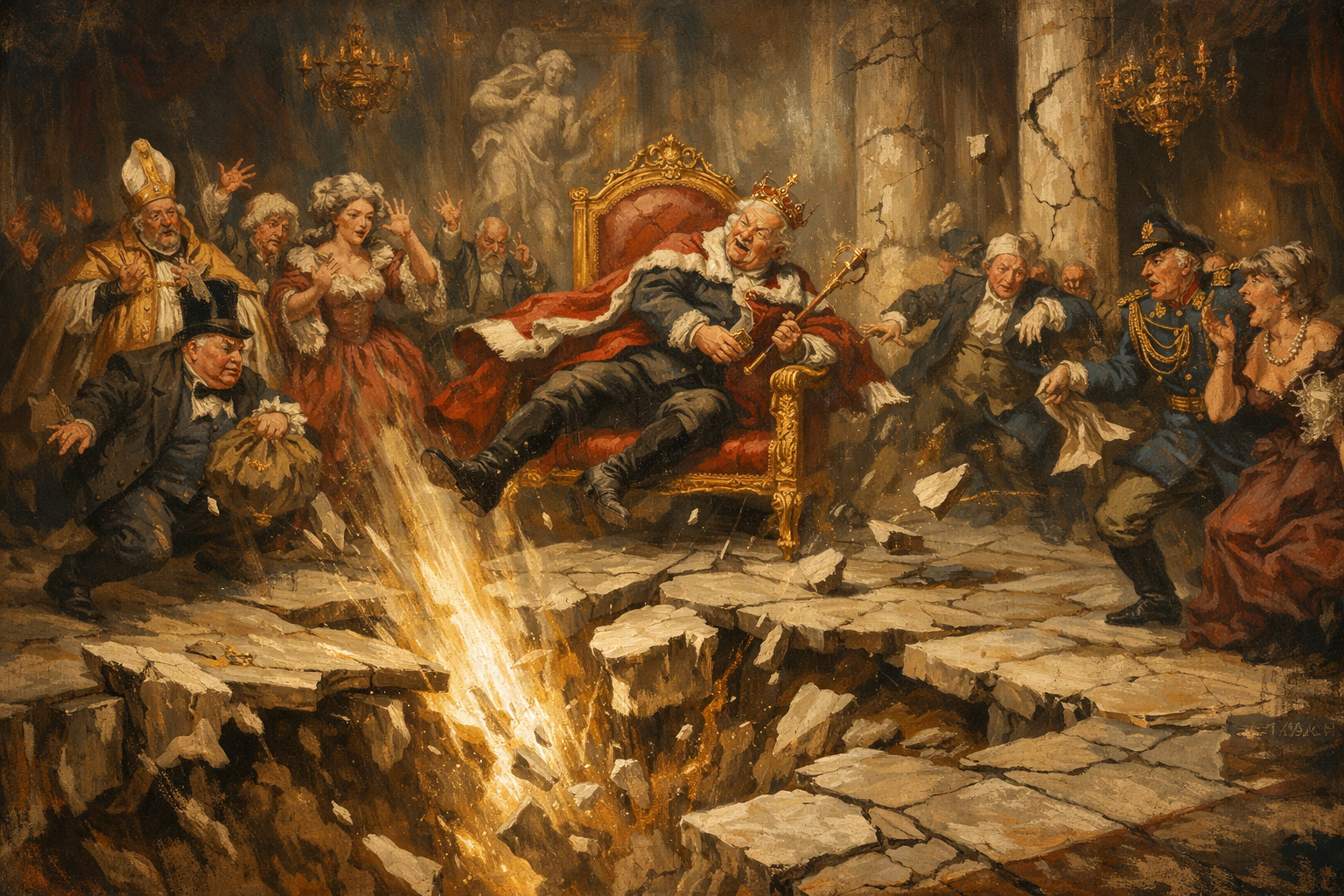
Truth in steel-capped boots rattles the marble halls
By Martin Foskett, Reporter
PUBLISHED:
UPDATED:
There are many ways to unsettle the powerful. One may march, shout, draft legislation, or commission a commemorative mural of interpretive despair. But nothing quite rearranges the furniture of authority like a simple, inconvenient sentence spoken aloud at the wrong moment. The old Italian theorist Antonio Gramsci once observed that telling the truth is revolutionary. He was correct, not because truth carries a red flag, but because it carries a crowbar.
Truth is not neutral. It does not sit quietly in the corner with a clipboard and a cup of tea. It is the blunt instrument that makes elegant lies look like damp cardboard. It asks questions at board meetings. It reads the small print on policy announcements. It’s frustrating that the numbers never quite add up, that cost overruns are always someone else’s fault, and that taxpayer funds both the mistake and the apology.
Power, by contrast, prefers upholstery. It prefers consensus language, strategic ambiguity, “challenging headwinds”, and the soothing hum of committee minutes. It prefers a narrative that glides. Systems built on half-truths and managed impressions are like Georgian terraces held together with decorator’s filler: handsome from the street, crumbly when tapped.
The moment someone taps.
Truth, in practice, rarely arrives wearing a sash. It turns up as an awkward spreadsheet. A whistleblower’s email. A local business owner asking why compliance paperwork has multiplied like rabbits on growth hormones. A parent querying a school policy that reads as if a sentient flip chart drafted it. No megaphone. No orchestra. Just a sentence that refuses to behave.
And that is the irritation.
Because institutions, be they political, corporate, cultural, or bureaucratic, depend less on brute force than on agreement. They require the quiet nod. The collective decision to pretend the emperor’s tailoring is avant-garde. They thrive on the gentle British instinct not to make a fuss. Truth, unfortunately for them, is a fuss in human form.
Consider the polite fiction that government spending equals compassion. Treasury figures may announce new programmes with the ceremonial gravitas of a royal christening. Still, truth asks whether the money exists, whether it is borrowed against grandchildren, and whether the promised outcomes materialise beyond the press release. It’s important to note that pouring billions into a malfunctioning system doesn’t fix the problem; it subsidises it.
This is where the foundations begin to tremble.
Because truth does not merely expose error; it exposes incentives. It reveals who benefits from the fog. It highlights that certain “temporary measures” develop the life expectancy of Galápagos tortoises. It notes that regulatory labyrinths rarely entangle the well-connected. It observes that entrepreneurs, those unfashionable creatures who risk capital and sleep, are often treated as livestock to be milked rather than engines to be oiled.
When such observations are aired, the reaction is rarely gratitude. It is discomfort. There will be panels. There will be statements about tone. There may be an urgent seminar on “responsible discourse”. But beneath the procedural choreography lies a simple truth: the façade has cracked.
Gramsci, writing from a prison cell, understood that power rests as much on cultural consent as on coercion. A population persuaded that a system is inevitable will rarely test its wiring. But once citizens recognise that inevitability is often a costume worn by habit, the spell weakens. The revolutionary element is not the slogan; it is the clarity.
Yet clarity is dangerous precisely because it is democratic. It does not require credentials. It does not need a grant application. It travels by word of mouth, by social media post, by pub conversation conducted over chips and scepticism. It spreads through small-business networks that compare notes on tax burdens. It circulates among workers who notice that productivity lectures are rarely delivered to those drafting them.
Truth levels the hierarchy of speech.
That levelling unsettles elites who prefer curated debate. It removes the velvet rope. It says that a nurse’s observation about hospital management inefficiencies may carry as much weight as a consultant’s slide deck. It suggests that a shopkeeper’s grasp of footfall economics may be more grounded than a policy adviser’s modelling.
None of this requires rage. In fact, truth is most destabilising when delivered calmly. A raised eyebrow can achieve what a thousand placards cannot. A quiet insistence on data can unravel a cathedral of spin. When official forecasts promise miraculous returns from vast public investments, truth waits a year and asks where the miracles have gone.
Silence often answers.
The courage required to speak truth lies not in theatrics but in endurance. Systems push back. Conformity is comfortable; dissent is administratively exhausting. There will be social penalties. Invitations may evaporate. Committees may become suddenly busy. The machinery of soft exclusion whirs efficiently. It has had practice.
But conformity has a cost of its own. It demands that individuals swallow obvious contradictions. It requires the mental gymnastics of applauding policies that erode the very prosperity they claim to champion. It asks workers to believe that stagnant wages are a feature of modern enlightenment. It invites taxpayers to celebrate the privilege of financing their own bureaucratic supervision.
Truth declines the invitation.
In doing so, it reveals injustice not merely as moral failure but as structural habit. When systems are built on distortions, inflated claims, selective statistics, and fashionable narratives, they become fragile; the more elaborate the deception, the more delicate the scaffolding. A single accurate figure can act like a dropped spanner in precision machinery.
The disruption is not chaos; it is correction.
Markets, when allowed to function, depend on accurate information. Prices signal reality. Profits and losses communicate success and error. Distort those signals with political vanity projects or ideological crusades, and the feedback loop falters. Truth restores the signal. It says: this policy costs more than it yields. This regulation burdens more than it protects. This subsidy props up what should adapt.
Such statements are not revolutionary because they incite mobs. They are revolutionary because they restore accountability.
Accountability, to the entrenched, feels suspiciously like an attack. When journalists, analysts, or ordinary citizens present uncomfortable facts, the response often shifts from rebuttal to character critique. Motives are questioned. Allegiances are speculated upon. The argument is nudged away from substance towards personality. It is an old trick. It saves having to adjust the policy.
But truth is stubborn. It does not evaporate under disapproval. It waits. It accumulates. It resurfaces in audit reports, in performance reviews, in election results. It lingers in the quiet resentment of those who sense that something is misaligned.
This is why honesty is not neutral. It tilts the table. It forces a recalibration of narratives that rely on selective blindness. It challenges the comforting myth that complexity absolves responsibility. Complexity may be real; obfuscation is optional.
In societies that prize liberty, the act of speaking plainly is both ordinary and radical. Ordinary, because it should be expected. Radical, because it threatens any structure that depends on managed perception. Truth demands change not through ideology but through exposure. Once a flaw is visible, ignoring it becomes harder.
And exposure is contagious.
A single honest disclosure can embolden others. A report on waste encourages further scrutiny. A candid interview prompts more candid questions. Gradually, the edifice of inevitability looks less like granite and more like polystyrene painted grey.
None of this guarantees utopia. Truth is not a magic wand. It can be misused, distorted, weaponised by those with their own agendas. Vigilance is required; facts must be checked; claims verified. But the alternative, comfortable falsehood, is a slower corrosion.
Systems built on lies eventually collapse under their own contradictions. Systems confronted with truth have the opportunity to reform. The former resent honesty; the latter depend on it.
The revolutionary force, then, is not chaos but candour. It is the accountant who refuses to fudge. The employee who flags the risk. The citizen who asks the dull, necessary question about cost and consequence. These acts lack glamour. They rarely trend. Yet they chip away at complacency.
Power prefers applause. Truth prefers accuracy.
And when accuracy enters the room, even the grandest architecture listens for cracks.
In the end, telling the truth does not always topple regimes or rewrite constitutions. More often, it adjusts incentives, recalibrates expectations, and forces small, cumulative corrections. But those corrections matter. They redistribute responsibility from myth to reality. They remind institutions that authority rests on trust, and trust rests on honesty.
Foundations shake not because truth shouts, but because it stands firm while the marble quivers.