Image by: Knelstrom Media
Moral issues are always terribly complex for someone without principles
By Martin Foskett, Reporter
PUBLISHED:
UPDATED:
The line arrives like a dropped pint glass in a carpeted committee room: sharp, sudden, and impossible to ignore. Moral issues, it suggests, do not become complicated because the world is subtle, but because the people charged with judging it have misplaced the measuring stick. The observation belongs to G.K. Chesterton, though it now wanders the modern age like an unattended suitcase, growing heavier with every mile.
The contemporary landscape is awash with ethical hand-wringing, values panels, consultation exercises, stakeholder roundtables, and advisory boards staffed by people who speak in laminated phrases. Principles, meanwhile, have been quietly left on a bus somewhere between sincerity and career progression. The result is a culture permanently perplexed by its own reflection, staring into mirrors and arguing with the glass.
There is a particular modern belief that moral complexity is a sign of intelligence: the more tortured the explanation, the more refined the thinker. Simplicity is dismissed as naïveté, conviction as extremism, and certainty as something to be treated with gloves and a warning label. In this schema, the most impressive moral stance is the one that concludes nothing at all after a great deal of talking.
Chesterton’s line cuts through that fog with a brick. Moral issues, he implies, are not inherently labyrinthine. They become so when principles are absent, because without them there is no starting point and no destination. Everything is improvised. Every decision is situational. Every action must be weighed, unweighed, reweighed, and then delayed pending a review by people who have confused caution with wisdom.
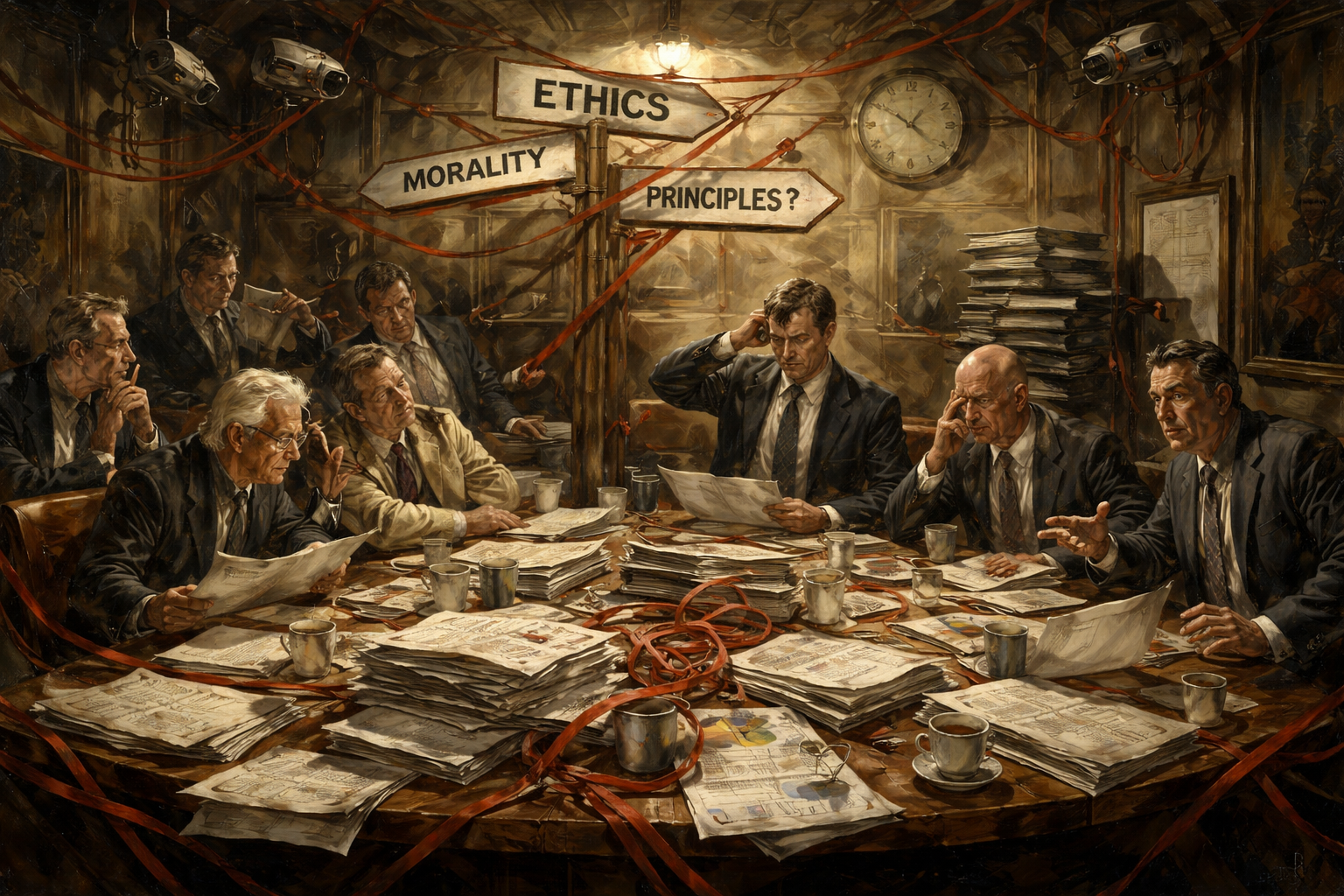
The age of the principle-free operator has been a golden one for bureaucracy. With no firm beliefs to anchor behaviour, systems expand to fill the void. Forms multiply. Guidelines breed like damp. Committees convene not to decide, but to demonstrate that deciding has been postponed responsibly. A moral question without principles becomes a career ladder.
This is not confined to government, though government has elevated the art. Corporate boardrooms have followed suit, issuing glossy manifestos about values that read like the back of a shampoo bottle. Words such as “integrity”, “inclusion”, and “responsibility” are printed in tasteful fonts, carefully defined as meaning whatever proves convenient that quarter. Principles are declared, then immediately surrounded by exceptions large enough to park a consultancy inside.
The absence of principles creates a strange theatre. People act out of concern rather than exercise judgement. They announce their discomfort as if it were a moral act in itself. The phrase “it’s complicated” is deployed like a security blanket, warding off the terror of actually standing for something. Complexity becomes camouflage.
Chesterton understood this long before ethics became an industry. A principle, properly understood, is not a slogan but a line in the sand. It simplifies by excluding. It says yes to one thing and no to another, without convening a seminar. That, in turn, makes life inconvenient for those who prefer to keep every option open, particularly when those options involve funding, influence, or applause.
The modern professional class has become adept at operating without such encumbrances. Moral positions are treated as adjustable settings, calibrated according to audience and time of day. The same action can be condemned in the morning and celebrated by evening, provided the context has been sufficiently massaged. This is not hypocrisy in the old-fashioned sense; it is flexibility elevated to the level of a worldview.
In politics, the principle-free approach manifests as permanent astonishment. Every crisis is described as unprecedented, every failure as unforeseen. When standards shift, those who shifted them express shock at the new position, as if discovering furniture rearranged by ghosts. Without principles, there is no memory, only reactions.
Economic life has suffered similarly. Free markets are praised when they produce agreeable outcomes and denounced when they do not, often by the same voices within the same week. Profit is virtuous until it is embarrassing. Risk is entrepreneurial until it goes wrong, at which point it becomes immoral. Principles would require consistency; consistency is expensive.
The working public, watching this from the outside, tends to notice. People with fixed wages and fixed bills have little patience for elastic ethics. They understand, instinctively, that a principle is something that costs something. It might cost popularity, comfort, or promotion. It certainly costs the ability to explain away inconvenient facts with a PowerPoint slide.
Chesterton’s genius was to see that moral confusion is rarely an accident. It is often cultivated. A complicated moral landscape allows for selective enforcement. It allows those in charge to decide, on a case-by-case basis, who deserves mercy and who deserves punishment, based not on rules but on usefulness. Principles, by contrast, are democratic in the most unfashionable sense: they apply to everyone.
This is why principles are so frequently caricatured as rigid, outdated, or cruel. They interfere with the modern preference for managerial discretion. They limit the ability to improvise narratives after the event. A principle does not care how sincere the apology is or how carefully the press release has been drafted. It simply asks whether the line was crossed.
There is also a psychological comfort in principle-free morality. If everything is complex, then nothing is truly wrong. Mistakes become learning experiences. Failures become conversations. Responsibility dissolves into process. The language of therapy replaces the language of morality, and judgement is treated as a pathology.
Yet outside the seminar room, life continues to present clear choices. People are honest or dishonest. They work, or they do not. They keep promises, or they break them. The attempt to smother these realities under layers of nuance tends to convince no one except those already invested in the performance.
Chesterton’s observation endures because it offends modern sensibilities while explaining them perfectly. It suggests that the confusion so proudly displayed is not a sign of depth, but of absence. Without principles, moral issues must be endlessly debated because there is no tool with which to cut through them. Everything is relative, except the careers of those doing the relativising.
The irony is that principles, far from making life smaller, make it manageable. They reduce the cognitive load. They allow decisions to be made quickly and defended. They make hypocrisy harder and courage more visible. They also make enemies, which is perhaps their greatest crime in an age obsessed with consensus.
In the end, Chesterton’s line functions as both diagnosis and warning. A society that abandons principles in favour of permanent moral negotiation does not become more humane; it becomes more arbitrary. Power fills the vacuum left by conviction, and complexity becomes the language through which that power excuses itself.
The modern world prides itself on having outgrown old certainties. It has replaced them with procedures, policies, and panels, all humming with earnest intent. Yet the old certainties persist, stubborn and unfashionable, in the expectations of ordinary life. When they are ignored, confusion follows, dressed up as sophistication.
Moral issues are only terribly complex when there is nothing solid to stand on. The rest is theatre, funded by someone else’s money, performed under lights that never quite go out.