Image by: Knelstrom Media
The nation of weathercocks and the vanishing signposts
By Martin Foskett, Reporter
PUBLISHED:
UPDATED:
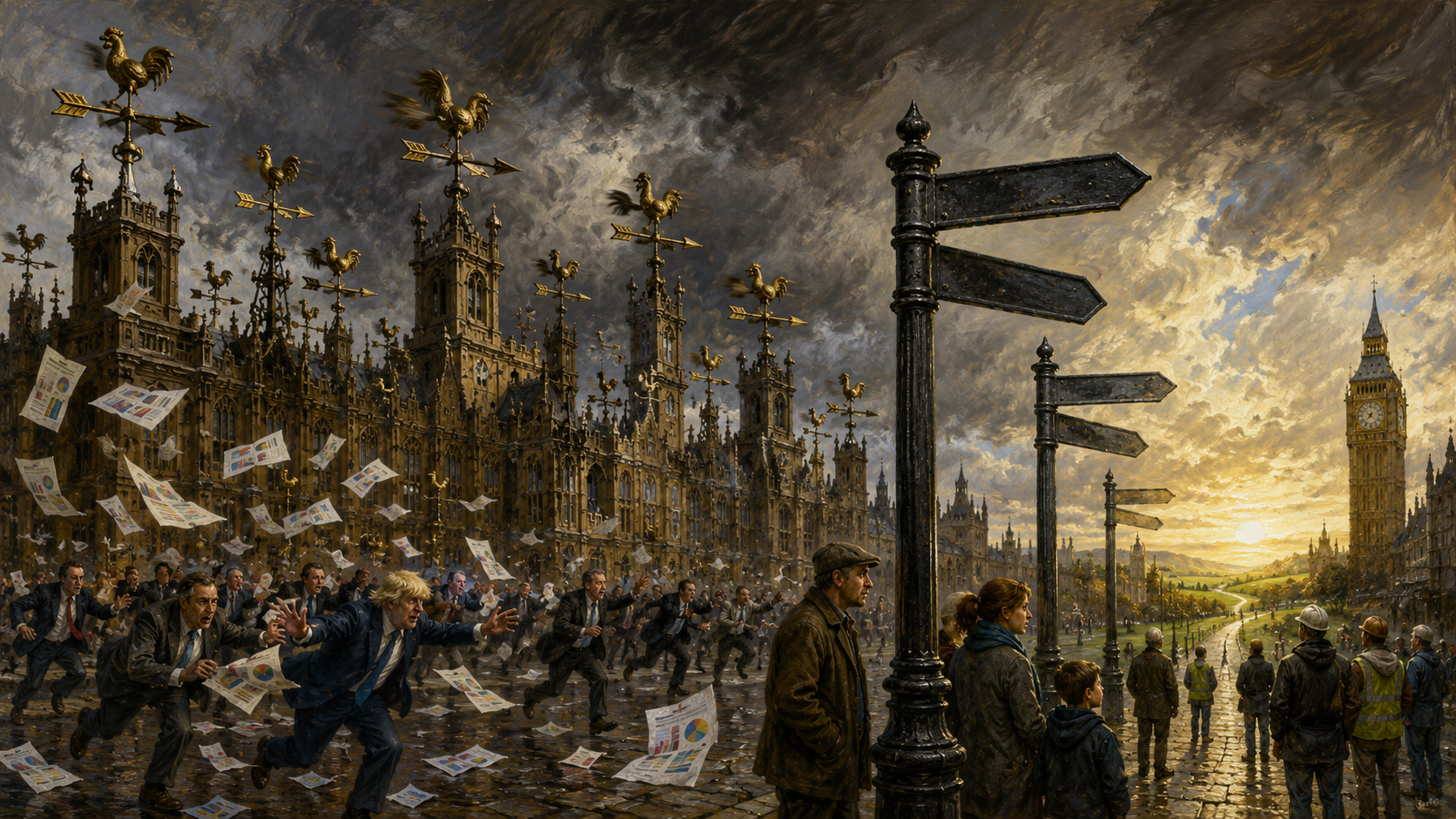
Britain has developed a curious surplus of weathercocks. They occupy television studios, ministerial offices, think tanks, conference platforms and occasionally entire front benches. They swivel magnificently. Every breeze receives immediate acknowledgement. Every passing gust of public opinion produces a fresh adjustment. Every opinion poll sends another metallic creak echoing across Westminster like a church steeple caught in a North Sea gale. The country has become crowded with men and women who can detect a shift in public sentiment from three counties away, yet somehow remain incapable of explaining where the nation ought to be heading.
The old distinction is simple enough. A weathercock follows the wind. A signpost points towards a destination.
One reacts.
The other leads.
For much of modern political life, reaction has become a substitute for leadership. The machinery of government increasingly resembles an enormous meteorological operation in which vast numbers of well-paid professionals devote their waking hours to studying atmospheric conditions. Pollsters produce charts. Consultants produce briefings. Focus groups meet in conference rooms near industrial estates to discuss whether voters feel more comfortable with one carefully crafted phrase than another. Entire careers rise and fall on the placement of a single adjective. Somewhere in the middle of this circus of permanent calibration sits the taxpayer, watching the spectacle unfold with the weary expression of a man watching builders argue over blueprints while the roof continues to leak.
The tragedy is not that politicians listen to public opinion. Any healthy democracy requires exactly that. The tragedy is that so many appear unable to do anything else. The prevailing wind arrives from one direction and policy follows. The wind changes, and policy follows again. Principles are treated less as foundations and more as temporary camping equipment, unpacked when conditions permit and hastily folded away at the first sign of adverse weather. Convictions become negotiable. Priorities become fluid. Manifestos begin to resemble restaurant menus where every item carries the warning that ingredients may change without notice.
Across the country, the consequences are visible in both large and small ways. Business owners considering investment discover that tax policy possesses all the permanence of a sandcastle at high tide. Families attempting to plan for the future find themselves navigating a landscape where major government commitments can survive only until the next communications crisis. Energy policy swerves. Infrastructure plans appear and disappear. Regulations multiply, mutate and occasionally contradict one another with the enthusiasm of bureaucrats trapped in a competitive knitting contest. The nation spends an extraordinary amount of time discussing growth while simultaneously constructing enough obstacles to make growth feel like an unauthorised activity.
None of this would matter quite so much if confidence were not such a fragile thing. Markets can survive bad news. Businesses can survive difficult conditions. Families can survive periods of uncertainty. What becomes far harder is surviving permanent uncertainty. People make decisions when they understand the direction of travel. They invest when they believe tomorrow will broadly resemble the promises made today. They build, hire, save, and expand when they are confident that the signposts will remain where they are. Remove that confidence, and caution begins to spread through an economy like damp through an old terrace house.
History, meanwhile, remains remarkably uninterested in weathercocks.
The politicians who merely followed events tend to dissolve into the background noise of their age. Their speeches gather dust. Their slogans fade. Their carefully managed reputations sink beneath the weight of newer headlines. The figures who endure are usually something else entirely. They are the awkward creatures who persisted when persistence was unfashionable. They are the stubborn individuals who irritated colleagues, alarmed consultants and generated endless criticism because they possessed a fixed idea of where they wanted to go. Some succeeded. Some failed spectacularly. But everybody knew where they stood.
That certainty carries value beyond politics itself. A signpost does not demand agreement. It merely provides direction. A traveller can ignore it, argue with it or march the other way enthusiastically, but the signpost remains useful because it is consistent. The weathercock offers no such service. It can reveal the current conditions. It can indicate the latest gust. What it cannot do is explain where the road leads.
Modern politics often behaves as though the purpose of leadership is to mirror public opinion with ever greater precision. Yet leadership has never been about holding up a mirror. Leadership is about providing a destination. The public may reject it. They may embrace it. They may remove the leader altogether. Those are risks inherent in democracy.
What cannot happen indefinitely is the pretence that endless movement constitutes progress. A spinning weathercock covers a great many directions while travelling nowhere at all.
Perhaps that explains the peculiar frustration hanging over so much of modern Britain. Governments change. Slogans change. Ministers change. Logos are redesigned. Websites are updated. Strategies are relaunched under slightly different names. Yet a nagging sense persists that the country remains trapped in a roundabout of perpetual adjustment. The vehicle keeps turning—the scenery changes. The destination never arrives.
Britain does not suffer from a shortage of clever people. It does not suffer from a shortage of communications experts, policy advisers or strategic consultants. If anything, there may be enough of those to populate a medium-sized republic. What appears increasingly scarce is the simpler quality that previous generations understood instinctively: the willingness to point in a direction and stay pointed there when criticism arrives.
Rain falls on signposts.
Storms batter signposts.
Entire governments rise and collapse around signposts.
They remain standing.
The country needs more of them.
Because nations rarely lose their way through lack of information. They lose their way because too many of the people entrusted with providing direction have become obsessed with studying the wind.
And no civilisation was ever built by a weathercock.