Image by: Knelstrom Media.
The revolving door of Downing Street’s travelling circus
By Martin Foskett, Reporter
PUBLISHED:
UPDATED:
Britain has burned through prime ministers with the efficiency of a vape shop changing staff after a failed stocktake. Seven leaders in ten years. The sort of turnover usually associated with collapsing restaurant chains beside dual carriageways. Westminster now feels less like a government and more like an insurance company midway through a police investigation.
The old political class at least projected permanence. Grey men in heavy coats muttering about interest rates and North Sea oil. Even failures looked durable. Modern politics produces leaders with the shelf life of supermarket strawberries.
David Cameron cracked the system open with the referendum gamble. Theresa May inherited the wreckage and spent three years moving like a geography teacher trapped inside a shopping trolley rolling downhill. Boris Johnson arrived later due to a power outage. Chaotic, entertaining, strangely effective for brief periods, then suddenly surrounded by smoke and panicked aides carrying folders.
The country tolerated the disorder because Britain had grown tired of managerial politics. For years, the public had been told that decline was maturity. Cheap optimism disappeared. Growth slowed. High streets emptied themselves into betting shops, vape counters and suspiciously bright dessert cafés.
Then lockdown arrived, and Westminster lost what remained of its mind.
The state discovered it could close businesses, police family gatherings and deliver daily televised sermons while still failing to organise basic logistics. Small firms disappeared quietly beneath the weight of debt and energy costs. Online giants grew fat enough to cast shadows over entire sectors of the economy.
Politics changed shape after that.
Prime ministers stopped being expected to govern. They were expected to provide emotional care. Every crisis became personal therapy conducted through press conferences. Ministers spoke like safeguarding officers, explaining why nobody could sit on a park bench without authorisation from three departments and a behavioural scientist from Surrey.
No system can survive governing like this for long.
Modern Britain expects Scandinavian services, American wages, low taxes, cheap housing, unlimited healthcare, secure borders and immediate solutions to every inconvenience from potholes to loneliness. Any politician mentioning trade-offs gets treated like a man cancelling Christmas over a spreadsheet.
Liz Truss discovered this at terminal velocity.
Her mini budget detonated confidence within days. Markets buckled. Television economists appeared wearing the expressions of air traffic controllers spotting smoke from both engines. The government collapsed so quickly that the whole thing resembled a gazebo failing during a garden centre promotion.
The panic exposed something larger than one administration. Britain still talks like an independent economic power while operating under constant supervision from markets, institutions and financial gravity. Governments may promise transformation, but only within carefully painted lines.
Rishi Sunak restored calm in the technical sense. The atmosphere shifted from nightclub fire to corporate waiting room. Competent, careful, polished. A man who always appears five minutes away from explaining pension contributions beside a touchscreen display.
Yet competence alone no longer inspires confidence because the underlying problems remain untouched.
Taxes climb. Services decay. Infrastructure takes decades. Energy policy changes direction every six weeks like a fox startled by wheelie bins. Planning restrictions suffocate development while politicians hold conferences about growth beneath banners printed by consultants charging six figures.
Meanwhile, ordinary Britain carries on beneath the noise.
On industrial estates in Essex, small business owners stare at electricity bills like medieval villagers examining plague symptoms. Tradesmen discuss inflation with forensic detail because inflation now decides whether the van gets replaced or patched together again with cable ties and misplaced optimism.
This world barely exists inside Westminster anymore.
Politics has become a sealed graduate industry. Advisers move from university societies into think tanks, lobbying firms and ministerial offices without ever dealing with payroll, late invoices or customers screaming beside a leaking shutter door on a wet Tuesday morning in Basildon.
The language reflects the separation.
Every failure becomes a “challenge”. Every tax rise becomes an “investment”. Every collapsing institution requires a “strategic framework”. Nobody in government speaks plainly because plain speech might accidentally reveal how little control actually exists.
That is why prime ministers keep failing.
The office now demands impossible contradictions. Leaders must sound radical while governing cautiously. They must increase spending while pretending taxes are stable. They must champion net zero without frightening pensioners staring nervously at heating controls during January.
Most absurdly, they must maintain public optimism while presiding over managed stagnation.
Britain still possesses serious strengths. Finance, advanced engineering, technology, entrepreneurship. Productive people continue building companies despite regulation spreading through the economy like Japanese knotweed along railway fencing.
But growth has become politically secondary to management.
The state expands constantly while results shrink. Entire departments produce little beyond consultations, initiatives and glossy PDFs featuring ethnically balanced stock photography beside phrases like “future resilience strategy”.
The public notices.
Another resignation barely interrupts lunchtime in Southend. Another scandal arrives and evaporates before the kettle finishes boiling. Westminster has become background noise. A permanent rotating drama populated by exhausted presenters in navy suits speaking urgently about things most taxpayers suspect will never improve anyway.
Seven prime ministers in ten years is not the disease. It is the symptom.
Britain has built a political system expected to provide prosperity, therapy, protection, identity and moral guidance simultaneously. The machine cannot carry that weight forever. So leaders arrive promising renewal, survive briefly inside the grinder, then vanish into consultancy work and after-dinner speaking circuits.
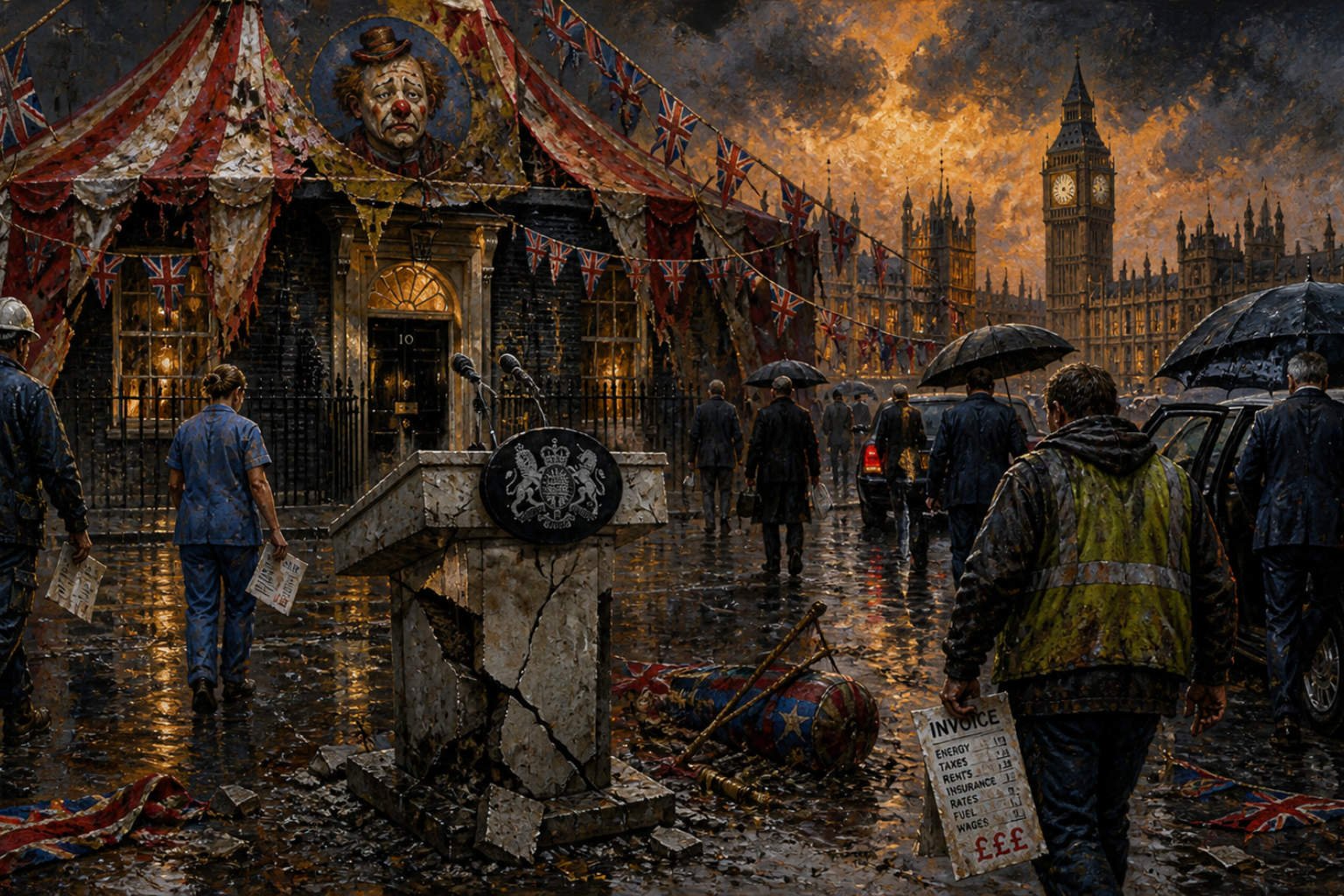
The ringmasters change because the circus itself is buckling.